Chapter 16
Fire
I loiter just outside the growing mass on the front lawn of the Marquette Hotel and try to look like a man with somewhere to be.
Guests in evening wear mill around in outrage. Some shout at hotel staff as if the young woman handing out towels personally arranged the emergency. Others use the interruption to keep drinking. Several reunion attendees continue swaying to music that no longer exists, dancing with the blind determination only alcohol can provide.
Funny enough, waiters still move through the crowd carrying trays of wine and finger sandwiches.
Five-star service means never letting catastrophe interrupt hospitality.
One of the waiters catches my eye.
Leather Jacket Kid.
Except now he wears a white serving coat two sizes too big and balances a tray of tiny cucumber triangles like he attended finishing school in the last hour.
He recognizes me and gives the smallest shrug in the world.
Sometimes you mug people.
Sometimes you serve canapés.
Sometimes a young man is simply versatile.
“Good for you,” I mutter.
The Village vans are loading fast.
Women move through the confusion with military efficiency, counting heads, grabbing wrists, shepherding stragglers. Belts, wallets, phones, and expensive trousers disappear into luggage and tote bags.
No one from their side appears rattled.
They came for a night out and somehow turned it into a strategic victory.
Then the first police cruiser arrives.
No fire truck.
No ambulance.
Just one black-and-white sliding into the roundabout like it owns the moon.
Two officers step out. One looks carved from granite. The other looks carved from larger granite.
The hotel manager rushes toward them, arms flailing.
Granite One raises a calming hand.
Granite Two walks straight to the alarm panel beside the entrance and silences the bells.
The sudden quiet feels wrong.
He turns toward the crowd.
“False alarm, folks. Show’s over. Safe to head inside.”
People actually applaud.
I stare at the officers.
No fire trucks.
No inspection.
Two cops declaring a crowded hotel safe without stepping through the doors.
Granite One looks across the lawn.
Right at me.
Then he winks.
Just once.
Small.
Quick.
Unmistakable.
My blood goes cold.
Ted hasn’t vanished.
He’s been working.
The Village.
I have nowhere else to go.
I tear off the waiter’s jacket, run for my motorcycle, and kick it alive hard enough to bruise my foot.
I smell the smoke before I see the flames.
Then I round the last bend and find hell organized into neat little streets.
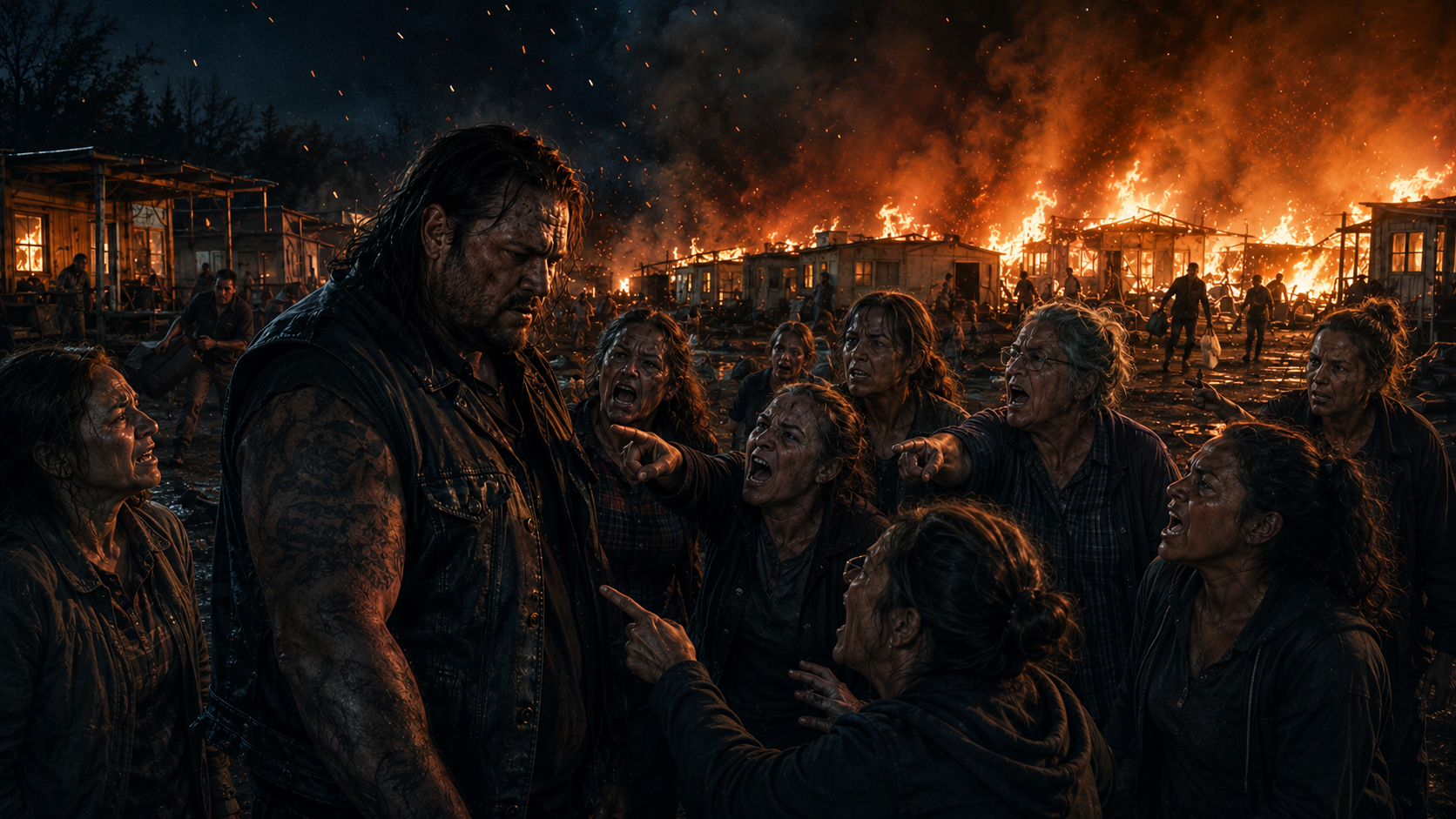
Sixteen homes that make up the heart of the Village burn in rows of orange violence. Roofs collapse inward. Windows burst. Curtains become ghosts. Sparks climb into the sky like fleeing souls.
Every fire truck in two counties is here.
So are the police cruisers.
Funny how resources appear once the right people are burning.
I park crooked and run toward the crowd.
Firefighters wrestle hoses through mud and shouting.
The blaze has been set too cleanly. Houses burn while nearby trees stand untouched. Cars melt in driveways while fences remain.
Professional work.
I find that insulting.
Patricia’s precautions are the only reason I’m looking at burning homes instead of bodies. Everyone who stayed behind tonight—children, new arrivals, people who couldn’t work the event—had been moved into the old community hall at the edge of the Village.
Ted’s people got the houses.
They didn’t get anyone inside them.
I push through neighbors, gawkers, reporters, and people who came because flames are better than television.
The Circle is gathered beneath blankets and smoke.
Patricia.
Simone.
Tiger.
Henry.
Dozens more stand around them, children clutched close, faces streaked with ash, eyes reflecting the fire that took their homes.
The woman from the hospital stands among them, sunglasses gone, one arm wrapped around the little boy who colored with the broken crayon.
She called the number.
She trusted me.
Now her new home is burning too.
I stop cold.
This is my fault.
Maybe not by match.
Maybe not by hand.
But by consequence.
Simone sees me first.
She tears off one high heel and throws it hard enough to qualify for state records.
It catches me in the shoulder.
“THIS IS YOUR FAULT!”
Heads turn.
That’s all it takes.
Faces harden toward me one by one.
I’ve seen friendlier expressions on men carrying warrants.
I bend, pick up the shoe, and carry it back to her.
She slaps it from my hand.
Good arm.
Henry steps forward.
“You need to leave.”
“I came to help.”
“You came too late.”
That one lands deep.
I look at Patricia.
She won’t meet my eyes.
Smoke drifts between us like something alive.
“Patricia.”
Nothing.
“Please.”
Finally, she looks up.
There is no softness left in her face.
Only grief.
Only fury.
Only the kind of exhaustion that changes people.
Simone points toward the burning homes.
“We should’ve thrown you out years ago.”
Maybe.
Henry raises a hand toward the road.
“You’re banned from the Village.”
I almost laugh.
Banned.
I’ve bled for this place since before some of these flower beds existed.
When the Village was three trailers, two broken fences, and faith held together with borrowed nails, I was the fence.
I stood watch on porches with a tire iron while men from old lives decided whether to come up the walk.
I broke noses in parking lots so children could sleep through the night.
I fixed roofs, carried groceries, buried dogs, and scared off drunks, dealers, ex-husbands, creditors, and one traveling evangelist who got handsy at a bake sale.
I slept in my truck outside these homes when threats came after dark.
Patricia, Simone, and Henry built something beautiful.
I just kept the wolves back long enough for it to grow teeth of its own.
Now I’m banned.
I want to argue.
I want to say Ted did this.
I want to say I’ll fix it.
I want to remind them that love can look ugly when it’s standing guard.
Instead, I nod once.
Every defense sounds selfish in my head.
Patricia finally speaks.
Her voice is low and flat.
“You don’t come back.”
That hurts worst of all.
I turn and walk away while roofs collapse behind me.
No one calls me back.
Freckles is fifteen minutes away and spiritually located in another nation.
Bright lights. Faux brick walls. Thirty televisions. Neon beer signs. A hostess stand shaped like a smile. Half-price appetizers advertised with evangelical confidence.
Somewhere near the kitchen, a birthday song is being forced onto strangers.
A teenager in suspenders asks if I prefer a booth or the bar.
“Whichever one says collapse.”
“The bar it is.”
I slide onto a stool beneath a television showing a game with no sound.
“Jägermeister.”
The bartender pours one shot.
“I said Jägermeister.”
He sets the bottle on the counter long enough to fill a second. He swishes his toothpick from side to side.
I grab the bottle by the neck with my right hand and pull it toward me.
He keeps one hand on it.
I brace it with my left.
The aluminum splint knocks against the glass and keeps my pinky sticking out like I’m observing tea etiquette.
His toothpick stops moving.
“Sir,” he says.
“Tonight’s not the night to discover your courage.”
He lets go.
Smart man.
I set the bottle down and glare at my finger.
Enough.
I catch the tape with my teeth, tear it loose, and yank the splint free.
Pain shoots through my pinky and halfway up my arm.
I toss the metal strip onto the bar.
The bartender stares at it.
“Doctor says I’m cured.”
I drink straight from the bottle until my eyes water, then wipe my mouth with the back of my hand like I was raised wrong.
Around me, Paradise keeps humming.
Families laugh.
Servers hustle.
A child drops fries with real commitment.
At the high-top to my right, four women in coordinated athleisure dissect their waitress with the precision of surgeons.
Their leader wears highlights, expensive teeth, and the confidence of someone who has never once been told no by a manager.
“I’m just saying,” she announces, “if ranch takes twenty minutes, maybe shut the place down.”
Her friends laugh on schedule.
“My Trevor would never tolerate this.”
Trevor sounds exhausted.
I drink again.
They aren’t my enemy.
They’re shallow, loud, and mean in the safe suburban way.
My enemy is smoke.
My enemy is fire.
My enemy is everyone who turned their backs while homes burned.
So naturally, I pick the wrong target.
I turn on my stool.
“Ma’am.”
She looks offended before I finish the word.
“Yes?”
I fill a shot glass, flick it across her table, and splash Jägermeister over her basket of fries.
“If ranch is the greatest hardship in your life, we should all write songs about your bravery.”
Her table gasps.
One of them actually clutches pearls she isn’t wearing.
“I’m sorry?” she says.
I pour another shot and throw that one too.
The glass hits the table hard and sprays her blouse.
“No,” I say. “You’re annoying.”
She stands.
“How dare you!”
I reach across their table, take a mozzarella stick, bite off half, and throw the rest over my shoulder.
“How dare you,” I say.
The room has gone quiet.
I like that less than I thought I would.
Athleisure Queen points toward the kitchen.
“Manager! Manager!”
A nervous man in a tie steps halfway out through the service doors.
I look at him once.
He retreats into the kitchen.
The women stare in disbelief.
I snatch a plate of loaded nachos from their table and send it sailing across the room. It strikes the wall and slides downward like modern art.
One woman screams.
“Good,” I say. “Now you sound honest.”
I stand too fast and catch myself against the bar.
Nobody moves.
Nobody challenges me.
Nobody says a word.
That’s when the shame hits.
I’m six-foot-five, drunk, furious, and terrifying people who pose no threat to me.
This isn’t strength.
It’s cowardice with an audience.
I look around at the frightened faces and hate myself for choosing easy prey.
Then laughter booms from the corner.
The two Devil’s Angels rise from their booth.
Leather cuts. Road grime. Heavy boots.
They shouldn’t be in a place like this.
But bad decisions have always preferred colorful addresses.
The lean one walks past a businessman at a nearby table and casually dumps the rest of his beer over the man’s head.
The larger one does the same to an elderly couple sharing onion rings.
No reason.
No warning.
Just enthusiasm.
“Now here’s a man who knows how to party,” the lean one says.
They reach me grinning.
The lean one sticks out his hand.
“Whiskey Trotter.”
The big one follows.
“P-p-puh... Putter.”
I shake both hands.
My broken pinky throbs when Putter squeezes it.
Good.
Watching them smile at me feels like seeing myself in a carnival mirror.
Whiskey nods toward the room.
“What’s next?”
I look at the bottle.
Look at the frightened patrons.
Look at the two men who think I’m one of them.
Then I look toward the door.
“You know a place called the Backside Lounge?”
Both men smile wider.
I toss cash onto the bar.
“Tell me something first,” I say.
“What’s that?” Whiskey asks.
“You boys know how to fight?”
Putter cracks his knuckles one at a time.
Whiskey Trotter laughs.
Then the three of us walk out into the Paradise night.
Around the fire
Join the conversation.
Reader comments appear only after T. G. Bonfire approves them. That keeps this space thoughtful, human, and free of noise.