Chapter 7
Release
I think I got lucky.
If they’d booked me in Mercantile Falls, I don’t think I would’ve seen the sun come up. Small towns like that don’t just hold grudges—they nurture them, feed them, tuck them in at night. And right now, I’m Public Enemy Number One with a crate of dynamite and nowhere to run.
Instead, they drove me to the Queens County Police Station in Paradise.
God bless bureaucracy.
Didn’t mean I was safe. Just meant I had better odds of keeping all my teeth.
Paradise looks polished. Glass buildings. Fresh pavement. New money.
But it’s busier. Louder. The kind of place where things slip through the cracks if you know how to stand in the right shadows.Queens County runs things out of here now—at least the important things. That alone told me something had gone sideways between them and Mercantile Falls.
I’d heard enough muttering in the back of patrol cars on the way in.
Jurisdictional tug-of-war. Hurt feelings. Bruised egos.
I almost felt bad for the Mercantile Falls cops.
Almost.
This was my first real arrest.
Sure, I’d been detained before. Questioned. Threatened with jail time by men who wanted to see if I’d blink. But this? This was the full experience. Fingerprints. Mugshot. The whole guided tour of regret.
Still hadn’t gotten my phone call.
I really wanted that phone call.
What the police wanted was for me to talk.
They rotated through them like actors in a bad play. Tough guy. Friendly guy. Disappointed dad. One of them even tried the quiet, spiritual angle—didn’t quite land, but I appreciated the effort.
I didn’t say a word.
Talking is how they get you. Not all at once. Not with some grand confession. Just a slip. A detail. A shrug in the wrong direction. Next thing you know, they’ve got a thread and they’re pulling until the whole sweater comes apart.
Better to sit still. Look them in the eye. Breathe air.
If they’re still talking, they don’t have anything.
It’s when they go quiet you start to worry.
They moved me around a lot. Benches. Holding cell. Back out again. Like they were trying to shake something loose just by changing the scenery. I got offered coffee more times than I could count and one bottle of water. Not a soda in sight.
Health nuts.
I would’ve killed for a drink. Not coffee. Something with a little more bite to it. I knew one of those desks had a bottle tucked away. They always do.
But I was too valuable for that.
Wouldn’t want to loosen my tongue with alcohol then have my testimony thrown out in court because I’d been plastered.
Cops are smart like that.
Said the man in handcuffs.
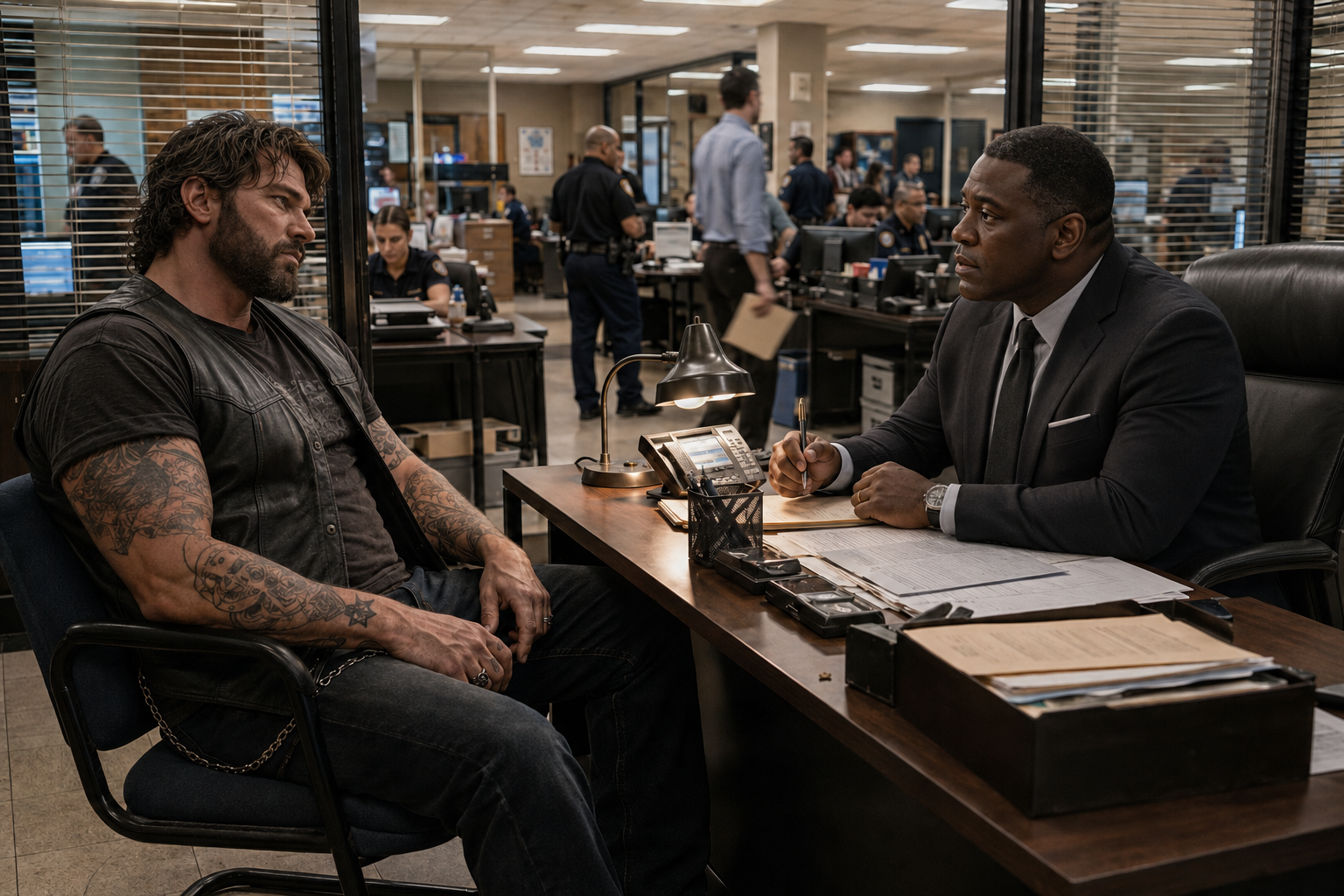
Eventually, they parked me in an office and cuffed me to a desk.
Captain Henderson’s desk.
Apparently, I was his.
The office sat open to the bullpen. No door, just a wide frame that let me see everything—and let everyone see me. Not exactly private, but that was the point. Henderson didn’t need privacy. He needed control.
And he had it.
I took my time looking around.
Nameplate said Charles Henderson.
Didn’t strike me as a Chuck.
Family photos lined one side of the desk. Smiles. Vacations. Something about a graduation. On the other side—photos with local officials, a couple national names I recognized. Handshakes. Awards. The kind of career you hang on walls.
Then there was the one that didn’t fit.
A framed newspaper photo.
Henderson, younger, standing out at the farm. Ambulance in the background. Another man shaking his hand—familiar, but I couldn’t place him. The headline and caption had been cropped away.
That was never a good sign.
I had just set it back down when Henderson walked in.
He didn’t acknowledge me touching his stuff. Didn’t raise his voice. Didn’t even sigh. He just sat down, opened a file, and started writing.
Didn’t say a word.
That made my stomach tighten.
I let a few seconds pass. Then a few more.
“Who’s the guy in the picture?” I asked.
Nothing.
Pen kept moving.
“Why am I not in an interrogation room?”
Still nothing.
I shifted in the chair, chains clinking softly against the desk. “You know, if you don’t have anything, you’re supposed to let me go, Chuck.”
That got him.
He stopped writing, looked up just long enough to let me know I existed.
“Only my friends call me Chuck,” he said. “You are not my friend.”
Then he went back to writing.
Fair enough.
“Well, Mr. Denzel, you said you wanted to be my friend. So which is it? Friend? No friend? Denzel? Chuck? How about lawyer?”
Nothing.
I leaned back as far as the cuffs would let me. “Could’ve been an actor. Instead you wound up here. That’s gotta sting a little.”
The pen scratched across the paper. Henderson wasn’t picking up on my charm.
“You know, Don Henley is a genius. Probably smarter than every cop in this building.” I raised an eyebrow. “Including you.”
Henderson stopped writing and closed the file. He gently placed his pen on top.
“Who’s Don Henley?” he asked.
That threw me.
“You’re kidding.”
“No.”
“You don’t know the Eagles?”
His expression didn’t change. That somehow made it worse.
“You think you could work crew for Don Henley?” Henderson finally asked.
“I think I could work for Motley Crue. Vince, Nikki, and the boys. Hell yes. I’d roadie for those guys in a heartbeat. How about you? You look like an Imagine Dragons fan. Maroon 5?”
Silence stretched.
Too far.
I felt it then—the shift. The moment where I’d pushed just enough.
Henderson leaned forward.
“Let’s talk about something I care about,” he said.
No anger. No edge.
That was worse.
“We’ve had the parcel formerly known as the Bowman Farm under surveillance for months,” he continued. “Long before you decided to take a stroll down that driveway.”
My chest tightened, but I kept my face still.
“We’ve seen people come and go. Deliveries. Late-night activity. Patterns.” He tapped the file lightly. “Then yesterday, a white van drops off a crate in the barn.”
He watched me as he spoke. Not for answers. For reactions.
“We wait. You show up. Take a call. Check the crate. Leave. Then you come back… and you don’t check it again.”
He let that sit.
“We swapped the dynamite,” he said. “You walked into a trap.”
I didn’t respond.
Didn’t need to.
He already knew that part.
“What I don’t know,” he went on, “is where you fit.”
He shifted slightly, eyes narrowing.
“You working for Ted Polmey?”
I said nothing.
“Or with him?”
Still nothing.
A flicker of something crossed his face. Not frustration. Interest.
“Ever hear of the Order of the Veil?” he asked.
That one almost got me.
Almost.
“Crossroads?” he added.
Silence.
“Vincent Crowe?”
I held steady.
He leaned back slightly, studying me like I’d just become a more interesting puzzle.
“You’re connected,” he said quietly. “Whether you understand it or not.”
He tapped the file again.
“You think Ted Polmey is the top of your food chain.”
A small pause.
“That’s funny.”
I didn’t bite.
Didn’t even blink.
He nodded once, like that told him something.
Then—
“Rachel Lewis.”
That was the first name I didn’t recognize.
“Who?” I asked.
This time, it wasn’t strategy. It was truth.
Henderson didn’t react right away. He reaches into the file and slides two photographs across the desk.
The first shows the heart above the bed.
The second shows the one across the living-room carpet.
My stomach drops.
“You’ve never gone inside the house before,” he says. “But this time you did. Why?”
I stared at the photo.
“That property used to be a front for a group called the Order of the Veil.”
I didn’t answer.
“Rachel Lewis disappeared near that property,” he said. “Car found just off the road. No body. No trace. Just gone.”
His voice stayed calm, but there was something under it now. Something heavier.
“We’ve been chasing threads for a long time,” he said. “Threads that lead back to that house. To people who shouldn’t be connected… but are.”
He leaned forward again.
“And now you show up. Drawing hearts on upstairs bedroom walls and living room carpets.”
He tapped the photo.
“What do the hearts mean?”
I met his eyes.
“Cupid made me do it.” I said.
It sounded stupid out loud. Hearing my own voice felt weird.
“Look, I don’t know who Rachel Lewis is,” I added. “And the hearts were stupid. I was bored.”
I wanted to mention the decaying bodies on the sofa, but since Captain Henderson didn’t mention them, I wasn’t going to either. I didn’t need to add a murder charge.
He studied me for a long moment.
Searching.
Weighing.
Then he exhaled slowly and sat back.
“You’re not the guy I want,” he said.
That caught me off guard.
“But you’re close to him,” he continued. “Closer than anyone we’ve been able to get.”
There it was.
The pivot.
“Help me,” he said, “and I can help you.”
I almost laughed.
Almost.
“What kind of help?” I asked.
Before he could answer—
A knock came from the open doorway.
“Captain,” a deputy said, hesitant. “We need to let him go.”
Henderson didn’t look away from me.
“On whose authority?”
“Comes from above, sir.”
A beat.
“I’m not done with him.”
“I know, sir. But—”
“Who signed it?”
The deputy swallowed. “Directive came from the governor’s office.”
That did it.
Henderson stood so fast his chair scraped hard against the floor.
“Of course it did,” he muttered.
He stepped out into the bullpen, voice rising as the doorframe swallowed him.
I couldn’t hear every word—but I caught enough.
“Not again—”
That one was clear.
A sharp crack followed.
I twisted in the chair as far as the cuffs would allow.
Henderson stood near the far wall, fist pressed against it, breathing hard. The entire bullpen had gone still. No one moved. No one spoke.
A man in a gray suit approached him slowly, saying something low and controlled.
Henderson shook his head once. Twice.
Then punched a second hole in the wall before being led away.
Just like that.
The spell broke.
Two officers came in, uncuffed me, and escorted me out without a word.
No goodbye.
No second chance at that deal.
I got my belongings back in a small side room. Wallet. Keys. Phone.
Freedom.
Funny thing about freedom—it doesn’t feel the way you expect it to.
Walking out of that station, I should’ve felt relieved.
Instead, all I could think about was Ted.
The farm had been under surveillance.
Which meant one of two things.
Either Ted didn’t know…
Or he did.
And if he did—
Then I hadn’t walked into a trap.
I’d been led into one.
Around the fire
Join the conversation.
Reader comments appear only after T. G. Bonfire approves them. That keeps this space thoughtful, human, and free of noise.