Chapter 1
Green Hot Dogs
The cafeteria buzzed with unstructured excitement.
Students hurried into line as if the food was worth the wait. Cliques and invisible borders took shape along sterile folding tables with attached seats. Who sat where—and with whom—was tradition, older than the building itself.
Everyone knew where they belonged.
Everyone except Tomas.
He dropped his red bookbag onto the seat beside him and studied his lunch.
“These hot dogs are green,” he said. “That can’t be normal.”
Red leaned toward the tray.
Maybe they ate yesterday’s meatloaf and got sick.
Tomas poked the hot dog with his fork.
It shivered.
That thing’s legally not food. If it moves again, I’m calling a priest.
Tomas didn’t smile. He kept his head down, shoulders hunched from years of practice. Cafeteria noise crashed around him—trays, laughter, the slap of sneakers on tile.
He counted his breaths.
Three in.
Three out.
Beside him, Red’s zipper clicked open half an inch.
A girl at the next table glanced down. Her eyes moved from the bookbag to Tomas’s hands.
One hand held his fork. The other rested beside his milk.
He hadn’t touched Red.
The girl frowned, looked at Tomas’s knee beneath the table, and decided he must have bumped the bag.
People were good at finding explanations for things they didn’t want to see.
A whistle cut through the cafeteria.
Not loud.
Not repeated.
Just sharp enough to command.
Tomas froze.
“Well,” a voice said, “would you look at that.”
White sneakers stopped beside the bench.
Thick calves. Gym shorts. A polo stretched across a chest built for mirrors instead of work.
Coach Chad loomed over the table.
Chad didn’t yell. He never needed to. He smiled—wide and polished, like someone might take his picture—and waited for the space around him to quiet.
It did.
It always did.
“Thomas,” Chad said.
He put the H into it on purpose.
“Tomas,” Tomas corrected. “No H.”
Chad nodded slowly.
“Right. No H.”
He paused long enough to make it mean something.
“Figures.”
A few students laughed.
Red sighed.
Here we go. Notice how he says your name like a diagnosis.
Tomas stared at his tray. “Did you need something, Coach?”
“You didn’t answer when I called you.”
“I didn’t hear you.”
Chad’s smile tightened. “Funny. You hear plenty when you’re talking to yourself.”
The laughter spread.
Tomas felt it crawl up his neck.
“I wasn’t—”
Chad reached down and gripped one of Red’s straps. He lifted the bookbag an inch off the bench.
“Oh, right,” he said. “You were talking to the bag.”
For the record, I’m deeply offended by being reduced to the bag.
Chad let go. Red dropped back onto the seat, but Chad’s foot slid forward and pinned one of his straps to the floor.
“You bring this thing everywhere,” Chad said. “Hallways. Locker room. Cafeteria.” His eyes flicked toward Tomas. “Aren’t you a little old to need a security blanket?”
“It’s just a bookbag.”
“Is it?”
Chad crouched, bringing himself closer to Tomas’s eye level. The smile remained, but something colder moved behind it.
“Because I’ve been hearing things.”
Ooh. Rumors. I love rumors. Am I haunted? Filled with bees? Wanted in three states?
Tomas reached for the strap.
Chad pressed down harder.
“What do you keep in there?” he asked. “Books? Makeup? Secrets?”
More laughter.
Some of the students looked uncomfortable.
None of them stopped him.
“Give him back,” Tomas said.
Chad’s eyebrows lifted.
“Him?”
Tomas felt the mistake as soon as it left his mouth.
Chad did too.
Something bright and satisfied passed across his face.
He hooked the strap with his foot, flicked Red into his hand, and held him up for the room to see.
The red fabric looked impossibly bright against his grip.
“Ladies and gentlemen,” Chad announced, “I believe we’re about to meet Tomas’s best friend.”
The V.I.P. table erupted.
Tomas stood.
“Coach.”
Chad found the zipper.
Red went still.
Careful.
“Please don’t open it.”
That was the wrong thing to say.
Chad’s fingers curled around the zipper pull.
“Oh,” he said quietly. “So there is something in here.”
The cafeteria lights flickered.
Once.
Fast.
Wrong.
A hush rippled through the room.
A chair scraped.
Someone near the drink machines whispered, “What was that?”
Chad froze with the zipper open less than an inch.
Red’s loose strap lifted from Chad’s wrist.
Slowly.
Deliberately.
It curled around his forearm.
Chad stared at it.
So did half the cafeteria.
Then the strap dropped.
A boy at the next table pointed at Tomas. “He pulled it with his foot.”
Tomas’s feet hadn’t moved.
No one checked.
No one wanted to.
Chad jerked the strap from his arm and glared at Tomas.
“Cute trick.”
“I didn’t do anything.”
“Fishing line?”
“There’s no line.”
Chad looked down as though he might search for one. Then he remembered how many people were watching.
“It’s an old building,” he announced. “Lights flicker.”
That explained the lights.
The strap became Tomas’s fault.
The room relaxed.
He was warned, Red said. I want that reflected in the official record.
Tomas reached for him.
Chad shoved Tomas backward with his forearm. Not enough to leave a bruise. Enough to drop him onto the bench.
Laughter broke out again—nervous at first, then louder when everyone realized Chad expected it.
Phones tilted.
Screens glowed.
Chad leaned closer, lowering his voice.
“A woman like your mother must be embarrassed watching you fold this easily.”
Tomas’s ears rang.
Red’s voice lost its humor.
Your mother would use him to wipe mud off her boots.
Tomas clenched his hands.
They shook.
He hated that they shook.
“Give him back.”
His voice cracked.
He forced it steady.
“Now.”
For a moment, Chad hesitated.
Then his fingers returned to the zipper.
A tray slid onto the table across from Tomas.
“Mind if I sit here?”
Tomas looked up.
For a second, he forgot how faces worked.
She was pretty.
Distractingly so.
Sun-lightened hair pulled into a ponytail. Athletic without looking like she lived in gym shorts. Comfortable in her skin in a way that felt unfair.
But she wasn’t looking at Tomas.
Not at first.
Her eyes were on Red.
Something moved across her face. Relief, maybe. It vanished too quickly for Tomas to be sure.
Then she looked at Coach Chad.
“Are you always this loud,” she asked, “or did I catch a special performance?”
A few students laughed before remembering they weren’t supposed to.
Color crawled up Chad’s neck.
“This doesn’t concern you.”
She nodded toward Red.
“Looks like it concerns him.”
Then toward Tomas.
“And him.”
She gestured around the cafeteria.
“And, apparently, everyone else.”
Red whispered to Tomas.
Oh. I like her.
Chad straightened.
“You lost?”
“No.”
“This table has a reputation.”
“So do you.”
The room made a small, dangerous sound.
Chad’s jaw flexed.
For one uncertain heartbeat, Tomas thought he might throw Red. Or unzip him. Or do something that would turn this into a story people whispered about for years.
Instead, he dropped Red onto the table.
The impact was soft.
Final.
“There,” Chad said. “Problem solved.”
The girl sat down.
Chad pointed at Tomas.
“Finish your lunch.”
Then he looked at her.
“Stay out of things you don’t understand.”
She smiled.
Not friendly.
Curious.
“I understand bullies.”
Chad stepped back, lifting his hands as though he were the reasonable person in the room.
“Watch yourself, Tomas.”
He pronounced the name correctly this time.
Then he walked toward the cafeteria doors, shoulders squared, posture perfect, whistle resting against his chest.
A few students watched him go.
No one clapped.
The noise gradually returned.
The girl exhaled and unwrapped her sandwich.
“Wow,” she said. “That was sad.”
“Thanks.”
She laughed.
“Not you. Him.”
“Oh.”
She glanced down at Red.
His zipper was still open the inch Chad had managed.
The girl’s fingers twitched as though she wanted to close it.
She stopped herself.
“So,” she said, “mind if I sit here?”
“You’re already sitting.”
“Good point.”
Red hummed approvingly.
Excellent timing. Low tolerance for nonsense. Potential access to snacks.
Tomas pulled Red closer and closed the zipper.
The girl watched his hands.
“I’m Courtney,” she said.
“Tomas.”
“No H.”
He waited for the joke.
It didn’t come.
Courtney stole one of his fries.
“I’m new,” she said. “Guidance says I should make friends. Apparently you have to talk to people for that.”
A laugh escaped Tomas before he could stop it.
“Risky strategy.”
“So far,” she said, smiling, “worth it.”
The cafeteria noise swelled around them.
Courtney’s attention moved across the room, checking the doors, the tables, the people passing behind Tomas.
Then her gaze returned to Red.
“So,” she asked, “does he always do that?”
Tomas glanced toward the doors.
“Coach Chad?”
Courtney hesitated.
“Yeah,” she said. “Coach Chad.”
“Depends.”
Red shifted closer to Tomas.
Translation: yes.
Courtney leaned back and stretched her legs beneath the table.
She looked settled.
She wasn’t.
Tomas couldn’t explain how he knew that. Something in her kept moving even when the rest of her didn’t—her eyes, her fingers, the slight turn of her head whenever someone passed too close.
Before he could ask about it, the noise changed.
Not louder.
Focused.
Red went quiet.
A shadow fell across Courtney’s tray.
“Well, look at that,” Bryce said. “Tommy Boy finally upgraded.”
His voice arrived a beat before the rest of him.
Bryce stepped behind Courtney and placed both hands on her shoulders like they belonged there.
Tomas’s stomach knotted.
“I’ve asked you not to call me that.”
Bryce dipped his head, smile widening.
“Have you?”
Courtney shifted beneath his hands.
Bryce didn’t tighten his grip.
He didn’t have to.
He kept his hands where they were and let the message settle.
“I didn’t know this seat was taken,” Bryce said, looking down at her. “You lost, or just slumming it?”
He’s peacocking, Red said. Watch the feathers.
Courtney twisted again, harder this time.
Bryce released her, but he didn’t move away. He planted his palms on the table, boxing Tomas in.
“Tomas,” he said, tasting the name. “No H. Right?”
Tomas nodded once.
“Weird.”
Behind Bryce, heads turned.
Smiles spread.
Bryce always knew who was watching.
He looked at Courtney again.
“You should sit with us. This table has a reputation.”
“I heard.”
Bryce grinned.
“Then you know.”
Courtney studied him.
Not impressed.
Not intimidated.
Her gaze flicked toward Coach Chad.
He had stopped beside the cafeteria doors.
Watching.
Bryce noticed him too.
His shoulders loosened.
“Listen, Sweetcakes,” he said. “You’re new. You don’t know how things work yet.”
He jerked his thumb toward Tomas.
“Don’t line up with Jim Henson over here. Sit with people who matter.”
On cue, the V.I.P. table erupted—fists pounding plastic, laughter already deciding how this would end.
Courtney waited for it to die down.
Then she looked up at Bryce.
“No.”
Quiet.
Almost polite.
The cheering stuttered.
Bryce blinked.
“Excuse me?”
“You talk a lot,” Courtney said. “That’s usually how I know someone doesn’t matter.”
A couple of laughs escaped before anyone could stop them.
Bryce’s smile tightened.
Courtney rested her hands flat against the table.
Calm.
Grounded.
“And don’t touch people you don’t know,” she added. “That habit catches up with you.”
Something in her voice made Tomas’s skin prickle.
Red moved closer to his leg.
Why does she feel familiar?
Bryce’s face went red.
Not embarrassed red.
Angry red.
He grabbed Courtney’s tray and threw it.
She ducked.
Tomas didn’t.
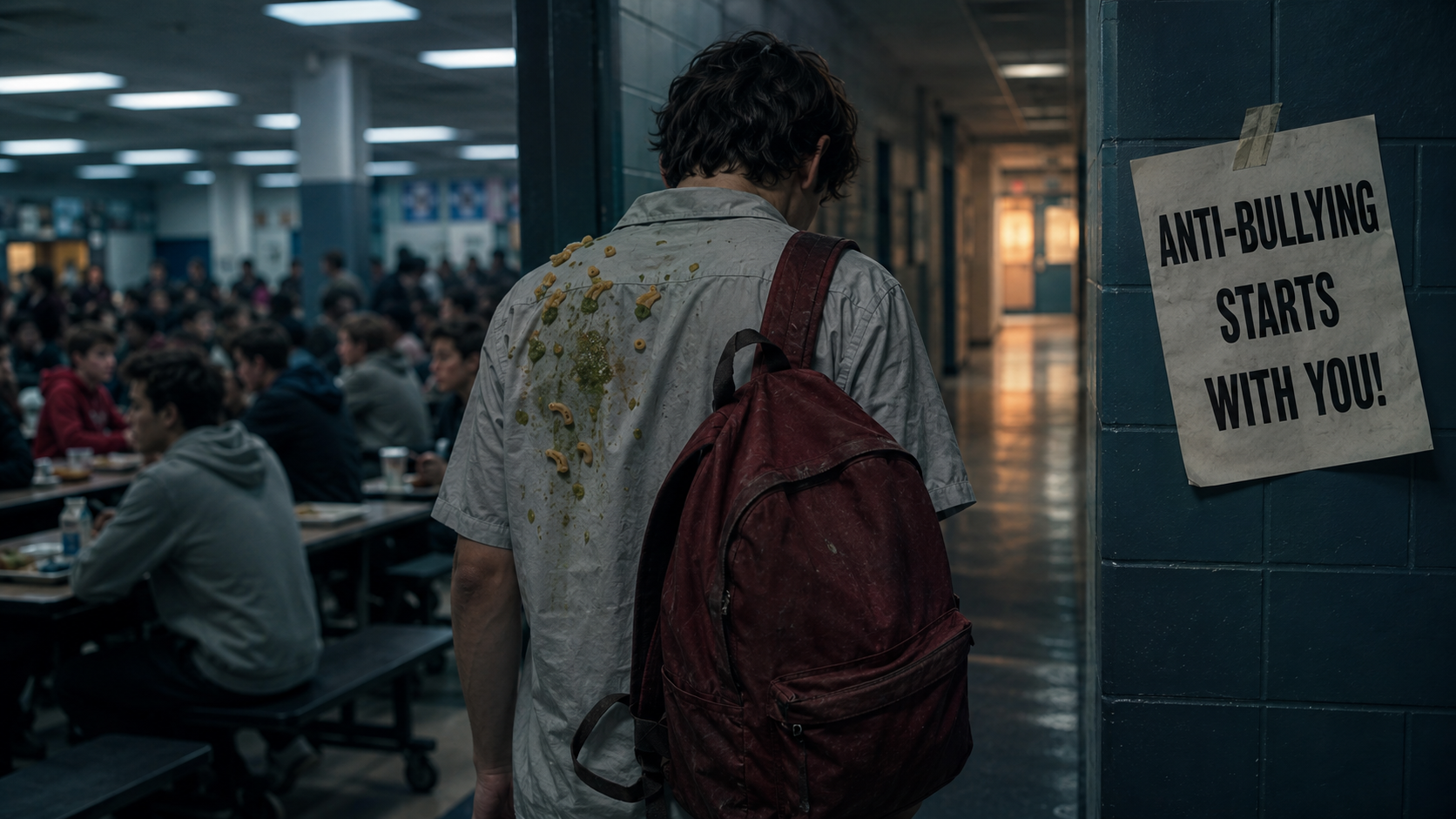
The green hot dog slapped against his chest and dropped into his lap. Macaroni salad splattered his shoulder and slid down his sleeve. The tray spun across the floor before slamming into a table leg.
For half a second, the cafeteria went silent.
Then it exploded.
Clapping.
Cheers.
Whistles.
Bryce lifted his hands like he’d accomplished something.
Tomas looked down at his shirt.
He brushed away a piece of macaroni with two fingers.
Careful.
Slow.
As though that part mattered.
Beside him, Red’s zipper opened.
The straps began to rise.
Say the word.
“No,” Tomas whispered.
The straps stopped.
A student across from them stared directly at Red.
Then she looked at Tomas.
“Tomas kicked it,” she said.
He hadn’t.
Bryce heard her and laughed.
“Careful. Puppet Boy’s doing tricks.”
Coach Chad’s whistle shrieked.
The room fell quiet.
He strode toward the table, taking his time, letting everyone see authority arrive.
He looked at Tomas.
Not Bryce.
Not Courtney.
Tomas.
“What did you do?”
Courtney stood.
“He didn’t do anything. Bryce threw my tray.”
Chad glanced toward Bryce.
Bryce shrugged.
“She ducked.”
A few students laughed.
Chad looked back at Courtney.
“I told you to stay out of things you don’t understand.”
“I understand what I saw.”
“Do you?”
“Yes.”
The answer came too quickly.
Too certainly.
For a moment, Courtney and Chad stared at each other.
Chad looked away first.
“Bryce, sit down.”
That was Bryce’s punishment.
Bryce grinned and returned to the V.I.P. table beneath a wave of applause.
Chad pointed toward the mess.
“Tomas, clean this up.”
“It wasn’t his tray,” Courtney said.
Chad ignored her.
His eyes dropped to Red.
“And if that thing causes another disturbance, it goes in my office.”
Red’s straps lowered to the floor.
So that’s the lesson, he said. Be entertaining. Don’t be difficult.
Tomas stood.
Macaroni slid from his sleeve and struck the floor.
He pulled Red over one shoulder and walked away.
Coach Chad watched him pass.
His mouth twitched.
Almost a smile.
A poster hung crooked beside the cafeteria doors, held in place by a single loop of tape.
ANTI-BULLYING STARTS WITH YOU!
Tomas kept walking.
The rest of the day blurred.
After lunch, the universe lost interest in Tomas. No more collisions. No more eyes tracking him down hallways. Just the hum of classrooms and the scrape of chairs.
When the final bell rang, it startled a smile out of him.
He left through the doors farthest from the bus lanes.
“Hey,” Courtney called.
Tomas didn’t slow.
She caught up anyway.
“Please don’t,” he said. “One public incident a day is my limit.”
“I remember defending you.”
“You made it worse.”
“I didn’t throw the tray.”
“No. You just lit the fuse.”
Courtney went quiet.
For three whole steps.
“That’s not fair.”
“I know.”
That stopped her.
Tomas kept walking.
A moment later, her footsteps resumed beside him.
Red shifted on his shoulder.
She has a point.
“You’re not helping.”
“I didn’t say anything,” Courtney replied.
“I wasn’t talking to you.”
“I know.”
Tomas glanced at her.
Courtney looked straight ahead.
The sidewalk thinned. Pavement cracked. Town slipped into fields and fencing without ceremony.
“You don’t live close,” Courtney said.
“Nope.”
“You walk like you’ve done this before.”
“Every day.”
“Why don’t you take the bus?”
Tomas didn’t answer.
They walked a few more yards before he stopped and tugged up the hem of his jeans.
The scar above his ankle was old but angry-looking—pale and uneven, shaped by the edge of someone else’s shoe.
Courtney looked at it.
“Oh.”
Tomas let the denim fall.
“That would do it,” she said.
He started walking again.
She didn’t ask for the story.
That helped.
At the edge of town, the road curved behind a stand of trees.
A truck waited on the other side.
The arrangement kept Kay’s vehicles away from the school and Tomas off the bus.
Everyone got what they wanted.
Berezina leaned against the driver’s door with her arms crossed. She wasn’t tall, but she took up space anyway—feet planted, shoulders squared, watching the road as if it might try something.
She straightened when she saw Tomas.
Her gaze moved to Courtney.
“You are late,” she said.
Not angry.
Not loud.
A fact that didn’t need arguing with.
“Bell rang late,” Tomas said.
Berezina studied him.
She knew he was lying.
She also knew his lies were rarely worth the trouble of pulling apart.
Her attention returned to Courtney.
“And this?”
“Courtney,” Courtney said.
“I did not ask your name.”
Courtney considered that.
“I’m headed the same direction.”
“Where?”
“Past the Calder farm. Other side of the old tar-and-chip road.”
Berezina’s expression didn’t change.
“Get in.”
Courtney climbed into the back seat without hesitation.
Tomas stared at her.
“What?”
“You get into trucks with strangers often?”
“She isn’t a stranger. You know her.”
“That’s not how strangers work.”
Berezina started the engine.
The truck smelled like leather, dust, and something metallic beneath both.
She turned on the radio as they pulled onto the road.
Static crackled.
Then a woman’s voice—warm and steady—filled the cab, with a man harmonizing beneath her.
He makes it easy to love somebody like that
Makes it easy to want someone so bad…
Berezina drummed her fingers against the steering wheel, perfectly on beat.
Courtney settled into the seat and looked out the window.
“My mom loves this song.”
Berezina nodded once.
“Good taste.”
Fields rolled past. Fence posts ticked by in time with the music.
For a few minutes, no one asked Tomas anything. No one looked at him like he was a problem waiting to be solved.
Red shifted against his back.
This is unsettling.
Tomas leaned his head against the window.
I don’t hate it, Red added.
The farm appeared in pieces.
Fencing.
Barn.
Pastures.
Then the house, set back from the road beneath a wide sky.
As Berezina slowed, the song faded into its final note.
Courtney reached for the door.
Berezina looked at her in the mirror.
“You sure you are getting out here?”
“Yes.”
Tomas turned around.
“You live here?”
“Near here.”
“You didn’t mention that.”
“You didn’t ask.”
Courtney climbed out.
Wind chimes moved on the porch, soft and irregular.
Kay stood beneath them with her sleeves rolled to her elbows. She didn’t wave. She didn’t need to.
The porch belonged to her in a way the house never quite had, as though she’d claimed that piece first and allowed the rest to grow around it.
“That’s Kay,” Tomas said. “My mom.”
Courtney slowed.
Kay’s eyes moved over her.
Sharp.
Fast.
The smile that followed arrived late and stayed shallow.
“You pick up strays now?” she asked Tomas.
He stared at the porch steps.
Courtney walked forward and offered her hand.
“I’m Courtney.”
Kay looked at the hand.
Then at Courtney.
She didn’t take it.
“Tomas doesn’t bring people home,” Kay said. “So either the world ended today, or you’re special.”
“Mom.”
Kay turned and went inside.
The door remained open.
Tomas followed, holding it for Courtney.
The house smelled like coffee and clean wood. Not decorative clean. Working clean. Every surface earned. Nothing soft unless it had to be.
“This is nice,” Courtney said.
“It works,” Kay replied.
The clock above the kitchen table ticked.
Loud.
Precise.
“Do we have anything to eat?” Tomas asked.
“Protein bars. Top shelf.”
Kay checked the clock.
“Dinner’s at six.”
Her eyes moved to Courtney.
“She staying?”
“I’d love to,” Courtney said.
Tomas looked at her.
Kay did too.
Longer this time.
“Eljen’s working on the fence behind the barn,” Kay said. “Go change.”
Tomas nodded.
“Where is everyone?”
Kay’s eyes cut toward him.
He immediately wished he hadn’t asked.
“Working.”
One word.
End of discussion.
“I can help,” Courtney offered.
Kay looked down at Courtney’s clean shoes.
Then at her hands.
“Suit yourself.”
Eljen had already pulled the damaged wire loose by the time Tomas and Courtney reached the fence line.
He was an older man with a narrow face and forearms turned dark by years in the sun. He looked at Courtney, then at Tomas.
“Company?”
“Apparently.”
Courtney pulled on a pair of work gloves.
Eljen handed Tomas the fencing pliers without asking whether he knew what to do.
At school, adults explained simple instructions twice and waited for him to fail.
Here, no one explained anything.
Tomas checked the leaning post, crouched near the break, and followed the wire to where it had twisted around itself. He worked it loose, threaded the replacement strand, and fastened it to the stretcher.
Courtney reached for the handle.
“Not yet,” Tomas said.
She stopped.
He checked the fence again.
A young mare stood on the other side, ears forward, watching them. When Courtney stepped closer, the mare backed away.
“Don’t look straight at her,” Tomas said.
“Why?”
“She’ll think you want something.”
“I do want something.”
“She doesn’t know it’s just to pet her.”
Courtney turned slightly and lowered her eyes.
Tomas approached the mare from the side. He didn’t reach for her. He stood quietly and waited.
The mare took one step.
Then another.
She stretched her neck and breathed against his hand.
Courtney watched him scratch the hollow beneath the mare’s jaw.
“You’re good with her,” she said.
“She tells you what she needs.”
“How?”
“You pay attention.”
Courtney’s gaze moved to Red, resting safely beyond the mud beside the fence post.
Something in her expression changed.
Tomas stepped away from the mare and returned to the wire.
He nodded toward the stretcher.
“Now.”
Courtney pulled.
The wire tightened.
The fence gave a low metallic hum.
Red’s zipper opened.
It sings. Should we pay royalties?
“Not now,” Tomas muttered.
Courtney looked at him.
Then at Red.
“You always carry that bookbag?”
“Him.”
The correction escaped before Tomas could stop it.
Courtney didn’t laugh.
“Why do you always carry him?”
Tomas glanced toward Red.
One strap had slipped into the dirt.
He picked it up, brushed it clean, and placed it back on the grass.
“He doesn’t like being alone.”
That is a malicious oversimplification.
“You talk to him,” Courtney said.
Tomas stiffened.
She tightened her grip on the fence stretcher.
“People at school say you do.”
“Oh.”
“Does he answer?”
Tomas looked at her.
Courtney’s expression was light.
Casual.
Her hands weren’t.
Her knuckles had gone white around the handle.
“No,” Tomas said.
Red stayed silent.
Courtney nodded as though the answer didn’t matter.
But disappointment passed across her face before she could hide it.
Eljen returned with another length of wire.
Courtney released the stretcher.
The color slowly returned to her hands.
By the time dinner ended, the sky beyond the kitchen windows had faded from blue to bruise-purple.
The ranch hands ate quickly and talked little. Courtney listened more than she spoke. When someone asked about her family, she said her parents had recently moved into the area and redirected the conversation before anyone could ask why.
Kay noticed.
Kay noticed everything.
The dishes were nearly finished when Courtney placed the last plate into the drying rack.
Tomas wiped the counter behind her.
Red sat in the corner chair, straps loose, zipper half-lidded like an eye that refused to close.
“I should probably head home,” Courtney said.
“I’ll walk you.”
She reached for Red before Tomas could stop her.
Her hand closed around the strap.
Red went rigid.
Not the bookbag.
The presence inside it.
Tomas felt the change as a pressure behind his eyes.
Courtney felt something too.
Her breath caught.
Red’s voice came quietly.
Warm.
A pause.
No. Not warm.
Courtney slid the strap over her shoulder.
Known.
“Don’t,” Tomas muttered.
Courtney looked at him.
“I’m only carrying him.”
“He doesn’t like strangers.”
The smallest sadness touched her face.
“I’m not a stranger.”
Before Tomas could ask what that meant, she opened the back door.
Kay was already on the porch.
She sat straight-backed in a chair, elbows resting on her knees, watching fireflies stitch dim light through the tall grass.
The wind chimes ticked once.
Then settled.
“Thank you for dinner,” Courtney said. “Mrs…?”
Kay didn’t turn from the field.
“You can call me Calder. Ms. Calder.”
Tomas winced.
“Mom—”
Kay looked back at him, one eyebrow lifting.
A warning.
Not a question.
“Problem?”
“No. Just surprised.”
Courtney adjusted Red’s strap.
“Thank you for dinner, Ms. Calder. And for letting me help.”
Kay’s mouth tightened.
Not a smile.
Close enough to count.
“You headed out?”
Tomas stepped forward.
“You need a ride?”
He hated how hopeful it sounded.
Courtney shook her head.
“I live just past the tree line. Other side of the old tar-and-chip road.”
Kay turned fully.
Her attention snapped into place like a trap closing.
“The Barlow property.”
“I think so,” Courtney said. “My parents bought it.”
Kay studied her.
Slowly.
Carefully.
Like she was reading fine print no one else could see.
“That’s funny,” she said. “No one told me.”
“People buy houses all the time,” Tomas said. “No one’s lived there in years.”
“I was going to buy it.”
Kay’s eyes remained on Courtney.
“Move your cousins up here.”
That wasn’t family talk.
That was business.
The porch seemed to tilt.
Tomas pictured Merrill’s grin—too wide, teeth always showing. The way Merrill liked corners. Liked standing too close. Liked asking questions that didn’t have right answers.
“No.”
The word came out flat.
Immediate.
Kay finally looked at him.
“That isn’t your decision.”
“I know. I just—no.”
Kay held his stare long enough for the night to press in around them.
Then she returned her attention to Courtney.
“You sure that’s where you’re staying?”
“Yes, ma’am.”
Kay nodded once.
Courtney removed Red from her shoulder.
For a moment, she held him in both hands.
Waiting.
Red didn’t speak.
Whatever she wanted from him, she didn’t get it.
She passed him back to Tomas carefully.
Not like a bookbag.
Like something injured.
“I’ll see you tomorrow,” she said.
Then she crossed the yard and disappeared into the trees.
Just before the darkness swallowed her, she stopped.
She looked toward the road.
Not back at Tomas.
Toward something beyond the farm.
Then she was gone.
Kay watched until the night finished its work.
“You okay?” she asked.
Tomas nodded too quickly.
“You have something to say?”
“I don’t like Merrill.”
Kay waited.
“He’s wrong,” Tomas said.
“That coming from the kid who talks to his bookbag?”
The words landed clean.
No anger.
No heat.
Just impact.
Tomas went still.
Kay let the silence sit long enough to hurt.
Then she nodded toward the trees.
“What do you know about her?”
“Nothing.”
“You brought her into my house.”
“She followed me.”
“People don’t find this place by accident.”
Tomas looked toward the tree line.
Courtney was gone.
“I didn’t tell her where I lived.”
Kay studied his face.
Searching.
Finding nothing she could use.
“Get inside.”
The screen door snapped shut behind him.
Later, Tomas lay on his bed with his hands folded behind his head, watching the ceiling fan click through another uneven rotation.
Courtney’s smile.
Merrill’s grin.
Bryce’s laugh.
Coach Chad’s whistle, sharp and pleased while Bryce walked away.
Red leaned against the wall, zipper half-open.
You’re spiraling.
“I’m thinking.”
Same thing. Louder.
Tomas exhaled.
“What if Merrill really moves here?”
One problem at a time.
Red shifted against the wall.
Want to hear my plan for Bryce?
“And Coach Chad?”
Red paused.
Longer than usual.
Later.
His fabric shifted again.
Restless.
Besides, this might impress Courtney.
Tomas turned his head.
“You don’t even know her.”
Red’s zipper teeth clicked.
Once.
Twice.
I do.
The room went quiet.
Tomas listened to the frogs singing outside, loud and careless.
“What do you mean?”
Red’s straps drew closer to his body.
I know her, he said. I just don’t remember how.
Tomas stared at him.
Red said nothing else.
After a while, Tomas looked back at the ceiling.
“Alright.”
Red’s zipper lifted slightly.
“What’s the plan?”
The zipper slowly curved into a smile.
Around the fire
Join the conversation.
Reader comments appear only after T. G. Bonfire approves them. That keeps this space thoughtful, human, and free of noise.