Chapter 13
Why Does the Ocean Wave?
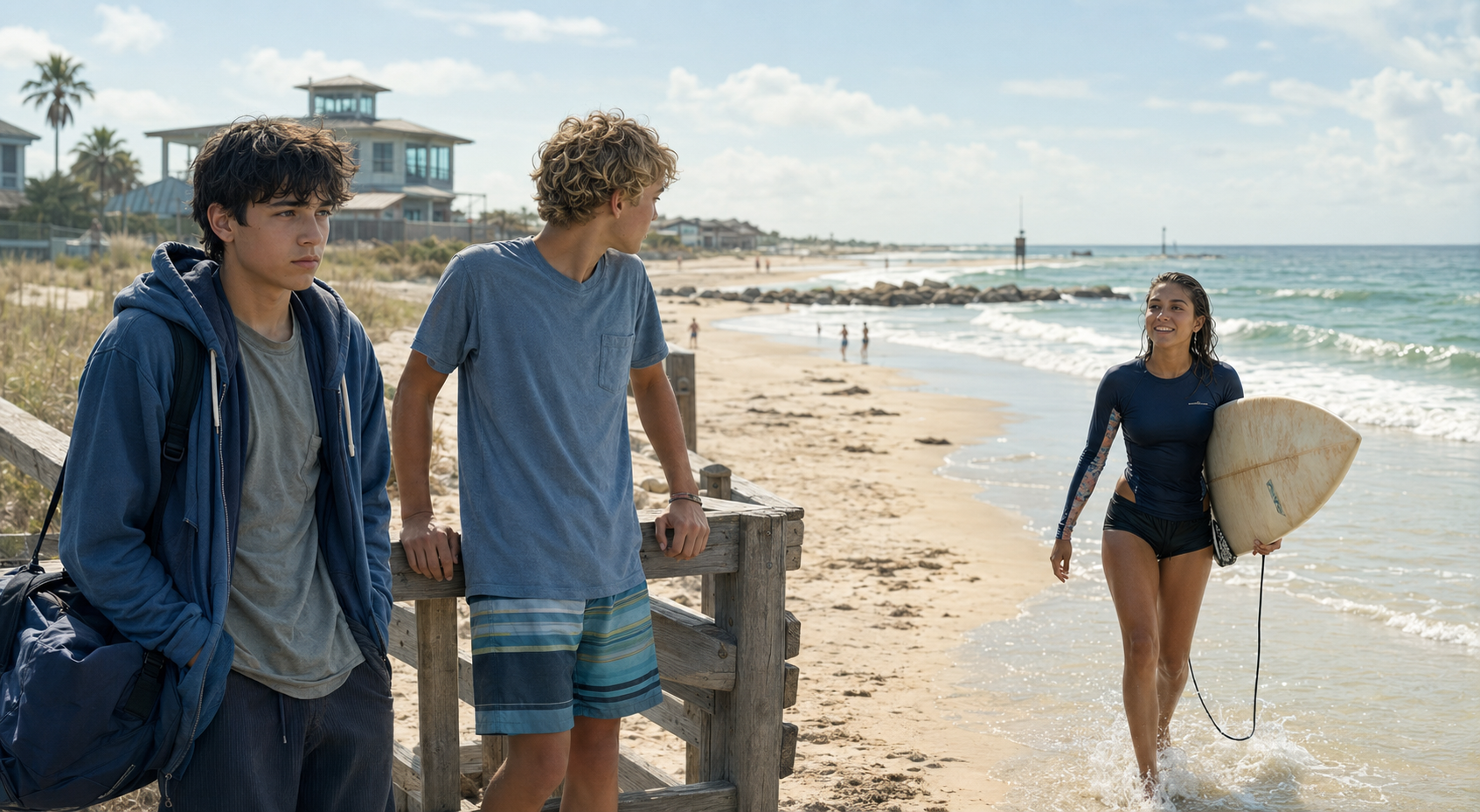
Tomas woke to a sharp tap.
Then another.
Tap.
Tap.
Tap.
A seagull stood on the hood of the stolen sedan, pecking furiously at a cold french fry trapped beneath the windshield wiper.
Tomas blinked at it.
“When did I get fries?”
The bird ripped the fry free and swallowed it in one violent gulp. Then it turned its head and stared through the windshield.
They studied each other.
Tomas lunged toward the steering wheel.
The gull didn’t move.
“So you’ve seen some things.”
He switched on the windshield wipers.
The blade bumped the gull’s feet. With an indignant squawk, it flapped into the air and glided toward several birds gathered along the beach.
“That’s what I thought.”
Tomas leaned back.
Sleeping in the driver’s seat had folded his spine into a shape no human body was designed to hold. He stretched and struck the roof with both hands.
“Fantastic life decisions.”
He had driven through the night.
Badly.
For the first hour, he kept drifting toward the shoulder every time headlights appeared behind him. A semi had blasted its horn when Tomas slowed to thirty-five on an entrance ramp. Twice, he missed an exit and had to drive miles before finding somewhere safe to turn around.
Farm roads had taught him how to control a vehicle.
They hadn’t taught him how to share a highway with people who believed speed limits were personal challenges.
His phone remained on his dresser at the farm.
He had left it deliberately.
Kay could track phones. Berezina could track nearly anything with a battery. Tomas had wanted to disappear, so he had abandoned the easiest way for anyone to find him.
He hadn’t known where he was going.
Then, sometime before dawn, a green highway sign appeared in the headlights.
Pelican Point
PUBLIC BEACH — 12 MILES
Tomas took the exit before deciding why.
Now morning sunlight rolled across the Gulf in long bands of gold. Joggers moved along the boardwalk in neon clothing. Dog walkers untangled leashes. Shopkeepers lifted metal shutters over beachfront windows.
Tomas climbed from the sedan.
Salt air filled his lungs.
For a moment, he stood motionless and stared at the water.
He hadn’t seen Pelican Point in almost ten years.
Not since Kay packed everything they owned into a car and drove away without explaining why. Tomas had been barely old enough for school. Old enough to remember the ocean. Old enough to remember asking when they were coming back.
They never had.
He remembered pieces.
A blue house with a broken mailbox.
A dog that hated strangers.
Two other children running through a sprinkler.
Adults speaking quietly in the kitchen, falling silent whenever Tomas entered.
The memories had no order. No beginning or ending.
Only pictures.
The boardwalk looked almost unchanged.
The same gulls screamed overhead. Fried food and sunscreen drifted from open windows. Waves rolled toward shore, steady and endless.
A runner passed Tomas and nodded.
“The beach fixes most things.”
Tomas nodded back. “I’m counting on it.”
His stomach growled.
He checked his pockets.
A few crumpled bills remained from the emergency money he had stuffed into his duffel. The duffel sat on the sedan’s passenger floor, along with everything else he had thought his life required.
Tomas locked the car and headed toward the boardwalk.
The Salty Skillet stood halfway down the planks, bolted into place as if it had grown there.
The name stirred another faint memory.
Kay drinking coffee beside a window.
A man’s voice somewhere behind Tomas.
Then nothing.
Inside, Tomas ordered eggs, hash browns and toast. He ate everything in less than five minutes.
For the first time since leaving the farm, nothing inside him pushed.
No Kay.
No police.
No Collector.
No Courtney telling him he was making a mistake.
No Red calling him a moron.
The last absence hurt more than the others.
Tomas paid, returned to the sedan and moved it onto an unmetered side street away from the boardwalk. The car was stolen. Someone might already be looking for it.
That felt like a future problem.
He walked to the beach and settled beneath the boardwalk, where the sand remained cool. He leaned against a wooden support and listened to the waves.
In.
Out.
In.
Out.
His eyes closed.
Each mile away from Red had made the pressure behind them worse. Tomas had blamed exhaustion, the highway and the hours of driving.
Now the ache felt like something stretched too far.
A cord pulled tight between him and a voice he could no longer hear.
Tomas matched his breathing to the water.
He fell asleep almost immediately.
At first, he dreamed of the ocean.
Something was wrong with it.
The waves didn’t break.
They unzipped.
Silver teeth appeared across the face of the water. The ocean opened again and again, as if someone dragged a zipper through miles of blue fabric.
Darkness waited inside.
Not empty darkness.
Stars.
Galaxies turned slowly beyond the opening. Vast and silent.
Tomas stood at the shoreline holding Red.
The bookbag was heavier than it should have been.
Full.
The twelve stones shifted inside with one movement.
One thought.
Don’t open me, Red whispered.
Tomas’s hands moved anyway.
The zipper parted.
There were no books inside.
No pencils.
No lunch.
Only distance without an ending.
The pull of it bent Tomas forward.
He leaned closer.
Something leaned back.
Tomas woke shouting.
Sand flew as he jerked upright.
A nearby couple gathered their children and hurried away.
“Homeless,” someone muttered.
“Crazy,” another person answered.
The word followed Tomas out from beneath the boardwalk.
Crazy.
Rook had used it.
Kay had used it.
His father existed somewhere inside it.
Tomas waved toward the retreating family.
“Show’s over. Next performance after lunch.”
The joke made them move faster.
Tomas staggered into the sunlight.
Heat struck him.
His shoes lay half-buried nearby. He found a public faucet, rinsed sand from his feet and pulled them on.
The pain behind his eyes intensified.
Not a normal headache.
Pressure.
Distance.
Something inside him was reaching for something that wasn’t there.
Tomas pressed one hand against his chest.
“Red?”
The waves answered.
He walked toward the small store he had noticed earlier. Every patch of shade felt too short. His stomach rolled despite breakfast.
A rack of beach umbrellas stood outside a souvenir shop. Tomas considered taking one.
The thought lasted longer than it should have.
The hand-painted sign on the next storefront read:
PELICAN POINT PHARMACY & SUNDRIES
“Sundries,” Tomas muttered. “What is this, 1932?”
Chimes rattled when he entered.
The clerk looked up immediately.
He was an older man with a gray mustache and the permanent squint of someone who had spent half his life staring into the sun.
“Aspirin?” Tomas asked.
“Aisle five. Past the cold medicine.”
The man returned to a sudoku puzzle behind the counter.
Tomas found the pain relievers.
Most bottles contained fifty or a hundred tablets. He needed two.
The cheapest bottle contained twenty.
Tomas checked the price.
Then counted his money.
Not enough.
He bent to check the lower shelf.
Pain pulsed behind his left eye.
When he straightened, the clerk was watching him over the top of his puzzle book.
Tomas examined the bottle.
He could leave.
He could ask for two tablets and hope the man had more sympathy than suspicion.
Or he could take them.
Tomas returned the generic bottle to the shelf.
If he was going to steal something, he might as well take the expensive brand.
He moved farther down the aisle until a rack of beach towels blocked the clerk’s view.
Tomas opened the box.
“You stealing those?”
A skinny boy leaned against the end of the aisle.
Bleached hair stuck up in chaotic spikes. He wore baby-blue surf trunks and no shirt. His skin carried the deep, permanent tan of someone raised outdoors.
Tomas held the open aspirin bottle.
“Huh?”
The boy took a bottle of sunscreen from the shelf, squeezed some into his palm and rubbed it across his chest.
“I asked if you were stealing.”
Tomas’s head hurt too badly to invent a respectable answer.
“Looks like it.”
He swallowed two tablets.
The boy grinned.
“All right.”
Then he raised his voice.
“Hey, Hank! This guy’s stealing your aspirin.”
A chair scraped behind the counter.
The clerk’s sudoku book struck the floor.
A baseball bat appeared from beneath the register.
“Bentley Varga!” Hank shouted. “Don’t you start!”
The boy backed away, shrugging helplessly.
“Better run.”
Then he bolted.
Hank charged into the aisle.
“Both of you little thieves are banned!”
Tomas shoved the aspirin into his pocket and ran.
He followed Bentley around the end of the aisle. His hip struck a charcoal display, sending bags sliding across the floor.
Hank shouted something about police.
They burst onto the boardwalk and sprinted two blocks before stopping beneath an elm tree.
Bentley bent over, laughing.
Tomas braced his hands against his knees.
His headache still pounded.
“What the hell was that?”
Bentley shrugged. “Felt like it.”
“You got me banned from a store I’ve been inside once.”
“You were stealing.”
“You opened sunscreen.”
“That was a sample.”
“There was a price tag.”
“Suggested donation.”
Tomas laughed despite himself.
He straightened and held out his hand.
“Tomas.”
Bentley’s grin faded.
He looked at Tomas’s face.
Then his hand.
“Tomas what?”
“Calder.”
Something moved through Bentley’s expression.
Recognition.
Then uncertainty, as if he had remembered an answer without remembering where he learned it.
He shook Tomas’s hand.
“You used to live here.”
Tomas frowned. “How do you know that?”
“Across from the blue house with the broken mailbox.”
Tomas stared at him.
“You had a dog that bit everybody,” he said.
Bentley’s grin returned.
“Duke.”
“No way.”
“Yeah way.”
They studied each other.
Tomas found a faint echo of the boy Bentley had been. Wet hair. Missing front tooth. A garden hose held like a weapon.
“Holy crap,” Bentley said. “Tommy.”
“Don’t call me that.”
Bentley laughed. “It is you.”
“How do you remember me?”
Bentley’s smile faltered.
“People talked.”
“What people?”
“You know. Adults.”
“No, I don’t.”
Bentley kicked at the dirt beside the tree.
“You hear things when you’re a kid.”
“What things?”
“Nothing useful.”
The answer felt practiced.
Bentley turned toward the boardwalk.
“How long has it been?”
“Almost ten years.”
“Damn.”
They walked toward the beach.
“So where’d you go?” Bentley asked.
“A farm.”
“You live on a farm?”
“Until last night.”
Bentley glanced at him. “That sounds like a story.”
“It isn’t a good one.”
“Those are usually the interesting kind.”
They passed Pelican Point’s small public library. Tomas remembered the squat brick building, though he couldn’t remember ever entering it.
“You still live here?” Tomas asked.
“Me and my sister.”
“Vette?”
Bentley looked at him sharply.
“You remember her?”
“Sort of.”
Another fragment surfaced.
A girl with scraped knees refusing to cry.
Bentley nodded. “She remembers you too.”
The certainty in his voice made Tomas uneasy.
“What about your mom?”
Bentley shrugged as if the answer didn’t matter.
“She left.”
“When?”
“Years ago.”
“Where’d she go?”
“If you find out, send a postcard.”
Tomas didn’t know what to say.
Bentley rescued him from trying.
“We still got the old man.”
“Your dad?”
Bentley stepped onto the sand and opened both arms toward the beach.
“Tell me someplace better than this.”
Tomas looked across the water.
“Malibu.”
Bentley barked out a laugh.
“Yeah. Well, there’s always Malibu.”
They found Vette beyond the break.
She rode the face of a rising wave with the confidence of someone who believed the ocean belonged to her.
A small crowd had gathered along the shore. Tourists in expensive wetsuits held surfboards too clean to have seen real use.
Bentley leaned against the rail.
“She gives lessons.”
“Is that what this is?”
“Nah. Lesson’s over. Now she’s showing off.”
Vette carved toward the top of the wave, launched into the air and landed again on the same wall of water.
Tomas leaned forward.
“She’s good.”
“She’s the best around here.”
“She going professional?”
“That’s the plan.”
“Will she?”
Bentley watched his sister.
“Depends.”
“On what?”
“A lot of things.”
Tomas looked at him.
Bentley didn’t elaborate.
Vette caught another wave and rode it all the way to shore. The tourists applauded as she climbed from the water.
She never looked back.
Bentley cupped his hands around his mouth.
“Hey, sis. Look what washed up.”
Vette approached carrying her board.
Her gaze passed over Tomas.
Sharp.
Assessing.
For less than a second, something changed in her face.
Not surprise.
Recognition she didn’t want to explain.
Then it vanished.
She pushed wet hair away from her eyes.
“Your friend’s about ten seconds from cooking his eyeballs.”
Bentley frowned. “I’m not wearing sunglasses.”
“You live here. Your eyeballs are already cooked.”
She propped the surfboard against the railing and pulled on a white T-shirt.
Her eyes returned to Tomas.
“You about to pass out?”
“I’m fine.”
He straightened.
The movement twisted his stomach.
Vette noticed.
“You’re sweating.”
“We’re at a beach.”
“You’re sweating like your organs are negotiating an exit.”
Bentley looked at Tomas more carefully.
“We should get him out of the sun.”
Vette watched him.
“If we take him with us, he becomes our problem.”
“He needs sleep and shade.”
“He needs more than that.”
Tomas pressed one hand to his stomach.
Vette and Bentley exchanged a look.
They knew something about him.
Maybe not the whole truth.
Enough to make his return feel dangerous.
Vette’s phone rang inside her beach bag.
She checked the screen and stepped several feet away before answering.
“Yes.”
A pause.
“We’re at the beach.”
Another pause.
Vette looked toward Tomas.
Her expression closed.
“Okay.”
She listened.
“I said okay.”
She ended the call.
Bentley straightened. “What happened?”
“We have to make a stop before we go home.”
“What kind of stop?”
“The kind we don’t discuss here.”
Bentley rubbed one hand across his ribs.
Tomas wondered when he had been hurt.
His stomach clenched again.
He bent forward and vomited into the sand.
Bentley jumped aside.
“Whoa.”
Tomas wiped his mouth.
“Sorry.”
“This happened when we were kids,” Bentley said.
Tomas looked up. “It did?”
Bentley went quiet.
Vette slung her bag over one shoulder.
“We’re taking him.”
Bentley nodded.
Neither asked Tomas if he agreed.
They helped him to a faded red Jeep Cherokee with surf racks bolted to the roof and sand permanently embedded in the floorboards.
Tomas collapsed across the back seat.
The interior smelled of salt, sunscreen and old fast-food wrappers.
“Where’s your stuff?” Bentley asked.
“In the car.”
“What car?”
Tomas pointed vaguely toward the side street.
“Silver sedan.”
“Is it yours?” Vette asked.
“No.”
She looked at Bentley.
He shrugged. “Told you he was interesting.”
Vette pulled away from the curb.
Sunlight became painfully bright through the windshield.
Tomas closed his eyes.
Before they reached the first intersection, the world disappeared.
Tomas woke to music.
Strings.
Slow and elegant.
Violins climbed toward a note that never quite arrived.
For several moments, he listened without moving.
The melody tugged at something inside his memory.
Nothing he could catch.
His headache had eased. His stomach had settled. But the stretched feeling remained in his chest.
Red was somewhere far away.
Tomas could still feel the absence.
He lay in an unfamiliar bedroom with white walls and a ceiling fan turning overhead.
He wasn’t wearing pants.
Tomas sat up.
His jeans were folded across the back of a chair. A note rested on top.
You threw up on these. Don’t wear them.
Borrow shorts from my drawer. —B
“That’s reassuring.”
Tomas opened the dresser and found black athletic shorts. They fit well enough.
The music drifted down the hallway.
He followed it.
The house opened into a wide kitchen and dining room facing the ocean through a wall of glass. Late-morning sunlight stretched across polished floors.
A long walnut table occupied the center of the room.
A man sat at its head.
Tall.
Lean.
Silver at the temples.
He wore a dark suit jacket despite the coastal heat.
Everything about him looked precise.
A young woman in a maid’s uniform stood beside him with a coffee pot. Her hands trembled as she poured.
“Thank you,” the man said.
His accent carried a faint European edge.
The maid nodded and retreated.
Relief showed in every step.
The man looked toward Tomas.
He didn’t appear surprised.
“You must be Tomas.”
“Yes, sir.”
A faint smile touched the man’s mouth.
“Please do not call me sir.”
He gestured toward the chair opposite him.
“Sit.”
Tomas obeyed.
The maid returned with a tall glass of thick red liquid. She placed it in front of him without meeting his eyes and quickly disappeared.
The man nodded toward the glass.
“Drink.”
Tomas studied it.
“What is it?”
“Tomato juice.”
Tomas lifted the glass and took a cautious sip.
It tasted exactly like tomato juice.
He still felt as though he had passed a test.
The man buttered toast with surgical precision.
“Bentley tells me you became unwell.”
“I’m better.”
“Good.”
The man took a bite.
No crumbs fell.
“Where are Bentley and Vette?”
“Working.”
“At what?”
The man sipped his coffee.
“That is their concern.”
Silence returned.
Outside, waves rolled toward the shore.
The man studied Tomas with an attention that felt too personal for someone meeting him for the first time.
“Bentley says you live on a farm.”
“Yes.”
“Hard work.”
“Sometimes.”
“Hard work creates useful people.”
The front door opened.
Bentley and Vette entered.
They stopped when they saw Tomas at the table.
Then they looked toward the man.
Bentley’s smile became careful.
“Morning.”
Vette crossed the room and placed a thick envelope beside the man’s plate.
He opened it.
Cash filled the envelope.
He counted quickly.
Satisfied, he set it aside.
“Well done.”
Vette folded her arms.
Bentley leaned against the wall with one hand held close to his ribs.
The man noticed.
“Trouble?”
“Nothing we couldn’t handle,” Bentley said.
The man reached for Vette.
His hand closed around her wrist.
She went completely still.
He pulled her closer.
His fingers traveled slowly along her arm. Over her shoulder. Down her side.
His hand settled too low against her back.
Possessive.
Familiar.
Wrong.
Vette stared beyond him toward the windows. Her face emptied.
Bentley looked away.
The man watched him do it.
Then he smiled.
Tomas felt something cold gather in his stomach.
This wasn’t affection.
It was a reminder.
The man released Vette.
She stepped away without rubbing her wrist until she had turned her back.
“Good,” he said.
He wiped his fingers on a cloth napkin.
“Is the project proceeding?”
Bentley nodded.
“On schedule.”
“Excellent.”
The man looked toward Tomas again.
“You should enjoy the day.”
Bentley blinked. “What?”
“Take your friend to the ocean. Show him what has changed.”
Vette hesitated. “Are you sure?”
The man smiled.
“I insist.”
Bentley pushed away from the wall.
“All right.”
Vette grabbed her bag.
Bentley nodded toward the door.
“Come on, farm boy.”
Tomas stood.
As he followed them, he glanced back.
The man remained at the table.
Coffee in one hand.
Toast in the other.
Watching Tomas leave.
Still smiling.
Outside, the ocean wind struck them.
Tomas waited until the door closed.
“Who was that?”
Bentley stared toward the water.
“That,” he said quietly, “is Soren Varga.”
Vette adjusted the strap of her bag.
“Also answers to Dad.”
Around the fire
Join the conversation.
Reader comments appear only after T. G. Bonfire approves them. That keeps this space thoughtful, human, and free of noise.