Chapter 4
Negotiations
Kay already had the engine running when Tomas stepped off the porch.
The car Courtney had driven the night before was gone.
Tomas hadn’t heard it leave.
Country music filled the truck’s cab—low and steady, something about long roads and knowing when to walk away. Kay didn’t sing. She never did. One hand rested on the wheel. The other tapped the door once before going still.
The truck was new.
Too new.
A white Super Duty. Diesel. Extended cab. Work trim. Built to haul weight without apologizing for it.
The paint was clean enough to reflect the morning sky. No dust had yet been brave enough to settle.
Tomas climbed into the passenger seat.
The door closed with a solid, final thud.
Red occupied the back seat, repaired side turned away from Kay.
She didn’t look at either of them.
She lowered the radio.
Not off.
Just quieter.
“You know what the principal asked me?”
Tomas stared through the windshield.
“No, ma’am.”
“He asked whether we were having trouble at home.”
Tomas stiffened.
“Mom—”
“Don’t.”
Kay raised one finger.
Calm.
Precise.
“You don’t get to explain yet.”
The truck rolled forward. Gravel crunched beneath the tires.
Not fast.
Not slow.
Controlled.
“Do you have any idea how difficult it is to build a life where people don’t ask questions?”
Tomas swallowed.
“Because last night, my son broke into a school and flooded part of the cafeteria.”
“It wasn’t—”
Kay looked at him.
Only once.
Sharp enough to stop the rest.
“It matters what they can prove,” she said. “And it matters what everyone else is willing to believe.”
Tomas looked toward the fields.
“I wasn’t trying to be seen.”
“Good.”
Kay turned the radio slightly louder.
“People who get seen don’t last long where we live.”
The words landed heavier than they should have.
In the back seat, Red remained quiet.
Parking took forever.
The truck was too wide for most of the spaces, so Kay parked at the back of the lot—far from the school entrance and farther from anyone likely to take an interest in the license plate.
She didn’t slow after leaving the cab.
Tomas collected Red from the back seat and lengthened his stride to keep up.
Kay’s boots struck the pavement in sharp, decisive beats. She moved like someone who expected doors to open before she reached them.
Inside, the front office smelled of toner and burnt coffee.
Nothing had changed since Tomas’s first day of kindergarten. Beige walls. Curling motivational posters. A fake fern in the corner surrendering slowly to dust.
Mrs. Donnelly looked up from behind the counter.
“Well,” she said.
A tight smile snapped into place.
“If it isn’t Kay Calder.”
Kay stopped.
“Diane.”
“I didn’t know you were back for good.”
“I didn’t know they let former prom queens run the front desk.”
Mrs. Donnelly’s smile stiffened.
“Someone has to keep this place running. Not everyone can disappear for a spell and walk back in as though nothing changed.”
Kay surveyed the office.
Slowly.
Deliberately.
“I remember you saying you’d never stay in this town. Said you were too smart for it.”
“Some of us chose stability.”
“Some of us chose work.”
Kay smiled.
It didn’t reach her eyes.
“Funny how neither of us ended up where we planned.”
Mrs. Donnelly’s fingers tightened against the desk.
“Principal Duong will see you now.”
“Appreciate it.”
Kay walked past without waiting for permission.
Tomas followed.
Red shifted lightly against his back.
Your mother collects enemies the way other people collect refrigerator magnets.
“Quiet,” Tomas whispered.
Kay looked back.
Tomas pretended to cough.
Inside the principal’s office, Mr. Duong rose from behind his desk.
Mr. Griggs and Mrs. McKinley sat in chairs to either side of him. Close enough to look arranged rather than seated.
“Ms. Calder. Tomas. Thank you for coming.”
Kay took the empty chair without waiting to be invited.
Tomas sat beside her.
Red settled against his feet.
“We’d like to resolve this quickly,” Mr. Duong said.
“Yes,” Kay replied. “Let’s.”
Mr. Griggs leaned forward.
“We have serious concerns about Tomas’s behavior.”
“I’m concerned about that word.”
Griggs frowned.
“Behavior?”
“Concerns. It’s what people say when they don’t want to tell you what they’ve already decided.”
Mrs. McKinley offered a careful smile.
“Tomas is bright. Very capable. But—”
“But,” Kay repeated.
“Tomas has difficulty connecting with the other students.”
“He gets bullied.”
“He isolates himself.”
“He gets bullied.”
“He talks to his bookbag,” Griggs said.
The room went quiet.
Kay looked at him.
“So we’re worried about the bookbag.”
“We’re worried about what it represents.”
“What does it represent?”
Griggs shifted in his chair.
“We believe Tomas may be unstable.”
The word entered the room and stayed there.
Kay didn’t raise her voice.
“Is that your professional assessment?”
“No one is diagnosing him,” Mrs. McKinley said quickly.
“Then don’t use diagnostic language.”
Mr. Duong folded his hands.
“Tomas has become a disruption.”
Kay laughed once.
Sharp.
Humorless.
“That’s the concern? Not students shoving him into lockers?”
She tipped her chin toward Tomas.
“Not the bruises?”
Mr. Duong’s gaze moved to Tomas’s face.
The swelling beneath his eye had darkened overnight. Yellow had begun to spread along its edges.
Mr. Duong looked away first.
“We investigated the hallway incident,” he said.
“Who did you speak to?”
“Several students.”
“The ones who watched?”
Mrs. McKinley shifted.
“Witness statements were inconsistent.”
“His bruises seem fairly consistent.”
Griggs crossed his arms.
“This isn’t about one hallway incident. Tomas repeatedly draws attention to himself.”
“He keeps his grades up,” Kay said. “He does what his teachers ask. He walks home because your bus wasn’t safe for him. He enters this building expecting to be hurt, and your concern is that other people notice him reacting to it.”
No one answered.
Kay leaned back.
“If this school makes him feel so alone that he talks to a bookbag, at least the bookbag listens.”
Mr. Duong opened a manila folder.
“Ms. Calder, Tomas entered the school illegally last night.”
Kay’s eyes moved toward Tomas.
He sank lower in his chair.
Mr. Duong slid a grainy photograph across the desk.
Two figures crossed the school parking lot.
Their faces were indistinct, but Tomas recognized himself immediately. The inward curve of his shoulders. The way he held Red close to his chest.
“We believe this is Tomas leaving the building shortly after the alarm activated.”
“You believe,” Kay repeated.
“The bookbag is fairly distinctive.”
Red pressed against Tomas’s ankle.
Rude.
Kay examined the photograph.
“And the second person?”
“We haven’t identified her,” Mr. Duong said. “We aren’t certain she attends this school.”
Mr. Griggs leaned forward.
“Perhaps Tomas can help. Courtney, isn’t it?”
Kay looked at Tomas.
He wished briefly and intensely for an earthquake.
Or a gas leak.
Anything large enough to end the meeting without requiring him to speak.
Mr. Duong slid another stack of photographs across the desk.
“In addition to the broken window and water damage, these markings appeared along the art hallway.”
Tomas reached for the photographs.
Symbols ran high along the walls, just below the ceiling.
They weren’t letters.
They weren’t pictures either.
Thin, precise grooves had been scored into the paint. Some curved inward and looped back upon themselves as though reconsidering their own direction. Others broke at impossible angles—bends that felt more decided than drawn.
There was rhythm to them.
Spacing.
Breath.
Whatever had made them hadn’t rushed.
The markings ran where no one normally looked unless they already suspected something was wrong.
Pressure formed behind Tomas’s eyes.
Red went completely still.
Tomas felt his attention sharpen through their connection.
The symbols weren’t intended for the school.
They weren’t even intended for Tomas.
They were meant to be recognized.
“We didn’t put those there,” Tomas said.
The room turned toward him.
Mr. Griggs’s eyes narrowed.
“How do you know?”
Tomas froze.
Kay took the photograph from his hand.
“That isn’t spray paint.”
“No,” Mr. Duong said. “Facilities hasn’t identified what was used.”
“And you have a photograph of my son carving these into the wall?”
“No.”
“Fingerprints?”
“Not yet.”
“A tool?”
Mr. Duong shook his head.
“Then you know he entered the building. You don’t know that he damaged it.”
“He admitted being there,” Mr. Griggs said.
“After you showed him a picture and called it proof.”
“Tomas’s presence coincides with extensive damage.”
Kay placed the photographs on the desk and aligned their edges.
“Then let’s discuss what you can prove.”
Mr. Duong’s expression tightened.
“We have sufficient cause to contact law enforcement and recommend alternative placement.”
Kay didn’t move.
“You can do that.”
Tomas looked at her.
“So can I,” she continued. “Then we can all answer questions.”
Mr. Duong’s eyes sharpened.
“What questions?”
“Why my son was sent to the office with a black eye and no injury report. Why no nurse examined him. Why the student who hit him returned to class. Why your staff repeatedly participated in or ignored harassment.”
“This sounds like a threat,” Griggs said.
“No.”
Kay looked at him.
“A threat is what happens after people refuse the reasonable option.”
Silence filled the office.
Mrs. McKinley looked toward Mr. Duong.
“What do you consider reasonable?” he asked.
Kay folded her hands.
“One-week suspension.”
Griggs scoffed.
“Tomas reports here after school during that week to help remove the markings and repair what can be repaired. Under supervision.”
She continued before anyone could interrupt.
“He finishes the school year. You enforce the anti-bullying policies printed on every third wall of this building. If another student puts his hands on Tomas, his punishment does not depend on whether your staff happens to like him.”
Mr. Duong considered her.
“And restitution?”
Kay reached into her jacket and removed a checkbook.
The click of her pen sounded loud in the room.
“Broken glass,” she said as she wrote. “Water damage. Facilities overtime.”
She paused.
“And Ms. Halvorsen’s medical expenses.”
“She was badly shaken,” Mrs. McKinley said.
Kay looked at her.
“So was my son.”
She finished writing and slid the check across the desk.
Mr. Duong looked down at the amount.
His expression changed.
“This covers the documented damage,” Kay said. “It does not admit responsibility for things no one can explain.”
No one reached for the check.
Kay turned toward Tomas.
“This does not make you invisible,” she told him. “It makes you expensive.”
Tomas didn’t know whether to feel relieved or sick.
Mr. Griggs shook his head.
“You aren’t in a position to dictate terms.”
Kay looked at him.
“What do you teach?”
“Social Studies.”
“Figures.”
His brow furrowed.
“Excuse me?”
“You talk about power structures for a living. I’d expect you to recognize one when it sits across from you.”
Mr. Duong picked up the check.
“One-week suspension,” he said. “Tomas reports after school for cleanup. We’ll defer the law-enforcement referral provided there are no further incidents.”
“There won’t be,” Kay said.
She stood.
Mr. Duong offered his hand.
Kay took it.
She didn’t look at the others.
As she closed the office door behind them, Tomas heard Mr. Griggs speak.
“Are you serious?”
Mr. Duong didn’t lower his voice.
“I’m not finding out whether the stories are true. This job isn’t worth it.”
The latch clicked.
Whatever followed remained on the other side.
Tomas expected Kay to take him straight home.
She drove out of town instead.
They passed the feed store, the gas station, and the last strip of houses. The road narrowed. Fields opened on both sides.
Kay pulled into a small roadside stand that looked permanently closed except for a flickering OPEN sign.
No windows.
No other cars.
No witnesses.
She shut off the engine.
“You hungry?”
Tomas blinked.
“What?”
Kay opened her door.
“Suspension or not, you still have to eat.”
Tomas reached automatically for Red.
Kay noticed.
“No.”
The word stopped him.
Tomas looked at Red, then at her.
“I’m not leaving him.”
Kay studied him.
Red remained perfectly still.
“Fine,” she said. “But he stays closed, and you stay quiet.”
She climbed out.
Inside, the stand smelled like sugar and bleach.
The kind of place people visited only if they knew it existed—or didn’t want to be remembered.
Kay ordered without looking at the menu.
Tomas received the same thing by default.
They sat at a metal table bolted to the floor.
Tomas watched frozen yogurt soften around the edges of his cup.
“A week,” Kay said. “That’s what you earned.”
“Yes, ma’am.”
“Every afternoon, you clean those walls. Every symbol. I don’t care how long it takes.”
“Yes, ma’am.”
Kay studied him.
She looked tired now.
Not weak.
Never weak.
Just tired.
“You aren’t in trouble because you’re different,” she said. “You’re in trouble because you did something stupid while trying to survive people who don’t know when to leave well enough alone.”
Tomas swallowed.
“I negotiated for you today.”
“I know.”
“I did not rescue you.”
“I know.”
“Do you?”
Kay set down her spoon.
“I will protect you. I always have. But you don’t get to make me protect you twice from the same mistake.”
“I understand.”
“I know you do.”
Something in her expression eased.
Only slightly.
“That’s why this scares them.”
Tomas didn’t ask who them meant.
Red shifted against his leg beneath the table.
Present.
Quiet.
Alive.
Kay’s attention dropped.
Then returned to Tomas.
“What do you know about Courtney?”
“Not much.”
“She lied about where she lives.”
“I know.”
“She left a car in my yard and somehow made it disappear without anyone hearing.”
“I know.”
“She knew where you lived before you told her.”
Tomas looked down.
“I know.”
“And you still trust her.”
“She helped me.”
“That may be true. It doesn’t make her safe.”
“You told her not to come back.”
“I did.”
“She will.”
Kay’s expression didn’t change.
“You sound certain.”
“She doesn’t listen very well.”
For a moment, Kay almost smiled.
It vanished before it fully arrived.
“If she comes back, you tell me.”
Tomas hesitated.
Kay noticed.
“If you tell me the truth,” she said, “I will go to the wall for you. Every time. But I cannot protect you from things you help hide.”
Tomas looked at Red.
The fresh stitches ran unevenly along his side.
Kay followed his gaze.
“You talk to that bag because it listens?”
Tomas stiffened.
“Or because you’re trying to fill an empty space?”
“I don’t know.”
It was the truth.
Kay sat back.
For one second, something unguarded moved across her face.
Pain, perhaps.
Or recognition.
“If this is about wanting answers,” she said, “I can find someone for you to talk to.”
“It isn’t that.”
“You’ve been asking about your father again.”
Tomas stared at the yogurt.
“I always ask.”
“And I always give you the same answer.”
“You don’t give me one.”
Kay’s jaw tightened.
The metal table seemed to shrink between them.
After a moment, she said, “Has anyone approached you?”
“What?”
“Someone you didn’t recognize. Someone using old names. Telling stories about our family that don’t belong to them.”
“No.”
“No one asking about me?”
“No, ma’am.”
Kay nodded.
She didn’t look relieved.
“And those markings,” she said.
Tomas went still.
“That wasn’t teenage nonsense.”
“No.”
“You know what it was?”
“No.”
Kay watched him.
“But I think Red does,” Tomas said.
The name left his mouth before he could stop it.
Kay looked beneath the table.
The bookbag remained motionless.
“Red.”
Tomas nodded.
“That’s what you call it?”
“Him.”
The correction escaped automatically.
Kay studied her son for a long time.
Then she picked up her spoon.
“All right.”
That frightened Tomas more than an argument would have.
“All right what?”
“One piece at a time.”
She returned to her yogurt.
“If anything comes looking for answers, you tell me before it reaches the house.”
Tomas nodded.
“Yes, ma’am.”
Kay stood and left cash on the table.
“Finish. Then we’re going home.”
As Tomas followed her outside, he understood something he hadn’t before.
He had entered the school expecting punishment.
What Kay had given him was preparation.
Tomas closed his bedroom door and locked it.
The click sounded unusually loud.
Red shifted on the bed, his straps tightening.
You don’t usually lock the door.
“I don’t usually have this much to think about.”
Tomas sat on the edge of the mattress.
The headache from the night before remained—a dull pressure behind his eyes. It sharpened whenever Red became frightened.
Or whenever something came close.
“What do you remember?”
Red didn’t answer immediately.
The pause carried weight.
Not everything.
“But more than before.”
Yes.
“The masks?”
Red’s straps drew inward.
They weren’t disguises.
“What were they?”
Markers. Ways of being seen without being named.
“That’s worse.”
Yes.
Tomas leaned closer.
“The symbols in the hallway?”
A faint violet glow pulsed beneath Red’s fabric.
Uneven.
A heartbeat trying to find its rhythm.
Boundaries.
“Keeping what out?”
Nothing.
Red went still.
Marking how far he can reach.
“The Collector.”
Yes.
“Was he in the school?”
Not completely.
Tomas’s stomach tightened.
“What does that mean?”
He reached through. The masks. The shadow. The markings. Pieces of him without the rest.
“But he’s coming.”
He’s always coming.
Red moved closer.
The mattress dipped beneath his weight.
Last night wasn’t about the school. He wanted to know whether I was still hidden. Whether I was alive.
“And now he knows.”
Red didn’t answer.
That was answer enough.
“What does a Collector collect?”
Red’s violet glow flickered.
Not objects. Not at first.
“What, then?”
Whatever makes something whole.
Tomas thought of the stones turning black.
“And Courtney?”
The violet light steadied.
“She’s not a Collector.”
No.
“How do you know?”
Red shifted.
Because she never touched what wasn’t hers to touch.
“She carried you. She patched you. She knows what’s inside.”
But she never opened me without permission. She never tried to take the stones.
Tomas let that settle.
“She knew what to do.”
Yes.
“She could hear you.”
Yes.
“She lied so she could stay close.”
Yes.
Tomas exhaled.
“What is she?”
Red hesitated.
Then—
A Keeper.
The word hung between them.
“A what?”
Someone who watches instead of takes. Someone who stands between what matters and the hands reaching for it.
“And a Collector?”
He doesn’t watch.
Red’s voice dropped.
He claims.
“You think Courtney is on our side.”
I think she has always been on the same side.
“Then why didn’t she tell us?”
Red’s zipper tightened.
A Keeper cannot simply announce herself and demand what she protects.
“Why not?”
Because that is what a Collector would do.
Tomas frowned.
Red continued.
She has to be recognized. Until I remember her—truly remember her—she cannot take me anywhere without becoming the thing she opposes.
“So she’s waiting.”
Yes.
“For you to remember.”
Yes.
“Do you?”
Red’s straps loosened.
Only slightly.
Not enough.
Tomas leaned back.
“So last night wasn’t random.”
No.
“The markings weren’t vandalism.”
No.
“They were a warning.”
Red didn’t correct him.
A clean pulse of pain moved through Tomas’s head.
Footsteps sounded on the stairs.
Even.
Unhurried.
He knew the rhythm.
Red went rigid.
She’s coming.
Tomas stood.
“Don’t move.”
I continue to lack legs.
The doorknob turned.
Stopped.
Locked.
“Tomas.”
Kay’s voice came through the door.
Calm.
Edged thin as wire.
“Tomas, open the door.”
He crossed the room and unlocked it.
Kay filled the doorway, arms folded, flannel sleeves rolled to her forearms.
Her eyes moved past him.
Scanning.
Measuring.
“Need you in the back field with Sagen,” she said. “Suspended from school doesn’t mean suspended from chores.”
“On it.”
Tomas picked up his work boots.
Mud clung to the soles, cracked and dry.
Kay looked at them.
“They’re supposed to live on the porch.”
“Mom, I live a complicated life.”
“Yes,” she said. “You do.”
She entered the room.
Tomas stepped aside.
Kay’s gaze found Red on the bed.
Then the fresh stitching.
“What happened to the bookbag?”
“Caught it on the fence.”
Kay looked at Tomas.
He knew immediately that she didn’t believe him.
She picked Red up.
Her grip was firm. Practiced. She turned him over and ran her fingers along the repaired seam.
Red stayed perfectly still.
“This isn’t fence damage.”
Tomas said nothing.
Kay’s thumb found the zipper.
Red tightened in her hands.
“Mom.”
She looked at him.
“What?”
“The zipper sticks.”
Kay pulled it down an inch.
The bedroom lights flickered.
Once.
Then again.
Subtle.
Wrong.
Kay looked toward the ceiling.
The lights steadied.
She looked back at Red.
No one spoke.
“Kay?” Marleen called from downstairs. “Need you outside.”
Kay’s fingers remained on the zipper.
Irritation passed across her face.
Quick.
Sharp.
“Of course you do.”
She closed the zipper and placed Red on the bed.
Her hand lingered against his repaired side.
“Interesting,” she said.
Then she turned toward Tomas.
“Back field. Now.”
She left the door open behind her.
Red didn’t move until her footsteps reached the stairs.
Then his straps collapsed.
I would like to formally object to whatever that was.
Tomas pulled on his boots.
“I thought people couldn’t see what they didn’t want to see.”
Your mother wants to see everything.
“That’s the problem.”
He lifted Red from the bed.
Where are we going?
“Back field.”
She didn’t say I could come.
“She didn’t say you couldn’t.”
Tomas carried him downstairs.
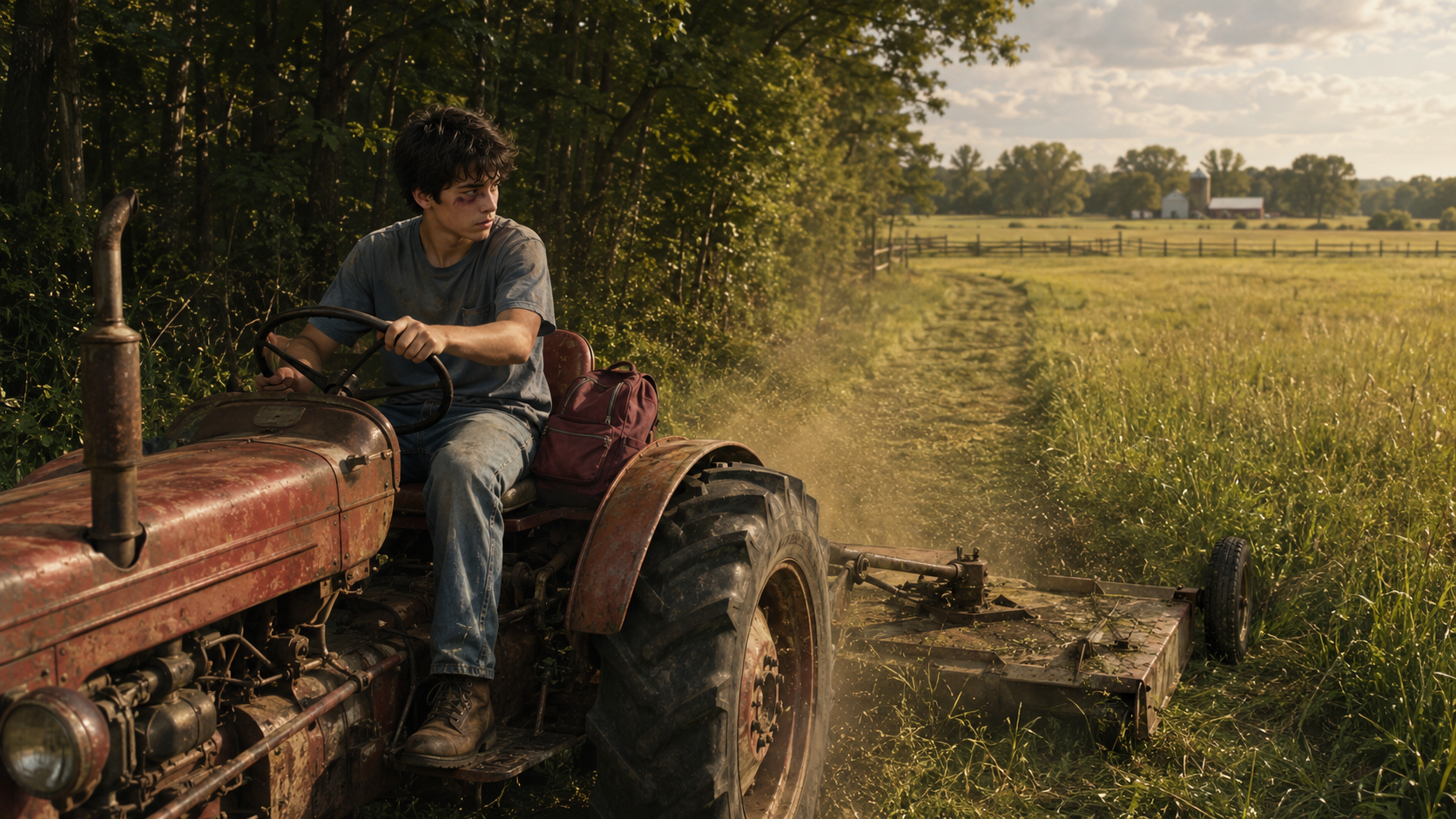
Sagen had already started the tractor when Tomas reached the equipment shed.
The mower attachment rattled behind it. Tall grass moved in the wind across the back field.
Sagen pointed toward the passenger step.
“You ride until we clear the fence line. Then you take over.”
Tomas climbed up and settled Red across his lap.
Sagen looked at the bookbag.
Then at Tomas.
He didn’t ask.
People on the farm knew when questions were worth the answers they might receive.
The tractor entered the field.
Grass folded beneath the mower. The engine drowned everything beneath a steady mechanical roar.
They had completed one long pass when engines sounded from the direction of the main drive.
Even over the tractor, Tomas heard them.
Sagen did too.
He stopped the machine.
The mower blades wound down.
Silence returned in pieces.
First insects.
Then wind.
Then the slow approach of vehicles over gravel.
Tomas looked toward the house.
Dust rose above the tree line.
One engine.
Then another.
Then a third.
Sagen climbed down from the tractor.
“That ain’t the school board.”
Three cruisers appeared around the bend.
No sirens.
No lights.
They moved slowly, evenly spaced.
Casual, if someone didn’t know what casual looked like when it was being performed.
A fourth vehicle followed.
Unmarked.
Government gray.
The kind that didn’t bother pretending.
Across the farm, work slowed.
Then stopped.
Eljen rested both arms on the fence.
Berezina appeared in the kitchen doorway.
Jose brought his horse to a standstill and held the reins close.
Marleen joined Kay on the porch.
The cruisers rolled into the yard and stopped short of the house. Angled away from the drive. Not blocking it.
Not aggressive.
Controlled.
Like the people inside expected to be invited forward.
Doors opened.
One at a time.
Boots struck gravel.
No one hurried.
No radios crackled.
Tomas felt Red go still against his lap.
“These aren’t local cops,” Tomas said.
Sagen looked toward Kay.
“No.”
Kay stepped fully onto the porch.
One boot rested on the top step.
Her shoulders squared.
She didn’t wave.
She didn’t retreat.
She waited.
The first man started toward her.
Tomas watched from the silent tractor, his headache returning one measured pulse at a time.
The visit wasn’t about vandalism.
It wasn’t about the school.
Something had followed them home.
Around the fire
Join the conversation.
Reader comments appear only after T. G. Bonfire approves them. That keeps this space thoughtful, human, and free of noise.