Chapter 7
Manhood’s Overrated
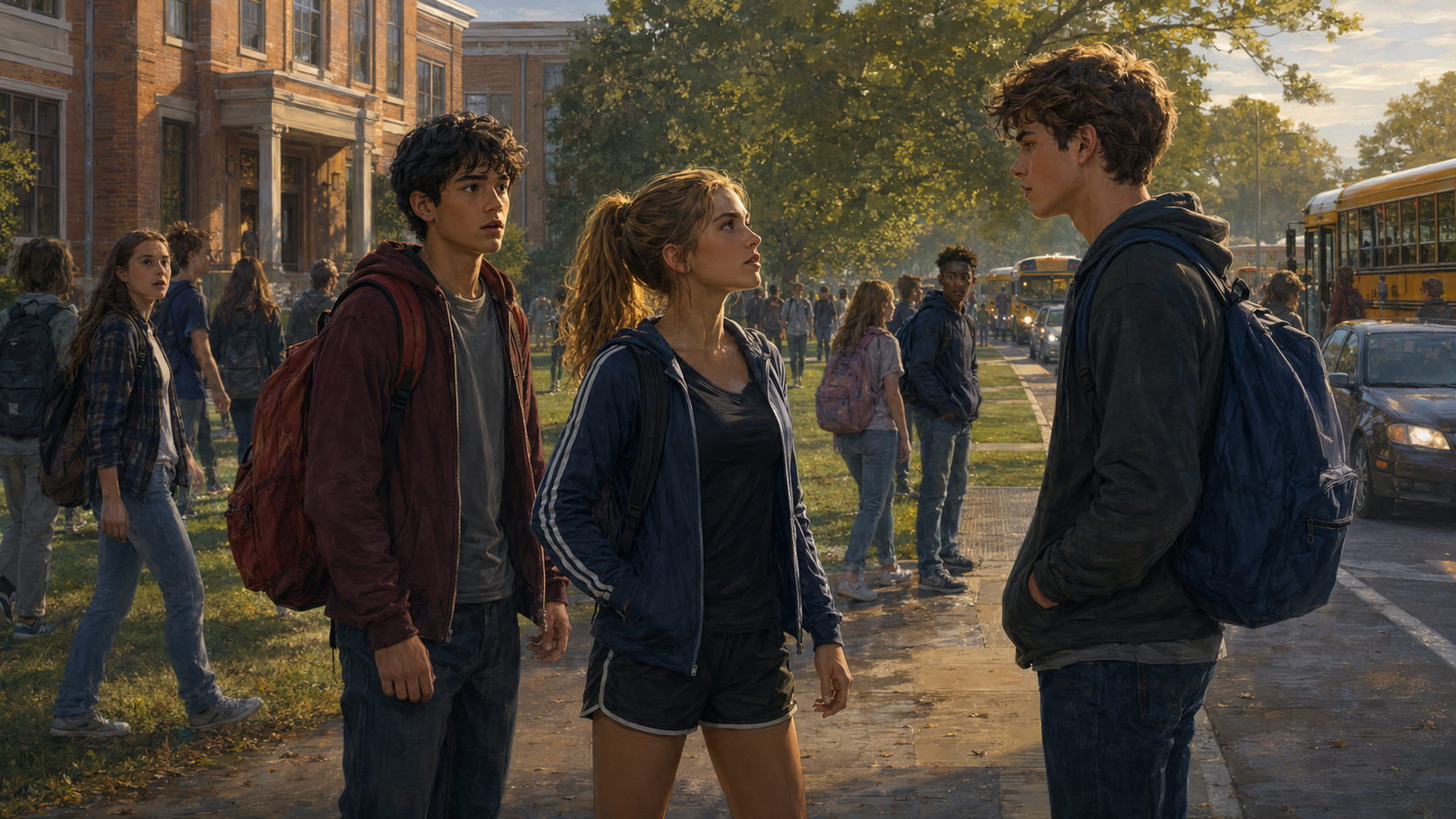
Five days after the markings disappeared—and on the morning Tomas’s suspension finally ended—he woke to shouting in the backyard.
At first, the noise tangled itself into whatever he’d been dreaming. Then someone yelled Kay’s name. A door slammed downstairs. Chairs scraped across the kitchen floor, followed by the pounding of boots heading toward the barn.
Tomas sat up.
Whatever was happening, it wasn’t good.
He leaned over the side of the bed.
Red lay slumped on the floor, zipped shut and silent.
Another shout carried across the yard.
Tomas pulled on jeans and a sweatshirt, then splashed water on his face. When he came out of the bathroom, Red was sitting upright on the bed.
Good morning.
“Morning.”
Any idea why everyone’s yelling?
“I think the horses got loose.”
Red didn’t answer.
That should have worried him.
Tomas lifted the strap over his shoulder. “Want breakfast?”
Poached egg. Two slices of toast—heavy on the butter. Jam. Sliced oranges. Four strips of bacon.
“Poptart it is.”
You asked what I wanted.
“And then I remembered who was cooking.”
The kitchen was empty.
No coffee brewing. No Marleen arguing with Eljen. No Sagen leaning against the counter while Kay pretended not to listen to whatever story he was telling.
Only the refrigerator hummed.
Tomas grabbed a Poptart from the pantry and headed outside.
The noise led him to the barn.
Kay stood in the center aisle with her arms folded. She wore yesterday’s jeans and a sweatshirt she hadn’t bothered to zip. Sagen faced her, his shoulders stiff. José stood near one of the stalls with his hat crushed between his hands.
The others had gathered behind them.
“Tell me again,” Kay said.
Sagen took a breath. “Six are missing.”
“And the others?”
Sagen looked toward José.
José lowered his eyes. “The other six are dead.”
Silence dropped over the barn.
Kay stared at him. “All six?”
“Sí.”
“Show me.”
She followed José toward the stalls.
Tomas started after them.
Kay caught him with one hand against his chest. “No.”
“I can help.”
“Not with this.”
“Mom—”
“Stay here.”
Marleen lingered at the stall entrance. She gave Tomas an apologetic look before pulling the door closed behind her.
A moment later, someone inside whispered, “Oh, God.”
Tomas stared at the closed door.
The barn smelled the same as it always had—hay, leather, manure, old wood—but something beneath those smells made the back of his throat tighten.
He set the uneaten half of his Poptart on a barrel.
At the front of the barn, the loft door stood open. The pulley rope swayed gently.
Red tightened against his back.
This wasn’t meant for animals.
“I know.”
Tomas grabbed the rope and climbed.
He pulled himself into the loft, crawled past the stacked hay bales and crouched beside the narrow stairs overlooking the stalls.
Below him, Kay moved from one body to the next.
Tomas could see only parts of them through the rails. A pale leg. Cinnamon’s white muzzle. Tuffy Hardnose’s black mane spread across the dirt.
None of them moved.
“Which ones?” Kay asked.
José’s voice shook as he answered. “Tuffy Hardnose. Sundancer. Noel. Cinnamon. Rio. Penny Moon.”
“And the missing six?”
“Slow Gin. Clyde. Max. Dove. Charlie Dear. Sissy Skipper.”
“Pairs,” Eljen said.
Kay turned toward him.
Eljen nodded toward the stalls. “Three pairs here. Three pairs gone.”
Sagen crouched beside Tuffy Hardnose. “No broken locks. No cut chains. Nothing forced.”
“Wounds?” Kay asked.
“Nothing I can find.”
“All six horses just dropped dead?”
“No,” Sagen said. “Horses don’t just do anything six at a time.”
Kay looked at Marleen. “What do you think?”
Marleen folded her arms. “I think somebody wanted us to wake up and find this.”
“That isn’t what I asked.”
“No,” Marleen said. “It’s what I know.”
Sagen rose. Dirt clung to one knee. “Could be connected to the delivery we refused.”
Kay’s head snapped toward him. “We’re not discussing that here.”
“We changed the arrangement,” he said. “Someone might be changing it back.”
“By killing horses?”
“By sending a message.”
Kay looked around the barn. Her gaze touched every stall, every open door and every person standing in the aisle.
“What kind of message takes six and leaves six?” she asked.
No one answered.
José crossed himself.
Red shifted against Tomas’s back.
Pairs matter.
Tomas whispered, “Why?”
I don’t remember.
That frightened Tomas more than if Red had given him an answer.
Below, Kay rubbed both hands over her face.
“We find the missing horses,” she said. “That comes first.”
Sagen nodded. “José and Eljen can check the roads and neighboring properties. Marleen and Berezina can start calling around.”
“No police,” Kay said.
Sagen studied her. “Wasn’t planning on it.”
“If anyone asks, a gate was left open.”
“It wasn’t.”
“I know.”
Sagen glanced toward the dead horses. “People will ask about these too.”
“Then give them an answer they can live with.”
Something moved beneath Tomas’s hand.
The wooden railing creaked.
Kay lifted her head.
Her gaze traveled straight to the loft.
“Tomas.”
He winced.
“Time for school.”
She always knows.
“She’s a mother. It’s unnatural.”
Unlike a talking bookbag.
“That’s different.”
Of course it is.
Kay continued staring up at him.
Tomas climbed down.
No one looked at him as he crossed the aisle. That felt worse than being told to leave.
Today was his first day back after the suspension. He’d imagined Kay driving him to school with a lecture about avoiding Bryce, staying away from Courtney and not giving Coach Chad another excuse to blame him for something.
Instead, she drove with both hands locked around the steering wheel.
Her phone sat faceup in the cupholder. It lit up every few minutes with calls and messages she refused to answer in front of him.
She checked the rearview mirror twice before they reached the main road.
Tomas waited until the school appeared ahead of them.
“Do you think Courtney did it?”
Kay’s hands tightened.
“I was going to ask you the same thing.”
“She didn’t.”
“You sound sure.”
“I am.”
Kay pulled to the curb. Students streamed around the truck, laughing and shoving one another as they headed inside.
“What makes you so sure?” she asked.
Tomas rested one hand on Red’s strap. “She wouldn’t hurt the horses.”
“You’ve known her for what? A week?”
“She wouldn’t.”
Kay studied him long enough to make him uncomfortable.
Then she nodded once. “All right.”
“That’s it?”
“That’s it.”
“You believe me?”
“I believe you believe her.”
That wasn’t the same thing, but it was probably all he was going to get.
Tomas opened the door.
“Tomas.”
He looked back.
“If anything strange happens today, you call me.”
He glanced down at Red.
Kay followed his gaze.
“Anything else strange,” she amended.
Tomas climbed out and shut the door.
The truck stayed at the curb until he entered the school grounds.
“Do you think Courtney did it?” Tomas asked.
No.
“Do you think the Collector did?”
Yes.
Tomas stopped walking.
A group of students split around him without looking up from their phones.
“Really?”
Probably.
“That isn’t yes.”
It was yes-adjacent.
“Do you know or not?”
Red went quiet.
No. I don’t know.
Tomas resumed walking.
The pairs bother me.
“Why?”
Collectors like patterns. Repetition. Balance. They take things apart in ways that mean something to them.
“So it was the Collector.”
I didn’t say that.
“You just said—”
People like patterns too. Especially people who want you to think they’re something more than people.
Tomas frowned. “Could somebody know about the Collector?”
Your mother knows something happened at the school. The principal has photographs. Half the town has probably heard a version by now. Secrets don’t stay secret simply because everyone agrees to misname them.
Before Tomas could answer, someone shoved him between the shoulders.
Not hard enough to knock him down. Hard enough to remind him it could have been.
“Talking to yourself again?”
Bryce walked beside him, flanked by two boys Tomas recognized but didn’t know well enough to hate by name.
“Nothing wrong with that,” Bryce said. “Probably the only person who can stand him.”
The boys laughed.
Tomas kept walking.
Bryce bumped his shoulder.
Tomas stopped.
Red’s strap tightened around his hand.
Keep walking.
Tomas turned.
“Hey, Bryce.”
Bryce looked almost pleased. “What?”
“Bite me.”
The words landed harder than Tomas expected.
One of Bryce’s friends made an impressed sound. The other stepped back.
Bryce’s smile vanished.
He took one step toward Tomas.
The first bell rang.
Students surged through the doors around them.
Bryce pointed at him. “Lucky.”
Then he turned and followed his friends inside.
Tomas released a breath.
Bite me?
“Shut up.”
What year do you think this is?
“It worked.”
Only because the bell rescued you from the consequences of your dated material.
“I wasn’t trying to be current.”
Clearly.
Tomas adjusted Red’s strap.
For future reference, if you open with bite me, you need a stronger closing line than shut up.
“Shut your face.”
Too late. The scene is over.
“You’re unbearable.”
I’m editorially supportive.
Tomas entered the main hall and nearly collided with Courtney.
“I’m not supposed to talk to you,” he said.
She fell into step beside him. “You’re doing a terrible job.”
“You’re not even a student here.”
“I’m auditing.”
“High school?”
“I’m thorough.”
“You keep walking into the building like you belong here.”
“People see what they expect to see.”
Tomas looked at her.
Courtney’s expression didn’t change, but the words felt deliberate.
They passed the trophy case.
“Something happened at the farm,” Tomas said.
The humor disappeared from her face. “What?”
“Six horses died. Six more are missing.”
Courtney stopped.
Students streamed around them, complaining about homework and the smell coming from the cafeteria.
“The ones that died were left in pairs,” Tomas continued. “The missing ones were taken in pairs.”
“Were there marks?”
“On the horses?”
“Anywhere. Stalls, gates, trees.”
“I don’t know. No one let me close enough to see.”
Courtney looked toward Red.
Red gave no sign that he noticed.
“You think the Collector did it,” Tomas said.
“I think he could have.”
“That isn’t an answer.”
“It’s the only one I have.”
“My mother thinks it has something to do with a delivery she refused.”
Courtney’s eyes narrowed. “What kind of delivery?”
“I don’t know. She wouldn’t say.”
“Then we have two possibilities.”
“At least.”
Courtney started walking again.
“The markings at the school might tell us more,” she said.
“We erased them.”
“You erased the paint. Mr. Duong photographed the claim before it disappeared.”
“So?”
“The first images matter.”
“Why?”
“They were made while the claim was still active. They may have caught more than its shape.”
“Like what?”
“Intent. Residue. Whatever was pressed into the markings when they were made.”
Tomas glanced around the crowded hallway. “They’re pictures.”
“People used to say the same thing about mirrors.”
“That doesn’t explain anything.”
“The first prints may carry part of the claim. Copies won’t. A copy remembers the lines. The original remembers what made them.”
“You want to steal evidence from the principal’s office.”
“I want to examine it.”
“And then return it?”
Courtney considered that.
“Eventually.”
“No.”
“We need those photographs.”
“No, you need them. I need to stay out of trouble for more than fifteen minutes.”
Courtney walked several steps without speaking.
Then she said, “I can’t get them alone.”
Tomas kept his eyes forward.
“The school hired someone to patrol the building after hours,” she continued. “And if the Collector is watching the claim—”
“You think he might come back.”
“I think he might already be here.”
Red moved against Tomas’s back.
Courtney looked at him. “I need both of you.”
“I said no.”
“The Collector killed my family.”
Tomas stopped.
Courtney kept walking.
“What?”
She didn’t turn around.
“Courtney.”
She disappeared into the crowd before he could catch her.
The words followed him through every class.
The Collector killed my family.
By lunch, Tomas had repeated them so many times they barely sounded like words. By the final bell, they had become something heavy and shapeless lodged behind his eyes.
“What do you think she meant?” he asked Red as they crossed the quad.
I think she meant the Collector killed her family.
“That isn’t helpful.”
It’s accurate.
“Have you heard of that happening before?”
Red didn’t answer immediately.
Students hurried past them toward the buses. Tomas stopped near a tree and waited.
“Red?”
Keepers don’t have families.
“What does that mean?”
They don’t form attachments outside the stones they protect. They can’t.
“Can’t, or aren’t supposed to?”
Another pause.
I don’t know.
“So Courtney lied.”
Or Courtney had a family when she shouldn’t have.
“Why is that worse?”
Because rules like that usually exist after someone learns why they’re necessary.
Across the quad, Courtney waited beside the main building.
When she saw Tomas looking, she pushed away from the wall.
“You came,” she said.
“I didn’t say I was helping.”
“You walked to the office instead of the bus.”
“I’m curious.”
“That’s how helping starts.”
Tomas lowered his voice. “If we get caught, you’re explaining this to my mother.”
“I’d rather face the Collector.”
“That can be arranged.”
The school emptied around them. Doors slammed. Engines started. The noise gradually thinned until their footsteps sounded too loud in the hall.
Courtney nodded toward the office.
Diane Donnelly sat behind the front desk, sorting papers into neat stacks. Her glasses rested low on her nose. A mug beside her read KEEP CALM AND FOLLOW PROCEDURE.
“We need to get her away from the desk,” Courtney whispered.
“How?”
“You go in and faint.”
“No.”
“Fake a seizure.”
“Absolutely not.”
“You lack commitment.”
“And you have too much.”
Diane looked up.
“May I help you?”
Tomas and Courtney stepped inside.
“We’re waiting for Coach Chad,” Courtney said.
Diane’s eyes moved between them. “Coach Chad has gone home.”
“He said he wanted to talk to us here.”
“About what?”
Courtney opened her mouth.
A metal crash erupted from the hall.
Diane stood.
Mr. Gramble appeared in the office doorway carrying a split cardboard box. Folders, pens and several heavy rings of keys lay scattered across the floor behind him.
“Faulty bottom,” he said.
Diane stared at the mess. “Why do you have those keys?”
Mr. Gramble looked down as if noticing them for the first time. “Found them.”
“Those belong to maintenance.”
“Then I suppose maintenance has lost them.”
Diane came around the desk. “You cannot walk through the school with keys you found lying around.”
“Why not?”
“Because they open things.”
Mr. Gramble glanced at Tomas.
His expression remained blank, but one eyebrow lifted.
“Do they?” he asked.
Diane pushed past him into the hall. “Where exactly did you find them?”
Mr. Gramble followed her, kicking a folder farther down the corridor as he went.
“Near a locker.”
“Which locker?”
“One of the blue ones.”
“They’re all blue.”
“That narrows it down.”
Diane’s voice sharpened as they moved away. “Mr. Gramble.”
Courtney looked at Tomas.
“That was convenient,” she said.
“Too convenient.”
You can investigate his motives after we finish committing the crime he just made possible.
They slipped behind the desk and entered Mr. Duong’s office.
Courtney shut the door.
“Where?” she asked.
“Middle drawer.”
Tomas pulled it open.
A thick folder lay on top of the others. His name was printed on the tab.
“Of course I have a file.”
You have several.
“That doesn’t make me feel better.”
He opened it.
Disciplinary reports filled the front half. Most contained words like disruptive, uncooperative and aggressive. None mentioned Bryce unless it was to say Tomas had provoked him.
Behind them were photographs of the markings.
Courtney leaned over his shoulder.
“Those,” she said.
Tomas lifted the prints free.
The symbols looked worse on paper.
Black lines crossed one another at angles his eyes couldn’t comfortably follow. In several photographs, the wall around the markings appeared darker than it should have been, as if the camera had captured a shadow without anything to cast it.
Courtney touched one corner.
The overhead light flickered.
“These are the first prints,” she whispered.
“How can you tell?”
“They still remember.”
Footsteps sounded outside.
Someone’s coming.
Tomas returned the folder to the drawer.
Courtney tucked the photographs under her jacket.
They stepped into the main office just as Diane returned.
Mr. Gramble followed several paces behind her, carrying the repaired box. The rings of keys were gone.
Diane stopped.
“What were you doing in there?”
“Waiting for Coach Chad,” Courtney said.
“I told you he went home.”
“We thought he might come back.”
“No, you didn’t.”
Mr. Gramble set the box on Diane’s desk.
A pen rolled off the top.
Diane snatched it before it hit the floor.
“Don’t you two move,” she said. “I’m calling Mr. Duong.”
Mr. Gramble peered into the box. “That one isn’t mine.”
Diane looked down despite herself.
Courtney grabbed Tomas’s wrist.
They ran.
Diane shouted after them, but they were through the doors before she finished saying Tomas’s name.
They didn’t laugh until they were halfway across the quad.
Courtney pulled the photographs from beneath her jacket and examined them while walking.
“You could at least pretend that was fun,” Tomas said.
“It wasn’t.”
“We committed theft with the help of a man who steals from lockers.”
“He didn’t help us.”
“He dropped a box full of keys and argued with Mrs. Donnelly until we were done.”
“Diane.”
“What?”
“Her name is Diane.”
“Why do you know that?”
“I pay attention.”
“You walked into a high school that you don’t attend and stole supernatural graffiti from the principal. Don’t act normal now.”
Something slammed into Tomas’s chest.
He staggered backward.
Red slipped from his shoulder and hit the pavement.
Oh, no.
Bryce stood in front of him.
“What’s so funny?” Bryce asked.
Two boys waited several feet behind him.
Tomas rubbed his chest. “Nothing.”
Bryce’s gaze settled on Courtney. “He tell you what he said to me this morning?”
“I heard him.”
“You thought that was funny?”
“No,” Courtney said. “I thought it was overdue.”
Bryce smiled, but his eyes didn’t.
He reached for the photographs.
Courtney pulled them away.
Bryce caught the top one and yanked.
The prints scattered across the pavement.
“What are these?” he asked.
“None of your business,” Tomas said.
A muffled buzz came from Bryce’s jacket pocket.
Bryce slapped one hand over it.
For an instant, something changed in his face. Not embarrassment. Alarm.
Then the buzzing stopped.
Tomas remembered the prepaid phone packaging in Bryce’s locker. Mr. Gramble’s voice came back to him.
He goes through phones.
Bryce noticed Tomas looking at his pocket.
“What?” he demanded.
“Nothing.”
“Quit saying that.”
“Then quit asking questions you don’t want answered.”
Bryce stepped closer.
His fist came back.
Tomas moved.
The punch passed his cheek close enough for him to feel the air shift.
For a second, they both looked surprised.
Bryce swung again.
Tomas ducked.
It wasn’t graceful. He nearly tripped over Red and had to throw out one hand to keep from falling.
But he hadn’t stood still.
He hadn’t let Bryce hit him.
Bryce swore and shoved him instead.
Tomas went down hard.
Courtney caught Bryce by the shoulder and pulled. His heel struck Red. The bookbag gave a small, deliberate twist beneath his foot.
Bryce lost his balance.
He hit the pavement.
Courtney dropped onto him and punched him in the nose.
Bryce cried out and shoved her away. He scrambled upright with blood running over his lip.
“You’re dead,” he said.
Statistically unlikely.
Bryce grabbed the photographs from the ground.
Courtney lunged.
He tore the stack in half.
Then he tore it again.
Pieces fluttered across the pavement.
Courtney froze.
Bryce wiped his nose on his sleeve.
“This isn’t over,” he said.
His jacket buzzed again.
He pressed his arm tightly against his side and hurried toward the street, his two friends following.
Tomas got to his feet.
“I had that under control.”
Courtney didn’t answer.
She knelt and began gathering the pieces. Her hands shook as she matched torn edges.
“They’re only paper,” Tomas said. “We can tape them.”
“No.”
“We can still see the markings.”
“The claim was already fading.” Courtney held up two pieces that had once been a single photograph. “Breaking the image breaks what remained attached to it.”
“So we make copies.”
“A copy remembers the shape. Not the intent.”
Red pulled himself closer.
That seems unnecessarily complicated.
Courtney looked at him. “The laws weren’t created for your convenience.”
Then I object to the laws.
Tomas crouched beside Courtney.
“Can you read any of it?”
She fitted two pieces together.
“Some.”
“What does it say?”
“I don’t know yet.”
“You said you could read it.”
“I said some.”
She turned one fragment sideways. A dark symbol crossed the glossy paper like the forked limb of a tree.
“This could mean fire,” she said.
Tomas’s stomach tightened.
“Could?”
“Fire. Cleansing. Hunger. There are differences in the complete mark, but Bryce tore through the part I need.”
“Could it mean burned?”
Courtney looked up.
Neither of them spoke.
Tomas thought about the horses lying in the barn. The six missing in pairs. The faint wrongness beneath the familiar smells.
Courtney shoved the pieces into her jacket pocket.
“What else?” he asked.
“I need time.”
“You don’t have to do it alone.”
Her expression closed.
“The Collector killed my family,” Tomas said. “That’s what you told me.”
“I know what I said.”
“Red says Keepers don’t have families.”
Courtney went still.
“So either you’re lying,” Tomas continued, “or you broke some Keeper rule you haven’t told us about.”
For a second, he thought she might answer.
Instead, she stood.
“I can’t talk about this.”
“You keep saying that.”
“Because you keep asking questions I can’t answer.”
“Can’t or won’t?”
Courtney took one step back.
Her face remained controlled, but her eyes didn’t. Fear lived there. So did anger. Tomas couldn’t tell which one was aimed at him.
“Thank you for helping,” she said.
Then she turned and walked away.
“Courtney.”
She didn’t stop.
She crossed the empty quad and disappeared between the buildings.
That went well, Red said.
An engine idled near the curb.
Eljen leaned against his truck with one boot propped on the bumper. His straw cowboy hat sat low over his eyes.
Tomas lifted Red from the pavement and carried him to the truck.
“I thought your mama told you to stay away from that girl,” Eljen said.
“She did.”
“And yet.”
Tomas shrugged.
Eljen opened the passenger door. “Saw that big boy get handsy with you.”
“It was nothing.”
“Didn’t look like nothing.”
“It’s handled.”
Eljen glanced in the direction Courtney had gone. “Looked like she handled most of it.”
“She surprised him.”
“Sure.”
Tomas climbed into the truck. “Why are you here?”
“I was driving by.”
“Eljen.”
“Your mama asked me to make sure you got home.”
“So you were watching me.”
“I was in the general area while facing this direction.”
“That’s watching.”
“Call it what you want.”
Red landed between Tomas’s boots.
I’d call it watching.
The truck rumbled away from the curb.
The radio played an old song about bad roads, loaded guns and a woman who knew better than to wait at home.
Red settled against Tomas’s ankle.
Music for men who solve problems with fists and regret.
Tomas watched the school shrink in the side mirror.
“Did you find the horses?”
Eljen turned the radio down.
“No.”
“Do you know who took them?”
Eljen kept his eyes on the road.
“It’s okay,” Tomas said. “You probably can’t tell me anyway.”
“Your mama would skin me alive for saying half the things I’ve already said to you.”
“She isn’t here.”
“That’s never stopped her before.”
“Eljen.”
He exhaled.
“Your mama crossed a bad hombre,” he said.
Tomas waited.
“The kind that doesn’t scare easy. She refused a job, and now someone wants her to regret it.”
“You think he killed the horses?”
“I think your mama refused a job. I think someone wants her to regret it.”
“That isn’t what I asked.”
“It’s the only answer I’ve got.”
Tomas looked out the window.
Fields rolled past in long strips of green and brown. Fence posts flickered beside the road.
“Could a person kill six horses without leaving a mark?”
Eljen’s jaw moved.
“People can do nearly anything if they want it bad enough.”
“That still isn’t an answer.”
“No,” Eljen said. “It isn’t.”
Dinner happened because it had to.
Food was cooked. Plates were filled. Forks scraped against ceramic. No one complained, and no one asked for seconds.
The search continued outside. Every few minutes, someone came in to use the phone, grab a flashlight or report another road that had turned up nothing.
Eljen broke the silence halfway through a mouthful of baked beans.
“Reminds me of that Detroit job. Remember those two Yankees?”
Marleen kicked him beneath the table.
Eljen jerked.
“Never mind,” he said.
No one asked.
After dinner, no one went home.
The farm remained awake as darkness gathered. Boots crossed the hall. The screen door opened and closed. Engines started in the yard, disappeared down the road and returned twenty minutes later.
Tomas caught fragments of conversation.
Routes.
Contacts.
A rejected shipment.
Someone who didn’t accept no.
None of it stayed together long enough to become an explanation.
He went upstairs and lay on his bed.
Red sat near his feet.
What are you thinking about?
“Everything.”
That seems inefficient.
“I don’t know who killed the horses. I don’t know where the others are. I don’t know what my mother is involved in. I don’t know what Courtney meant about her family.”
That is a lot of not knowing.
“You aren’t helping.”
I don’t know enough to help.
“That’s never stopped you before.”
Red’s front pocket lifted slightly, then dropped.
Courtney was frightened.
“She didn’t look frightened.”
People rarely look like the thing they’re trying not to be.
Tomas rolled onto his side.
“Do you believe her?”
About her family?
“Yes.”
A long silence passed.
I believe she believes it.
“That sounds like something my mother would say.”
Your mother is an intelligent woman.
“She threatened to cut you open.”
Intelligence doesn’t guarantee good judgment.
Tomas heard a sound downstairs.
At first, he thought it was a chair dragging across the kitchen floor.
Then he heard it again.
Someone was crying.
He got off the bed.
Two steps from the door, he stopped.
Red waited behind him.
Tomas returned, picked him up and carried him downstairs.
Learning, Red said.
“Don’t make a thing out of it.”
I make a thing out of everything.
The kitchen smelled like coffee that had burned hours ago.
Tomas poured a glass of water.
The crying came from the porch.
He looked at Red.
Red’s zipper tilted toward the door.
Go.
“I want to talk to her alone.”
Then I’ll be quiet.
“That isn’t the same.”
Tomas set Red on a kitchen chair and turned him toward the wall.
He kept one hand on the strap.
Light pulsed faintly through the seams.
He had felt it before—the connection running between them, a pressure with no shape. Red was always somewhere behind his thoughts now. Not reading them exactly, but near enough to know when one sharpened.
Tomas wanted distance.
Only for a minute.
He pressed his thumb into the canvas.
The pressure behind his eyes bloomed.
What are you—
“Quiet,” Tomas whispered.
Something gave way.
The connection didn’t break. It folded.
Red’s voice vanished.
Tomas snatched his hand back.
The bookbag remained upright on the chair.
A dim rose-colored light glowed around the zipper.
Tomas stared.
He hadn’t known what he was doing. He still didn’t.
But for the first time since the stones had awakened, the inside of his head belonged only to him.
The silence felt wonderful.
Then it felt wrong.
“I’ll be right outside,” he said.
Red didn’t answer.
Tomas left the kitchen light on and stepped onto the porch.
Kay sat alone on the swing.
Her hands were knotted in her lap. The swing moved in short, uneven arcs.
She wiped her face when she saw him.
“Hey,” Tomas said.
“Hey.”
“You okay?”
“Everything’s fine.”
Her smile appeared too quickly and disappeared just as fast.
“What are you doing awake?”
“Couldn’t sleep.”
“It’s not late.”
“I’m planning ahead.”
Kay almost smiled.
Almost.
Tomas sat beside her.
For a while, neither of them spoke. Crickets chirped beneath the porch. Farther out, an engine moved along one of the farm roads.
“There’s bourbon in the cabinet,” Kay said. “If you want a splash.”
Tomas looked at her.
She kept her gaze on the yard.
“I’m fifteen.”
“I know how old you are.”
“I don’t want bourbon.”
“Good.”
“Were you going to give it to me?”
“No.”
“Then why did you offer?”
Kay rubbed her palms against her jeans. “Seemed like something to say.”
“You could tell me what’s happening.”
“I could.”
“But you won’t.”
“No.”
Tomas took a drink of water.
“Who would hurt the horses?”
“Someone’s idea of a bad prank.”
“That wasn’t a prank.”
Kay’s jaw tightened.
“Eljen told me you refused a job.”
Her head turned sharply.
“He shouldn’t have told you that.”
“He didn’t tell me much.”
“He told you enough.”
“Was it drugs?”
Kay looked toward the pasture.
“We move things,” she said. “Sometimes people mistake that for ownership.”
“What does that mean?”
“It means I decide what crosses my property. I decide what goes in my trucks. Someone disagreed.”
“And now the horses are dead.”
“We don’t know that it’s connected.”
“You think it is.”
“I think a lot of things. Thinking doesn’t make them true.”
Tomas stared out into the darkness.
“Could Courtney have done it?” Kay asked.
“No.”
“What about whatever is after that bag?”
Tomas looked through the kitchen window.
Red’s outline sat motionless on the chair.
“I don’t know.”
Kay nodded.
It seemed to be the answer everyone had reached.
Headlights appeared beyond the pasture.
A truck bounced over the north trail and came toward the house too fast.
Kay stood before Tomas heard the engine clearly.
The truck stopped near the barn.
Sagen climbed out.
He didn’t run, but something about the way he crossed the yard made Kay reach beneath her sweatshirt.
Her hand closed around the pistol at her waist.
Tomas hadn’t noticed it before.
Sagen stopped at the bottom of the porch steps.
“We found the missing six,” he said.
Kay’s hand remained on the gun. “Alive?”
Sagen removed his hat.
No one spoke.
“Where?” Kay asked.
“Old clearing beyond the north trail. Other side of the creek.”
“What happened?”
“Burned.”
The word barely sounded real.
Kay gripped the porch railing.
“All of them?”
“Yes.”
“How?”
“Smells like gasoline. Chains left around two of them. Ground’s torn up.”
“Tracks?”
“Too many. Truck tires. Boots. Horse prints. Some lead into the clearing. Some lead out and circle back.”
“Could you follow them?”
Sagen shook his head. “Looks like somebody wanted us to find tracks more than they wanted us to follow them.”
“Staged,” Kay said.
“Maybe.”
“Or exactly what it looks like.”
“Maybe that too.”
Tomas’s mouth had gone dry.
“Who did it?” he asked.
Sagen looked at him.
“I don’t know.”
“Was it the man Mom crossed?”
“Tomas,” Kay warned.
“Was it?”
Sagen put his hat back on. “It was a message.”
“That isn’t what I asked.”
“It’s what I found.”
The wind shifted.
A bitter smell reached the porch. Smoke, gasoline and something thick beneath both.
Tomas gagged.
Kay closed her eyes.
When she opened them, there were no tears left.
“Get everyone inside,” she told Sagen. “No one stays alone tonight.”
Sagen nodded.
“Leave two trucks near the main road. Kill the lights in the south barn. Anyone comes through the gate, I want to know before they reach the house.”
He headed toward the bunkhouse.
Kay went inside without looking at Tomas.
The screen door closed behind her.
Tomas remained on the porch.
Beyond the pasture, a thin smear of smoke darkened the stars.
Something cried out near the tree line.
It might have been a bird.
It might have been laughter.
It might have been neither.
Tomas hurried into the kitchen.
Red sat where he had left him, turned toward the wall.
The light around his zipper had weakened.
Tomas placed one hand against the canvas.
He didn’t know how he had folded the connection away. He didn’t know how to bring it back.
He thought of Red’s voice.
He thought of noise.
He thought of not being alone.
The barrier collapsed.
Pain stabbed behind Tomas’s eyes.
Red’s voice struck him at the same moment.
You shut me out.
“I didn’t know I could.”
Neither did I.
Tomas turned Red around.
“I only wanted to talk to her privately.”
You could have asked me not to listen.
“Would you have?”
That isn’t the point.
“They found the missing horses.”
Red went still.
“Someone burned them.”
The light beneath the zipper pulsed once.
All six?
Tomas nodded.
“Was it the Collector?”
For once, Red didn’t make a joke. He didn’t offer a guess and pretend it was certainty.
I don’t know.
“Courtney thinks the markings were connected.”
They might have been.
“My mother thinks it was retaliation for refusing a delivery.”
She might be right.
“Which is it?”
Red’s strap curled around Tomas’s wrist.
Maybe the Collector left the claim and someone else answered it. Maybe one enemy wants you to blame the other.
“That doesn’t help.”
The truth doesn’t become helpful simply because you need it to.
Tomas looked through the window.
Kay crossed the yard with her pistol visible. Sagen moved in the opposite direction carrying a rifle. Lights went dark across the farm one building at a time.
“Is this my fault?” Tomas asked.
Red’s strap tightened.
I don’t know that either.
Two different monsters were circling the house.
One had killed the horses.
Tomas didn’t know which.
Around the fire
Join the conversation.
Reader comments appear only after T. G. Bonfire approves them. That keeps this space thoughtful, human, and free of noise.