Chapter 1
Good Intentions
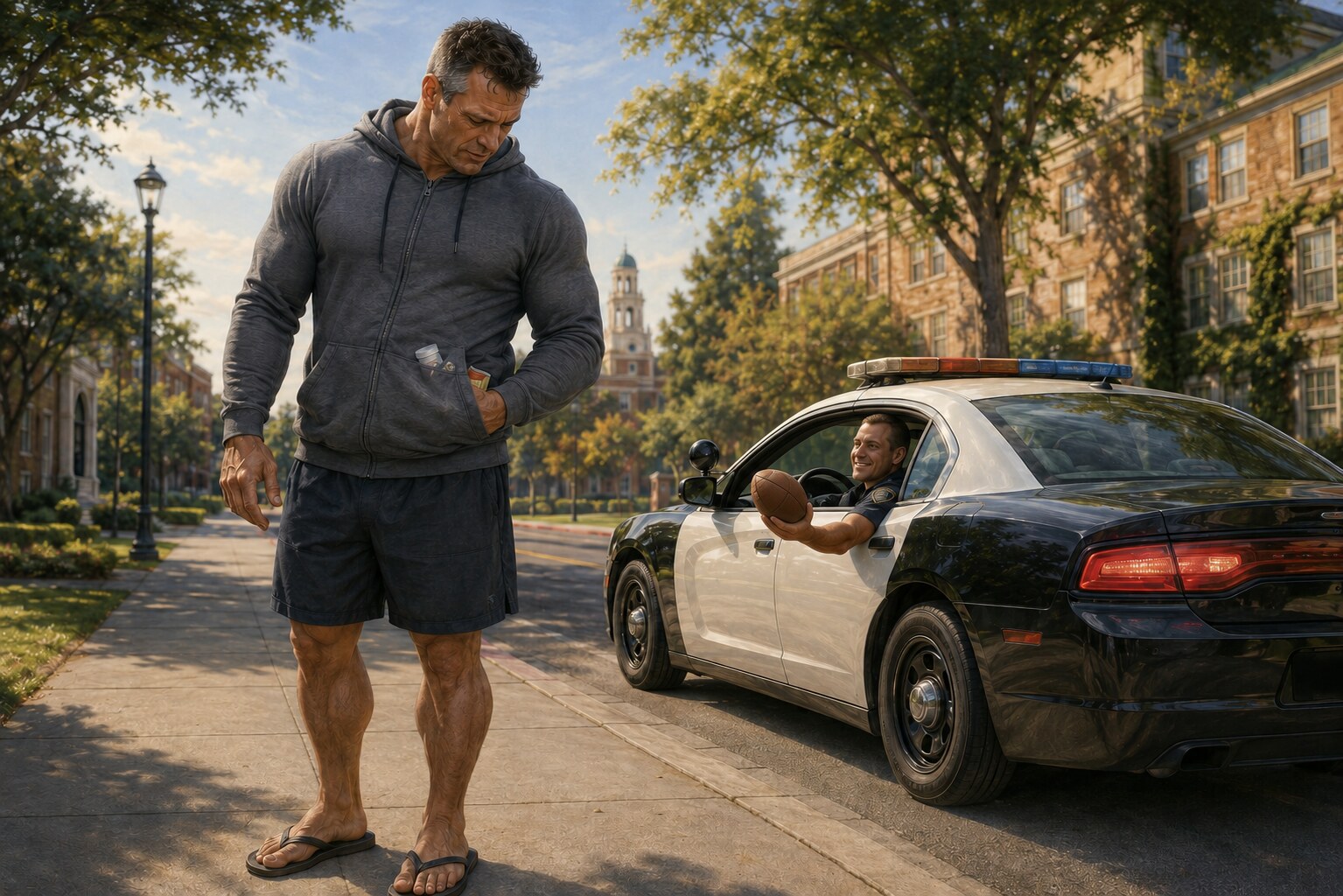
I have always enjoyed the sunshine.
Not in some postcard, toes-in-the-sand, tropical-drink kind of way. I’m talking about honest sunshine. The kind that finds your face before you’re fully awake. The kind that seeps into your pores and reminds your old bones they’re still useful.
I’ve always liked that.
If I wasn’t such an exceptionally gifted specimen of finely tuned athletic superiority, I might’ve been a poet.
At least that’s what I tell myself on mornings like this.
Then again, if I were a poet, I’d probably be broke, divorced, and living in a studio apartment over a coffee shop somewhere in Portland, arguing with a man named Cedar about espresso beans.
So maybe God knew what He was doing.
I smiled to myself as I walked.
The campus was still asleep.
That’s one thing I’ve always loved about college towns. For a couple hours every morning, before the alarms start going off and the backpacks come out and kids start pretending they’re adults, a university feels almost holy.
Quiet.
Still.
Potential everywhere.
I pulled in a deep breath and looked up at the California sky.
Not a cloud in sight.
Forty-four years old, and I could still appreciate a perfect morning.
I could also still fill out a T-shirt.
That didn’t hurt either.
I caught my reflection in a dark dormitory window as I passed and gave myself a little nod.
Gray at the temples.
Broad shoulders.
Arms that still looked like they could put a grown man through drywall if circumstances required it.
Mama says vanity is a sin.
I tell her confidence paid for her ranch.
She tells me humility keeps me invited back.
Mama usually wins.
My name is Dan Callahan.
Ten years ago, you probably knew me.
If you watched football, you definitely knew me.
If you didn’t watch football, your husband probably explained who I was during one of my commercials.
If your husband didn’t, your grandmother probably did.
Grandmas love me.
Don’t ask me why.
Maybe it’s the smile.
Maybe it’s because older women appreciate a man who still opens doors and says ma’am.
Maybe it’s because they know I could still pick up their Buick if the battery died.
Hard telling.
I played defensive line for the University of Notre Dame back when a coach could call me soft on Monday and I’d spend Saturday proving him wrong.
Best decision I ever made.
Shamrock, Texas, didn’t agree.
A five-star defensive lineman from the Panhandle wasn’t supposed to leave Texas. Folks back home acted like I’d joined a cult or married into Oklahoma.
Mama caught more grief than I did.
She handled it the same way she handles everything.
With prayer…
…and a cast-iron skillet.
I won’t say which one was more effective.
At Notre Dame, I learned two things.
How to destroy a pocket…
…and how to build one.
Football and business.
Four-year commitment for a forty-year opportunity.
That wasn’t a slogan.
That was survival.
By the time I left South Bend, half the country knew my name.
By the time I retired from the pros, most of the world did.
First overall pick.
San Diego.
Expansion team.
Two championships.
One slogan.
One very hot microphone.
I smiled remembering it.
Fourth quarter.
We were getting our tails whipped.
Other team jawing.
Refs jawing.
Everybody whining.
So I said what everybody was thinking.
Quit your bitchin’. Line up and play.
I didn’t mean for it to become a brand.
But the Lord gave me a mouth…
…and Dan Callahan had enough sense to trademark it.
That little phrase made me almost as much money as football did.
Almost.
Wall Street made me more.
Turns out people trust a man who can sack quarterbacks and read a balance sheet.
Who knew?
By forty, I had enough money to buy just about anything I wanted.
By forty-two, I realized I didn’t want most of it.
I remember standing in the kitchen of a house overlooking the ocean, eating takeout over the sink because I didn’t know which cabinet held the plates.
I’d lived there eleven months.
That’s when Mama saved my life without ever leaving Texas.
Funny how mothers do that.
I went home.
Not because I was broken.
Not because I got arrested.
Not because I found Jesus in a bottle or woke up in somebody else’s house wondering where my morals had gone.
Nothing dramatic like that.
I was just tired.
Successful…
and empty.
Mama looked at me over a cup of coffee one morning and said, “Baby, you keep climbing ladders nobody asked you to climb.”
That one hurt.
Mostly because she was right.
I spent the next two years on the megachurch circuit.
Guest speaker.
Fundraiser.
Former professional athlete who could put people in the seats and keep them there through the offering.
I told stories.
Shook hands.
Shared my testimony.
Laid out the vision.
Then I asked people to help me pay for it.
I called them donors because the word investors made pastors nervous.
I put plenty of my own money into the idea. Then I raised more, because if I was going to build something, I intended to build it right.
At forty-four, Lost River was born.
A ministry for athletes.
Young men with too much money, too much talent, and too many people clapping for all the wrong reasons.
I built it the way I’d built everything else.
A plan.
A board.
A budget.
Benchmarks.
Relationships with coaches, athletic directors, agents, and anyone else who might open a door.
I figured if I could read a blitz, negotiate a hostile acquisition, and bench-press four hundred pounds…
helping a twenty-year-old not ruin his life ought to be easy.
Turns out salvation doesn’t work like a pass rush.
I was still learning that.
Which is why I was back in San Diego.
Lost River had rented a furnished house a few blocks from campus. Less intimidating than a church. More private than an athletic building.
I called it our first field office.
The owner called it a short-term corporate rental.
The owner was probably more accurate.
I wasn’t there because I missed the beaches.
I wasn’t there because I missed the endorsements.
I wasn’t even there because I missed hearing strangers tell me where they were when I sacked somebody famous.
I was there because of a kid.
E. Shaw Alvarado.
Quarterback.
Money.
NIL.
Boosters.
Social media.
Girls.
Entourage.
Every bad decision in America wearing expensive sneakers and a perfect smile.
The file on him was three inches thick.
The ego was probably thicker.
I liked him already.
He was supposed to meet me at eight.
I still had plenty of time when I turned onto Mary Jane Lane and noticed movement up ahead.
Two men.
Arguing.
One old.
One young.
Both loud.
Neither making much sense.
The older man wore a heavy coat despite the California morning. A bedroll hung beneath a faded backpack, and everything he owned appeared to be either strapped to his body or stuffed inside it.
The younger man had clean shoes, nervous hands, and one eye on the street.
“Come on, man,” the older one said. “Help a brother out.”
“I told you the price.”
“You got plenty.”
“You don’t.”
The old man shoved him.
The younger man shoved back.
I sighed.
“Lord,” I muttered. “I’m off the clock.”
The Lord, as usual, didn’t seem interested in my schedule.
By the time I reached them, shoving had turned into swinging.
And swinging…
well…
swinging usually turns into paperwork.
I looked down at my flip-flops.
“Seriously?”
Then I went anyway.
The younger man threw a haymaker that could’ve missed a barn.
I stepped inside it, caught his wrist, turned my hips, and folded him like laundry.
The old man froze.
The kid yelped.
A plastic bottle hit the sidewalk. No label. A few loose pills rattled inside.
The younger man looked at it.
Then at me.
Then at the pocket of his sweatshirt.
I pointed at both of them.
“Enough.”
That was all it took.
Sometimes size still matters.
I released the younger man and picked up the bottle.
One look at their eyes told me the rest.
The twitching.
The desperation.
Drugs.
Didn’t take a detective.
Didn’t even take a preacher.
“How much?” I asked.
The kid rubbed his wrist. “For what?”
“For all of it.”
He studied me.
Then named a number.
Eight hundred dollars.
He said it quickly, like he expected me to argue.
I didn’t know what a handful of pills and several small bags of powder were supposed to cost. I had never purchased street drugs. Never used them. Never had much interest in either one.
But I knew eight hundred dollars wasn’t enough money to spend the rest of my morning negotiating over.
I pulled out my money clip.
The kid’s eyes widened.
The old man’s widened more.
I handed over the cash, and the younger man emptied his pockets into mine.
Pills.
Baggies.
Two more bottles without labels.
Enough bad decisions to ruin several lives and most of my endorsement contracts.
I tucked everything into the front pocket of my hoodie.
“St. John’s Catholic Church,” I said. “Two blocks east.”
Neither moved.
“They serve breakfast downstairs. Hot showers out back. Prayer, Bible study, and people who know a lot more about this than I do.”
The younger man glanced at the money in his hand.
“Go,” I said.
They went.
The older man stayed close to the dealer as they walked away.
Too close.
“You owe me some of that,” I heard him say.
“I don’t owe you nothing.”
“You only made that sale because of me.”
“Get away from me.”
“You know he paid too much. Help a brother out.”
The older man looked back.
For a moment, I thought he was grateful.
Then he started to turn around.
A campus police cruiser rolled up beside me.
The older man saw it, reconsidered whatever he had been about to do, and hurried after the dealer.
They disappeared around the corner, already arguing again.
The officer watched them go.
Then he looked at me.
“Everything all right?”
“It is now.”
He looked again.
Then smiled.
“You got a minute?”
I smiled back.
“Depends.”
He reached across the passenger seat and pulled out a football.
“Would you sign this?”
“You carry a football in your cruiser?”
“Found it behind the rec center.”
“Shouldn’t you turn it in?”
“That’s the plan.” He produced a permanent marker. “After you sign it.”
I laughed so hard I nearly got arrested.
Five minutes later, he drove away with a school-owned football and Dan Callahan’s signature across the side.
I watched his cruiser disappear.
Something crackled inside my hoodie.
I looked down.
Then toward the corner where the officer had vanished.
I had just allowed the most convenient law-enforcement option available to drive away while I stood there carrying enough narcotics to get myself canceled by six different networks.
“Good work, Dan.”
I walked back to the house.
Sometimes even an exceptionally gifted specimen of finely tuned athletic superiority needs a minute to reevaluate the plan.
Once inside, I dumped everything onto the kitchen counter.
Loose pills.
Plastic bags.
Unmarked bottles.
It wasn’t a mountain.
It was worse.
A small, deeply depressing pharmacy assembled from pockets and bad intentions.
I stared at the collection.
Then at myself in the microwave reflection.
“Dan,” I said quietly, “Mama would beat you to death.”
I was still laughing when the doorbell rang.
Once.
Then twice.
Then a third time.
Impatient.
Confident.
Not accustomed to being ignored.
I checked the clock.
Eight on the dot.
I already knew who it was before I opened the door.
Standing on the porch in designer sweats, mirrored sunglasses, and enough natural arrogance to fuel a small city…
was E. Shaw Alvarado.
He looked past me.
Into the house.
At the collection of drugs spread across the kitchen counter.
Then back at me.
Long silence.
Finally, he grinned.
“Hey, man…”
“I got boosters that can get me way better product than whatever you’re selling.”
And just like that…
I knew this wasn’t going to go according to plan.
Around the fire
Join the conversation.
Reader comments appear only after T. G. Bonfire approves them. That keeps this space thoughtful, human, and free of noise.