Chapter 10
Things Not Seen
I did not believe in ghosts unless they were holy.
I believed in grief.
Grief could make a man hear voices in empty rooms. It could put faces in shadows and meaning in random events. Grief could turn coincidence into destiny and fear into religion.
I knew that much.
Still, I stared at the man sitting across from me in Mama’s little office and struggled to explain him away.
The barn was quiet except for crickets outside and old wood settling beneath the weight of the night. Mama called this place her she-shed, though it was the size of a small apartment. Three horse stalls converted into a private sanctuary where she wrote letters, paid bills, prayed, and escaped the noise of the world.
Now a stranger sat in her chair like he belonged there.
Blond hair.
Broad shoulders.
Clear eyes that seemed too steady for normal people.
He wore no expression I could properly identify.
Not anger.
Not kindness.
Certainly not fear.
Just certainty.
I didn’t trust certainty in other men.
I folded my arms.
“What’s with the salt?”
John’s eyes drifted toward the doorway.
“It was placed there to keep me inside.”
Cold moved through me.
I refused to acknowledge it.
“Who put it down?”
“Your mother.”
I stared at him.
“Mama trapped you in her barn?”
“Yes.”
“Why?”
“She wanted me to meet you.”
“You were already here.”
“Not when she first asked.”
I waited.
John said nothing else.
The man could turn silence into a personal insult.
“And you said no?”
“I told her the time wasn’t right.”
A reluctant laugh escaped me.
“So she locked you in a barn.”
“She attempted to improve the schedule.”
That sounded so much like Mama I almost smiled.
Almost.
Then the rest of it settled over me.
My eyes moved toward the salt scattered across the doorway.
“How long were you in here?”
“Long enough.”
My throat tightened.
“You were here when she died.”
John held my eyes.
“Yes.”
The word cracked something open inside me.
I stood so fast Mama’s desk chair rolled backward into the wall.
“You sat in here while somebody murdered her?”
“I could not cross the circle.”
“You disappeared in a flash of light five minutes ago.”
“You broke the circle five minutes ago.”
I pointed toward the open door.
“It was salt.”
“It was faith given purpose.”
“It was seasoning.”
“To you.”
I stared at him.
He didn’t look away.
“Why didn’t you call someone?”
“I had no phone.”
“Yell?”
“The barn is too far from the house.”
“Break a window.”
“I could not cross the boundary.”
“You expect me to believe a line of table salt held you prisoner?”
“No.”
His calm made me angrier.
“Then what exactly do you expect?”
“Nothing.”
That stopped me.
John leaned forward slightly.
“Expectation is the tool you use when you still believe you control the outcome.”
Something in my chest tightened.
“You don’t know anything about me.”
“I know you built your life by imposing your will upon it.”
“I worked.”
“You conquered.”
“I earned everything I have.”
“You collected victories.”
“I helped people.”
“Yes.”
That answer came too easily.
I narrowed my eyes.
“You say that like it’s a bad thing.”
“It isn’t.”
“Then what’s your point?”
“You found faith and attacked it the same way you attacked a football field. You studied it. Organized it. Financed it. Turned it into an enterprise that produced measurable results.”
“Lost River saves lives.”
“Perhaps it does.”
“Not perhaps.”
John remained still.
“You have done good, Dan. That is not the same as surrender.”
I laughed without humor.
“There it is. The judgment.”
“The truth.”
“According to you.”
“Your faith has never required you to surrender.”
The words landed harder than they should have.
I looked away first.
Outside, wind brushed softly against the barn. Somewhere in the darkness, a horse snorted.
“You think control belongs to you,” John said.
“My life does.”
“No.”
One quiet word.
No argument.
No apology.
Just no.
I turned back toward him.
“You know, Mama spent two years listening to men like me tell people how to live. Stadiums. Churches. Conferences. Every preacher with a private jet and a building fund wanted the retired football player onstage.”
“I know.”
“I’ve watched men use God to sell books, vitamins, politicians, miracle water, and themselves. I know manipulation when I see it.”
“Do you?”
“I know crazy when I see it too.”
The corner of his mouth almost moved.
Almost.
“I buried friends before I turned twenty-five,” I continued. “I played a game where men destroyed each other for applause and money. I’ve sat in locker rooms with criminals and boardrooms with billionaires. Most of them weren’t as different as they imagined.”
John said nothing.
“I know damaged people,” I said. “I know desperate people. And the people in my house are both.”
“They are.”
That answer surprised me.
“They brought danger here.”
“Yes.”
“Mama would still be alive if they hadn’t.”
“No.”
The word hit me again.
Harder this time.
“You don’t know that.”
“Danger reached this ranch before they did. Your mother knew there was a war happening around you.”
“My mother was scared.”
“She was faithful.”
“She trapped you in a barn because you wouldn’t follow her schedule.”
“She was also impatient.”
Despite myself, I barked out a laugh.
John’s expression softened.
Only slightly.
“She was afraid time was running out,” he said.
“She was right.”
“Yes.”
The anger vanished from me so quickly it left pain behind.
I lowered myself into Mama’s desk chair.
Her reading glasses sat folded beside a yellow legal pad. A half-burned candle rested near the edge of the desk. Beside it was a coffee mug with SAN DIEGO STALLIONS MOM printed across the side.
The room still smelled faintly like her lotion.
For one impossible second, I expected her to walk through the door carrying sweet tea and complaining that both of us had our boots on inside.
Instead, I sat with the man she’d imprisoned because she wanted God’s plan to move faster.
That sounded like Mama too.
It also sounded uncomfortably like me.
“She thought forcing us together would save me?”
“She hoped it would.”
“Would it have?”
“No.”
I looked up.
“Then why are you here?”
“To tell you the people in your house are in danger.”
“They can leave in the morning.”
“You believe sending them away will return your life to what it was.”
“It might.”
“No.”
I rubbed both hands over my face.
“There you go again.”
“Your life is already gone, Dan.”
Anger flared through the grief.
“I’m aware my mother is dead.”
“I am not speaking only of Hannah.”
“Don’t say her name like you knew her.”
“I did know her.”
“Then you should’ve helped her.”
Pain appeared in his eyes.
Small.
Gone almost immediately.
But I saw it.
“I should have,” he said.
That answer took the fight out of me.
I leaned back and studied him.
“Suppose I buy any of this. Suppose I don’t think you’re completely insane. What do you want me to do?”
“That question is the problem.”
“Of course it is.”
“You still believe this begins with what you want.”
“There’s that cryptic kung-fu wisdom.”
This time the corner of his mouth actually moved.
Then it disappeared.
“You must decide who to trust.”
“Fine. Who should I trust?”
“I cannot decide that for you.”
“So you came here to tell me nothing.”
“I came because Hannah wanted us to meet.”
“After telling her it wasn’t time.”
“The time ran out.”
Silence settled between us.
I looked toward the maps covering the far wall. Photographs. Newspaper clippings. Names connected by lines. Rachel’s face appeared more than once.
So did mine.
Mama had been building a war room fifteen hundred feet from my house while I traveled the country telling strangers how well I understood God.
“Is Rachel dangerous?” I asked.
John’s expression didn’t change.
“Which Rachel?”
A chill crawled across my shoulders.
“There’s only one in my house.”
“That was not my question.”
“Then answer mine.”
“Warmth is not always holy.”
Mama’s lavender still hung in the air.
So did the memory of the plane.
Rachel’s hand touching mine.
The nightmare disappearing.
Peace arriving without prayer.
I pushed myself out of the chair.
“I want you off my property.”
John watched me for a long moment.
“You are trying very hard not to believe.”
“You’re giving me plenty of reasons.”
“No. I’m giving you none.”
I frowned.
“Belief supported by proof is merely acceptance. Faith begins after certainty ends.”
“I’m done.”
John nodded once.
“As you wish.”
White light filled the barn.
I threw an arm over my eyes.
The brightness vanished almost immediately.
John was gone.
Just gone.
No smoke.
No thunder.
No sound of retreating footsteps.
One second he stood in front of me.
The next he didn’t.
I checked behind Mama’s desk.
Then the stalls.
The loft.
The storage closet.
I walked the outside of the barn looking for another door. Checked the windows. The roofline. Even kicked at the floorboards searching for a trapdoor I knew wasn’t there.
Nothing.
No footprints crossed the salt except mine.
No vehicle waited in the field.
No blond man in a dark coat walked toward the highway.
There was no explanation.
So I made one.
Grief.
Light.
Misdirection.
Some elaborate trick designed to impress a vulnerable man.
People made elephants disappear in Las Vegas every night. Surely a human being could escape Mama’s barn.
I returned to her desk and lowered myself into the chair.
“This is insane.”
My eyes drifted toward a stack of papers near the lamp.
The top page had been folded in half.
Something was written across the front.
Dan.
Mama’s handwriting.
My throat tightened before I touched it.
I opened the letter carefully.
Baby,
If you’re reading this, then either I’m gone or I finally worked up the courage to show you this foolish letter. I pray it’s the second one.
Lord knows your Mama can be dramatic.
I smiled despite myself.
Then kept reading.
Strange things have been happening around here. I don’t rightly know how to explain them. Maybe it’s stress. Maybe grief. Maybe the Lord trying to tell me something I’m too stubborn to hear proper.
There’s a war happening around you, baby. I feel it in my bones.
I don’t understand any of it.
That line stopped me.
I read it again.
I don’t understand any of it.
Not certainty.
Not prophecy.
Fear.
Confusion.
Humanity.
Mama.
I continued.
I don’t know who’s good and who ain’t anymore. Some people feel warm till they smile at you too long. Some people seem frightening until you look them in the eyes.
Be careful who tells you they know the truth.
Even me.
I swallowed.
That sounded like Mama.
Not mystical.
Not prophetic.
Just honest.
A rich retired athlete with a dead mother.
A group of damaged strangers talking about angels, witches, cults, other worlds, and destiny.
A mysterious man appearing in a barn.
How easy would it be to manipulate someone in grief?
How easy would it be to build a story around his fear?
Maybe these people weren’t crazy.
Maybe they were opportunists.
Maybe they had found a lonely rich man vulnerable enough to exploit.
The thought settled into my chest with alarming comfort.
That made sense.
It made far more sense than angels trapped by table salt.
I folded Mama’s letter and slipped it into my pocket.
Then I stood.
I was done.
Absolutely done.
The house glowed warmly against the darkness as I crossed the yard. Laughter drifted from inside. Glasses clinked.
They were probably doing what damaged people do.
Breathing between disasters.
I didn’t care.
My mother was dead.
What exactly was there to celebrate?
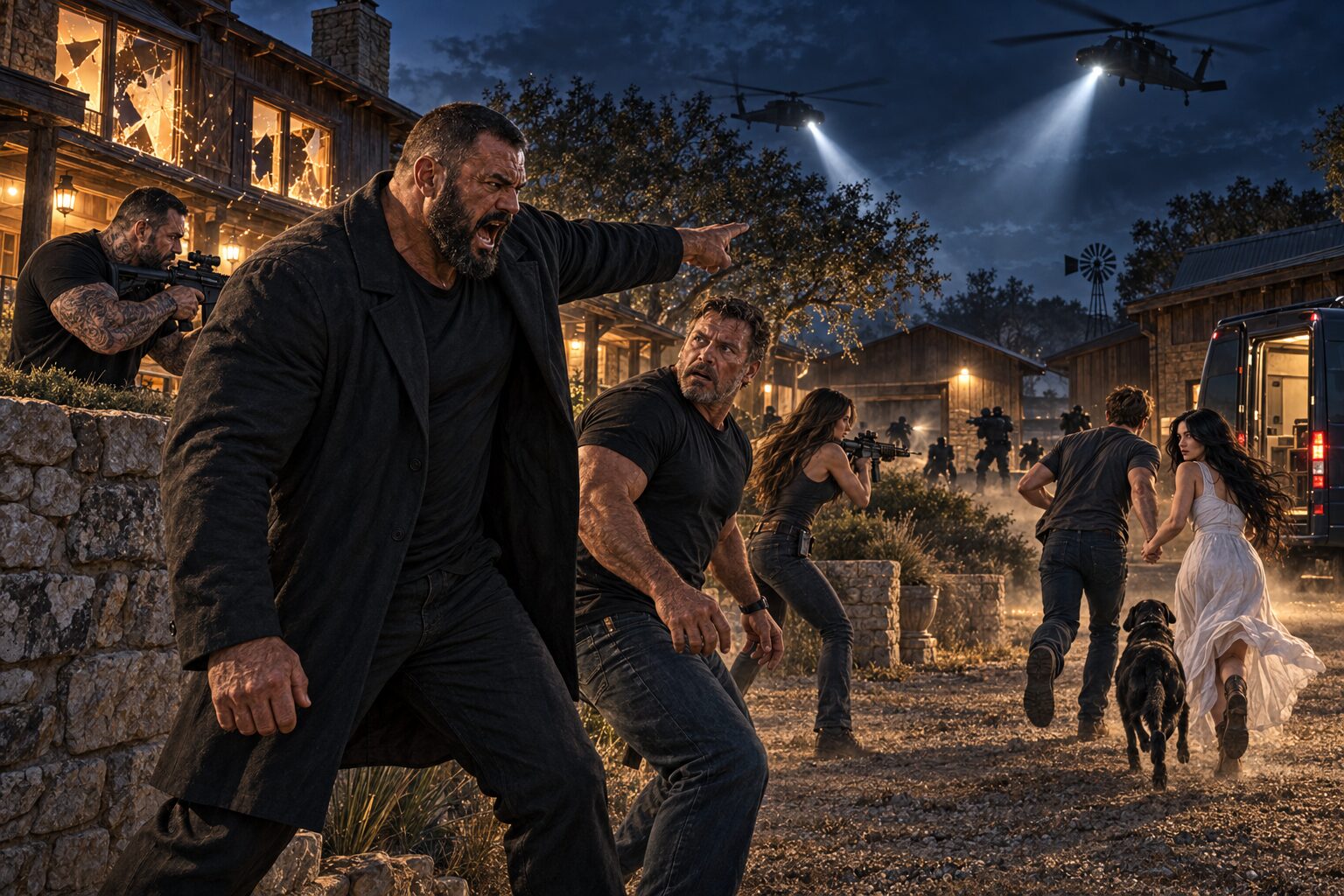
I stepped through the back door and stopped.
Everyone had gathered around the kitchen island.
Drinking.
Gene sat shirtless for reasons known only to Gene, waving a glass of amber liquid while Kristy Lee laughed despite herself. Bodhi stood close to Rachel. Sasha slept beneath Kristy Lee’s chair.
Nain remained near the counter, watching everyone like a nightclub bouncer nearing the end of a very long shift.
Several bottles covered the island.
Whiskey.
Vodka.
Tequila.
None of them looked familiar.
“Where did all that come from?”
Gene raised his glass.
“Your shockingly well-stocked bar.”
“I don’t have a bar.”
Gene looked into his drink.
“That is concerning.”
Kristy Lee pointed toward Rachel.
“She provided it.”
Rachel smiled.
“I’m full of little tricks.”
Nain’s eyes met mine.
He didn’t look amused.
That smile of Rachel’s bothered me more than it had an hour earlier.
Some people feel warm till they smile at you too long.
Gene noticed me staring.
“There he is. Texas Thunder himself.”
“I thought it was Callahan the Muffin Man,” Kristy Lee said.
“Both can be true,” Gene said solemnly.
Then he snorted at his own joke.
I didn’t smile.
“You’re leaving in the morning.”
The room quieted.
Rachel studied my face.
“You spoke with John.”
“I met a crazy man in my mother’s barn.”
“He told you something.”
“He told me enough.”
Gene lowered his drink.
I continued before anyone could interrupt.
“You can stay tonight. Tomorrow morning, everyone who brought this war onto my ranch leaves.”
Bodhi frowned.
“Dan—”
“No.”
The firmness in my voice surprised even me.
“My father walked away before I was old enough to remember him. Mama and I built a life without him. In the last two days, I watched two men I knew die. Now I have to bury her.”
I pointed toward the door.
“Whatever game this is, I am finished playing it.”
Rachel’s eyes narrowed.
“This isn’t a game.”
“That’s exactly what someone running a con would say.”
The room shifted.
Kristy Lee looked uncomfortable.
Gene blinked hard, as if trying to sober himself through effort alone.
Rachel tilted her head.
“You think we’re using you?”
“I think grief makes people vulnerable.”
A shadow crossed her expression.
“You don’t believe any of this.”
“I don’t want to.”
The honesty surprised everyone.
Including me.
Silence lingered.
Gene set down his glass.
“Man, trust me. Nobody would choose this life.”
For the first time since I’d met him, he looked genuinely tired.
Not goofy.
Not sarcastic.
Broken.
I hardened myself anyway.
“I’m done.”
Rachel stepped closer.
“People will die if you walk away.”
I laughed bitterly.
“People already died.”
Something sharpened behind her eyes.
Then it vanished.
“We are in need,” she said softly.
“You know,” Gene added, “for a man of faith, you sure don’t seem to have much.”
That hit harder than I expected.
Before I could answer, Nain straightened.
His head tilted slightly.
One hand rose.
Listen.
At first, I heard nothing.
Then—
Thump.
Thump.
Thump-thump-thump.
The beating grew louder.
Helicopters.
Rachel looked toward the windows half a second before everyone else.
Then the first searchlight swept across the back pasture.
The room erupted into movement.
Glasses abandoned.
Bags grabbed.
Weapons pulled from beneath furniture and behind doors.
No questions.
No debate.
Pure instinct.
These people had lived this moment before.
I hadn’t.
A second searchlight struck the barn.
A third found the house.
Beyond the windows, headlights poured through the outer gate.
Black SUVs crossed the cattle guard in a tight line and separated without slowing. One went toward the hangar. Another cut across the front drive. Two more spread across the eastern pasture.
They weren’t surrounding us.
Not completely.
The western service road remained open.
I didn’t notice that then.
Later, I would.
Gene tossed me a duffel bag.
“Sorry, man. Looks like morning came early.”
The first helicopter swept low over the shelterbelt.
Not military.
No missiles.
No guns mounted beneath its frame.
An unmarked utility aircraft dressed for war.
The side door stood open.
Men in black tactical gear descended on ropes before the skids cleared the cottonwoods.
A second helicopter dropped another team near the maintenance buildings.
The Order had found us again.
“They tracked us,” Bodhi said.
Kristy Lee looked toward Rachel.
Only for a second.
Then the front windows exploded.
Automatic gunfire ripped through the upper panes, chewing apart wooden frames and showering the room with glass.
The rounds struck high.
High enough to make us duck.
Not low enough to hit anyone already on the floor.
I didn’t notice that either.
Nain crossed the room in three strides and killed the lights.
Darkness swallowed the kitchen.
Another controlled burst tore through the windows.
Kristy Lee crawled toward the mudroom.
“They’re pushing us away from the front!”
“Then let’s not disappoint them,” Gene said.
Bodhi grabbed Rachel’s hand.
Sasha exploded into barking chaos.
I remained frozen half a heartbeat too long.
This was real.
Not cult fantasy.
Not grief-induced paranoia.
Not damaged people trying to con a wealthy stranger.
Real men.
Real rifles.
Real bullets cutting through my mother’s house.
Nain caught me by the shoulder and shoved me toward the mudroom.
We spilled into the warm night.
Helicopters thundered overhead. Searchlights crossed the yard. Armed men moved between the outbuildings with professional precision.
Bullets tore dirt from the ground behind us.
Kristy Lee dropped behind a stone watering trough and returned fire with one of my rifles.
Three measured shots.
Pause.
Two more.
Gene slid beside her carrying a shotgun.
“Now this,” he yelled, “is a terrible vacation.”
The maintenance garage stood sixty yards away.
A four-wheel-drive service van waited beside it.
Our only clear route.
Because they had left it clear.
Nain saw the opening.
So did Kristy Lee.
Her face changed.
“They want us going that way.”
Gene glanced toward the advancing teams.
“You see another option?”
She didn’t answer.
Nain pointed toward the van.
Go.
Then he turned toward the men coming around the side of the house.
I grabbed his arm.
“You’re coming with us.”
He pulled free.
Two operatives rounded the corner near the covered walkway.
Nain disappeared behind the stone wall.
The first man followed.
Bad decision.
Nain caught him at full speed and drove him into the wall hard enough to knock the rifle from his hands. Before the second operative could aim, Nain hurled the first man into him.
Both went down.
Nain kicked the rifle beneath the porch.
Then he looked at me.
He pointed toward the van again.
I shook my head.
“I’m not leaving you.”
His jaw tightened.
For a second, something moved behind his eyes.
Decision.
Regret.
Then Nain Stevens broke his vow.
“MOVE!”
The word tore out of him rough and enormous.
A voice unused for years.
One word worth breaking a promise he’d made to God.
Everyone heard it.
Everyone obeyed.
Nain shoved a heavy feed cart across the walkway, blocking the nearest route, then disappeared behind the wall as another burst of gunfire tore through the stone above him.
I ran.
We sprinted across the yard while rounds struck gravel and dirt around us.
Kristy Lee moved backward, covering us with disciplined bursts. Gene stayed beside her.
Bodhi fired too quickly toward a team advancing from the hangar. Most of his shots went high, but the men took cover.
Sasha remained at his side.
Until an operative stepped from behind a tractor twenty yards ahead.
His rifle came up.
Pointed directly at Bodhi.
Sasha hit him before he fired.
Not chest-high.
Not like some trained police dog.
She lunged at the only thing she understood—the arm holding the weapon—and clamped down with everything she had.
The rifle discharged into the air.
The man screamed as Sasha twisted and dragged him off balance.
Bodhi kicked the weapon away.
“Sasha!”
She released instantly and ran with him.
“Good girl,” Gene shouted.
We reached the van.
Gene grabbed the driver’s door.
I shoved him aside.
“This time I drive.”
“Why?”
I climbed behind the wheel and flipped down the visor.
A ring of keys dropped into my lap.
Gene stared.
“You leave keys in your vehicles?”
“On my ranch.”
“That feels irresponsible.”
“Get in.”
Everybody piled inside.
Kristy Lee slammed the side door as bullets hammered the rear panels.
PING.
PING.
PINGPINGPING.
The windshield cracked.
I turned the key and buried the accelerator.
The van fishtailed across the gravel before the four-wheel drive caught.
A searchlight swept over us.
Then moved away.
At the time, I thought we’d gotten lucky.
We tore past the maintenance garage and onto the western service road.
In the side mirror, Nain emerged from behind the stone wall and drove his shoulder into another operative. The man folded over him. Nain used the momentum to throw him across the hood of an SUV.
More black-clad figures converged.
Nain retreated toward the barn, using the stone wall and equipment for cover.
From where I sat, it looked like a last stand.
Maybe that was what he wanted us to see.
Then the road dropped into a dry wash and the ranch disappeared behind us.
Mesquite scraped both sides of the van. Rocks hammered the undercarriage. The narrow two-track twisted between high dirt banks cut by years of flash floods.
Gene grabbed the dashboard.
“You sure you know where you’re going?”
“I know where this road goes.”
“That wasn’t the question.”
“It’s the answer I have.”
The van hit a rut.
Everyone slammed upward.
Kristy Lee cursed.
Bodhi wrapped one arm around Rachel and the other around Sasha.
“Slow down,” he shouted.
“Bullets or bruises,” I called back. “Choose.”
“Bruises,” Gene answered. “Definitely bruises.”
A deep explosion rolled across the pasture behind us.
Orange light flashed above the edge of the wash.
I gripped the wheel harder.
Mama’s house.
The barn.
Nain.
Every tether I had left lay somewhere behind me.
We climbed out of the wash and onto a rough cattle road cutting through open grassland. The helicopter blades grew distant.
Not gone.
Just distant.
No one spoke for several seconds.
Only the engine.
Ragged breathing.
Glass rattling somewhere behind us.
I looked at the fractured windshield and tried to understand how my life had become this.
That morning, I’d owned a ranch.
A ministry.
An airplane.
A plan.
By midnight, I was driving into the dark with four fugitives, a dog, and a woman who might not be a woman at all.
I had no idea where we were going.
Then Rachel’s voice drifted from the back.
Soft.
Certain.
“I know a place.”
I stared through the broken windshield at the black Texas horizon.
“That,” I said quietly, “might be the scariest thing I’ve heard all week.”
Around the fire
Join the conversation.
Reader comments appear only after T. G. Bonfire approves them. That keeps this space thoughtful, human, and free of noise.