Chapter 13
Too Late for Cookie Sales
Francine Ash made herself at home wherever she went.
I awoke on the couch to the sound of cabinets opening and closing , like someone had broken into my house and decided to organize it.
For a second, I thought I was back on the gym floor. Fists. Boots. Devon’s voice telling me to get out.
Then the pain showed up.
It rolled through me slow and deliberate, like it had all the time in the world. My ribs protested first. Then my jaw. Then one eye, already swelling shut and feeling less like a body part than a personal vendetta. My tongue found the split inside my lip. I tasted blood again. I tried to sit up.
Bad decision.
“Don’t,” a voice said from the kitchen.
Francine.
Of course it was.
Rachel had given her an emergency key years ago. I’d forgotten that included the lock on the back gate.
Because when your life is falling apart, why not add your estranged mother-in-law to the guest list?
I leaned back against the couch and waited for the room to stop tilting. Sasha padded into view, tail wagging like nothing in the world had gone wrong. She hopped up beside me and immediately started licking my face like she was trying to sand me down to a smoother finish.
“Easy, girl,” I muttered. “I’m already missing a few layers.”
Footsteps approached.
Francine Ash stepped into the living room carrying a glass of water and two pills like she was delivering last rites.
Even like this, she had presence. The kind of woman people noticed without meaning to. Rooms adjusted around her—voices softened, posture straightened, eyes lingered a beat too long.
Only… something was off.
This wasn’t the Francine I knew.
No makeup. None. Not even the “effortless” version that probably took an hour and better lighting than my entire house could provide.
Her hair was pulled back into a simple ponytail. Not styled. Not sculpted. Just… pulled back.
And her clothes—
I blinked my good eye.
Knockoffs.
Not even good ones.
Francine Ash didn’t do knockoffs.
Francine Ash was the standard people knocked off.
“What happened to you?” she asked, stopping just short of the couch.
I gave a half-smile that hurt more than it helped. “You should see the other guy.”
“I doubt that,” she said flatly. “Sit up.”
I considered arguing.
Then I remembered I couldn’t win a fight with gravity right now, let alone her.
I pushed myself upright, took the pills, and chased them with water. It went down like broken glass.
She watched me the whole time.
Not judging.
Not exactly.
Assessing.
“You’re in bad shape,” she said.
“You need a hospital.”
“No.”
“Bodhi—”
“Henderson will know before they finish taking my blood pressure.”
She didn’t like that answer, but she understood it.
“Been told worse on Yelp.”
That almost got a smile.
Almost.
She sat beside me, close enough that I could feel the hesitation in her. Like she wasn’t sure if she was allowed to be here. Like she wasn’t sure if I was.
That made two of us.
We sat in silence for a beat too long.
Then I said, “So… are we doing this again?”
Her brow furrowed. “Doing what?”
“The part where we pretend this is a normal visit,” I said. “You bring groceries. I get concussed. We avoid the fact the last time we saw each other you called me something that would get you banned from daytime television.”
She exhaled slowly.
“No,” she said. “We’re not doing that.”
“Good.”
“I didn’t come here to fight.”
“Also good.”
“I came because…” She hesitated. “Because I didn’t know where else to go.”
That landed.
Harder than Devon’s right hook.
I studied her again. Really looked this time.
The clothes. The lack of makeup. The tension in her shoulders.
This wasn’t a visit.
This was a retreat.
“What happened?” I asked.
She didn’t answer right away. Instead, she stood and walked toward the kitchen like the question had weight and she needed space to carry it.
“I brought groceries,” she said, gesturing toward the island.
“I saw.”
“You probably haven’t been eating.”
“I had a protein bar yesterday.”
She looked at me.
“That counts.”
“It does not.”
“Agree to disagree.”
She didn’t smile this time.
That’s when I knew.
Whatever she was about to say—it was big.
I pushed myself to my feet. The room swayed but stayed upright out of what I can only assume was pity.
I followed her into the kitchen.
She was already unpacking bags. Methodical. Controlled. Like if she kept moving, she wouldn’t have to feel anything.
I leaned against the counter.
“Francine.”
Nothing.
“Fran.”
She stopped.
Just for a second.
Then kept going.
“Country club,” she said.
I blinked. “What about it?”
“We’re no longer welcome.”
That didn’t make sense.
“They revoked our membership this morning.”
“Why?”
She let out a short, humorless laugh. “They didn’t say.”
“Of course they didn’t.”
“Friends stopped calling,” she continued. “People we’ve known for years. Decades.” She set a carton of eggs down a little too hard. “Harold’s contracts are disappearing. One by one.”
I felt something cold settle in my chest.
“And now,” she said, quieter, “the IRS is auditing the company.”
There it was.
Not random.
Not coincidence.
Pattern.
“They’re doing this,” I said.
She didn’t look at me.
“Who?”
“I don’t know yet.”
Silence filled the kitchen.
Heavy. Knowing.
“They’re doing it to me too,” I said. “Gym. Businesses. People.” I gestured vaguely to my face. “Enthusiastic customer service.”
She turned then.
And for the first time since she walked in—
We were on the same side of something.
“They want something,” she said.
“They want Rachel.”
We didn’t say anything after that.
We didn’t have to.
We settled for coffee since neither of us were hungry.
It was her eyes that found the piano.
She froze mid-motion, her cup halfway to her lips.
“That’s new,” she said softly.
I followed her gaze.
The piano sat near the far wall. Polished. Untouched. Waiting.
“Yeah,” I said. “Got it last year.”
She looked at me.
“For when she gets back.”
Something flickered across her face.
Not pity.
Not sadness.
Recognition.
“She used to play,” Francine said.
“I know.”
Her fingers tightened slightly around the mug. “Not like other kids.”
I frowned. “What does that mean?”
She didn’t answer right away. Just kept looking at the piano like it might look back.
“Her teachers didn’t understand it,” she said finally. “They’d show her something simple… scales, exercises… and she’d nod like she was listening.”
A small breath.
“Then she’d sit down and play something else entirely.”
I felt a shift in my chest. “Like what?”
“Beautiful,” Francine said. “Too beautiful. Too… complete.”
She shook her head slightly.
“She was too young for it. Too new to it. But she played like she’d already lived a whole life inside those keys.”
I watched her now. Really watched her.
“You’re saying she was gifted.”
“I’m saying…” She hesitated. “I don’t know what I’m saying.”
Silence settled between us.
Then—
“She only played once a week,” Francine added. “Wednesday afternoons. Like clockwork.”
“Lessons?”
“At first.”
A pause.
“Then not anymore.”
I frowned. “Why?”
Francine looked down into her coffee like the answer might be floating there.
“I started finding them,” she said quietly.
Something in her voice made my stomach tighten. “Finding what?”
“Birds.”
I blinked. “What?”
“In the yard. On the sidewalk. Sometimes on my morning walk.” Her voice stayed steady, but thinner now. “Dead. No marks. No reason.”
A beat.
“At first I thought it was coincidence.”
She let out a breath that almost turned into a laugh.
“Until I realized it was always the same day.”
The room felt smaller.
“Thursday mornings,” she said. “Every time.”
My chest tightened. “After she played.”
Francine didn’t answer.
Didn’t have to.
“I told Harold once,” she said. “At dinner. Just making conversation. Complaining, really.”
Her eyes drifted somewhere else. Somewhere older.
“She was sitting right there. Listening.”
A pause.
“She didn’t say anything.”
My throat felt dry. “And?”
“And the next week…”
Francine swallowed.
“She sat down at the piano.”
I could see it. Somehow. A younger Rachel. Hands on the keys.
“She played for maybe thirty seconds,” Francine said. “Then she stopped.”
Another pause.
“Just… stopped.”
I didn’t move.
“She never played again,” Francine said.
Silence filled the space between us.
Heavy.
Final.
I glanced at the piano. “You think she knew.”
“I know she knew,” Francine said softly.
The words landed.
Hard.
“She stopped because of the birds,” I said.
Francine didn’t look at me.
“Yes.”
The room shifted. Just slightly.
I felt it.
“Francine—”
“The piano started playing again,” she said.
I froze.
“What?”
“At the house,” she said. “A few weeks ago.”
Her eyes lifted to mine.
“Not the way she used to play.”
A beat.
“Different.”
“How?”
“Slower,” she said. “Heavier.”
Her voice dropped.
“Sad.”
The word hung there.
“Like something was trying to remember how to be beautiful and couldn’t quite get there.”
A chill ran through me.
“And the birds?” I asked.
Her silence was answer enough.
Then—
A note sounded behind her.
Clean.
Perfect.
We both froze.
Another note followed.
Then another.
Slow.
Measured.
The beginning of something that didn’t belong in an empty room.
Francine turned.
“No…” she whispered.
The music grew.
Not bright. Not light.
Dark.
Layered.
Wrong in a way that felt intentional.
Like grief had found a voice.
Tears welled in her eyes.
“That’s it,” she breathed. “That’s what it sounds like.”
The melody twisted, deepened, pressed into the room like it had weight.
Like it was trying to say something and couldn’t find the right language.
Francine moved first.
Fast.
She crossed the room and dropped beside the piano, wrapping her arms around it, pressing herself against the polished wood like she could hold it together.
“I’m here,” she whispered, voice breaking. “I’m here, baby.”
The music surged.
Louder now.
Straining.
“Tell me what to do,” she sobbed. “Please… just tell me what to do.”
I moved behind her, hands settling on her shoulders, steadying her—or maybe myself.
“Rachel…” I said.
The music faltered.
Then—
Stopped.
Silence crashed in.
Total.
Absolute.
Sasha started barking.
Loud. Sharp. Different.
Warning.
Francine stiffened.
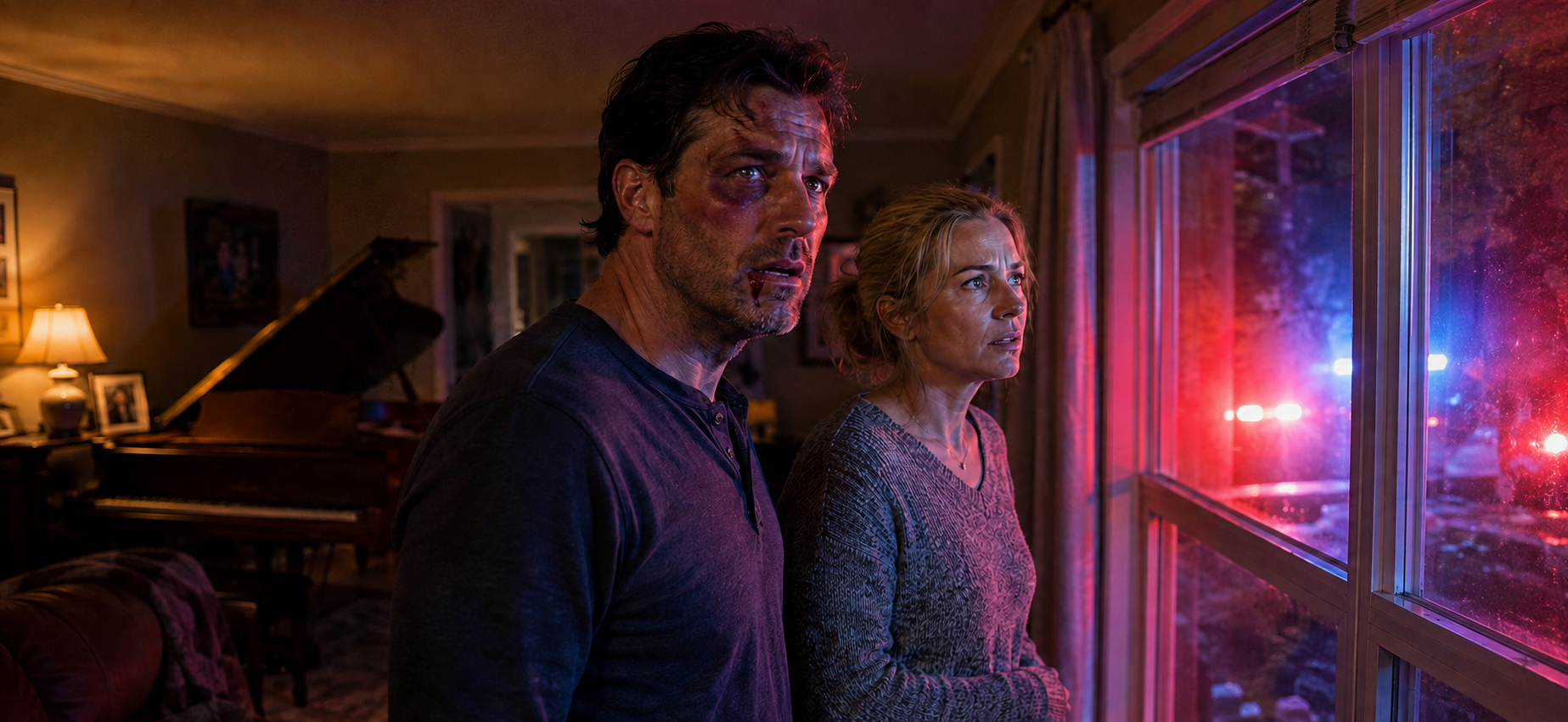
Slowly, she turned toward the window.
“No,” she whispered.
My pulse spiked. “What?”
She stepped closer to the glass.
Her body went rigid.
“Oh my God.”
“What is it?”
She turned back to me, all the color drained from her face.
“They’re here.”
Outside—
Car doors slammed.
Red and blue lights flooded through the windows, washing the room in color that didn’t belong.
Around the fire
Join the conversation.
Reader comments appear only after T. G. Bonfire approves them. That keeps this space thoughtful, human, and free of noise.