Chapter 15
Do You Even Like Kids?
The Wailing Woman never came.
I stood on the back patio longer than I meant to, staring out at the yard like it owed me something.
Nothing moved.
No wind through the trees. No shift in the air. No whispers crawling up the back of my neck.
Nothing.
“Okay,” I muttered. “Good talk.”
I pressed a hand against my ribs and immediately regretted it. Pain flared sharp and deep, like something inside me had been cracked and just… left that way. My whole body felt off. Like I’d been borrowed overnight and returned with pieces missing.
No warning. No guide. No missing wife appearing out of nowhere to point me in the right direction.
“All right, Girlie Girl,” I said quietly, eyes still locked on the dark. “If you’re out there… you’re gonna have to be a little clearer than that.”
Silence.
I waited anyway.
Because of course I did.
Another minute. Then another.
Nothing.
“Yeah,” I said under my breath. “I expected as much.”
Eventually exhaustion won. I dragged myself upstairs and collapsed into bed half-dressed, not even bothering with the lights.
The knocking ripped me out of nothing.
No dreams. No warning. Just—
“Hello? Bodhi? You alive in there?”
Woody.
I sat up too fast and the world tilted sideways. My ribs screamed. My head followed. I grabbed the edge of the mattress until the room stopped trying to spin off the planet.
“Hold on,” I croaked.
Getting downstairs was less walking and more… controlled falling. One hand on the wall, moving sideways like I was trying not to set something off.
Woody knocked again. Louder.
“Yeah, yeah,” I muttered. “Coming.”
I moved the chair bracing what was left of the front door and pulled it open.
Woody stood there like he always did—cargo shorts, sun-bleached Grateful Dead shirt, gray hair tied back like he’d given up trying to impress anyone sometime in the late eighties. Toolbox in one hand. Coffee the size of a toddler in the other.
“Man.” His gaze traveled over my swollen eye and split lip. “Door isn’t the only thing that got worked over.” He stepped past me like he lived there. “Got your text.”
I blinked. “They?”
He gave me a look. “Don’t play dumb. You don’t get a door kicked in like that over a misunderstanding.”
I didn’t answer.
Didn’t know how to.
Woody crouched near the busted frame, running his fingers along the splintered wood like he was reading it.
“Yeah,” he murmured. “Forced entry. Clean. Professional. Government or private. Not your average smash-and-grab.”
Of course that’s what he saw. Woody had never met a conspiracy he didn’t immediately fall in love with.
“Can you fix it?” I asked.
He glanced up at me. “Fix it? Sure.” A beat. “Question is—do you want to keep them out or just make it look like you tried?”
“Keep them out.”
He nodded once, like that was the only answer he respected.
“Alright then. I’ll get you something solid. Might not match. Might not be pretty.”
“Don’t care.”
I pulled out my phone on instinct.
Nothing.
No signal. No access. No anything.
“Right,” I muttered. “Of course.”
I headed upstairs, slower this time, ribs complaining the whole way. Went straight to the wall safe in the bedroom.
Punched in the code.
The door clicked open.
Empty.
For a second, I just stared at it.
Then I saw the note.
Small. Folded. Placed neatly inside like a gift.
I picked it up.
Told you we were watching. ♥
Jessica.
I let out a quiet breath through my nose.
“Yeah,” I said. “I’m getting that.”
I crumpled the note in my fist, then stopped.
Smoothed it back out.
Because that felt like something she’d expect me to do.
Instead, I folded it carefully and set it on the dresser.
“Not everything,” I said under my breath.
I crossed the room and grabbed the ceramic panda off the shelf.
Rachel’s.
She used to keep a panda hanging from her rearview mirror. Said it reminded her of when she was a little girl.
I asked her why once.
She smiled like she’d already decided not to tell me.
“Just… trust me,” she said. “They’re not what people think.”
I never got an answer better than that.
After—
I swallowed that thought before it finished.
The base wasn’t glued in place.
She’d shown me the false bottom once, laughing like it was a secret that mattered. After she disappeared, I started keeping emergency cash there. Maybe because it was one hiding place that still felt like hers.
I twisted it open.
Cash.
Still there.
“Jessica doesn’t know everything,” I said.
I came back downstairs and handed him a stack of bills.
He raised an eyebrow. “Well damn. Guess I’m definitely your guy today.”
He stood, rolled his shoulders, then leaned in like he was about to tell me how the world really worked.
“You got people watching you, Bodhi. I can feel it. Same patterns. Same moves. Ever since the eighties, man. You ever see shrapnel wounds?”
I closed my eyes. “Woody—”
“I got three.” He was already pulling at his collar. “One here, one here—”
“I believe you.”
He stopped. Considered that. Then nodded like we’d just reached an understanding.
“Good,” he said. “Means you’re paying attention.”
I hesitated. “Hey… why are you helping me? I’ve been losing friends left and right lately.”
Woody gave a half-knowing smile, like he’d been waiting for me to ask.
“Ain’t no one got nothing on me that I ain’t already lost a long time ago. Some of us just keep moving on to keep moving on.”
He made a lazy circular wave of his hand, showing what he meant.
I frowned. Kinda… almost made sense.
He grabbed his coffee. Headed for the door.
“I’ll be back. Don’t go doing anything stupid.”
“That depends,” I muttered.
He grinned. “It always does.”
I stood in the doorway a second longer than I needed to.
Everyone else had turned on me.
But Woody?
Woody showed up.
Didn’t ask questions. Didn’t hesitate. Didn’t try to fix me.
Just… showed up.
“Yeah,” I muttered. “That tracks.”
I shut the door as best I could and headed into the kitchen.
Sasha was already waiting by her bowl, tail thumping like none of this was weird.
“At least one of us has priorities,” I said.
I filled her food, topped off her water, then leaned against the counter and watched her eat like that might somehow ground me.
“You ever get the feeling,” I said, “that you’re the only one who doesn’t know what’s going on?”
She didn’t even look up.
“Cool,” I said. “Me neither.”
The drive out of town felt wrong.
Not longer.
Just… off.
Like I’d taken a turn I didn’t remember making and now the world was slightly out of alignment.
The Jeep’s navigation kept guiding me down roads I didn’t recognize. Long stretches of land that weren’t abandoned—but felt like they’d been… skipped over. Like whatever kept the rest of the world running had decided this part wasn’t worth the effort.
I tapped the steering wheel with my thumb.
“All right, Girlie Girl,” I said softly. “I’m following the trail. If this is wrong… now would be a great time for a sign.”
Nothing.
I huffed a quiet laugh. “Yeah. Figured.”
The sign came out of nowhere.
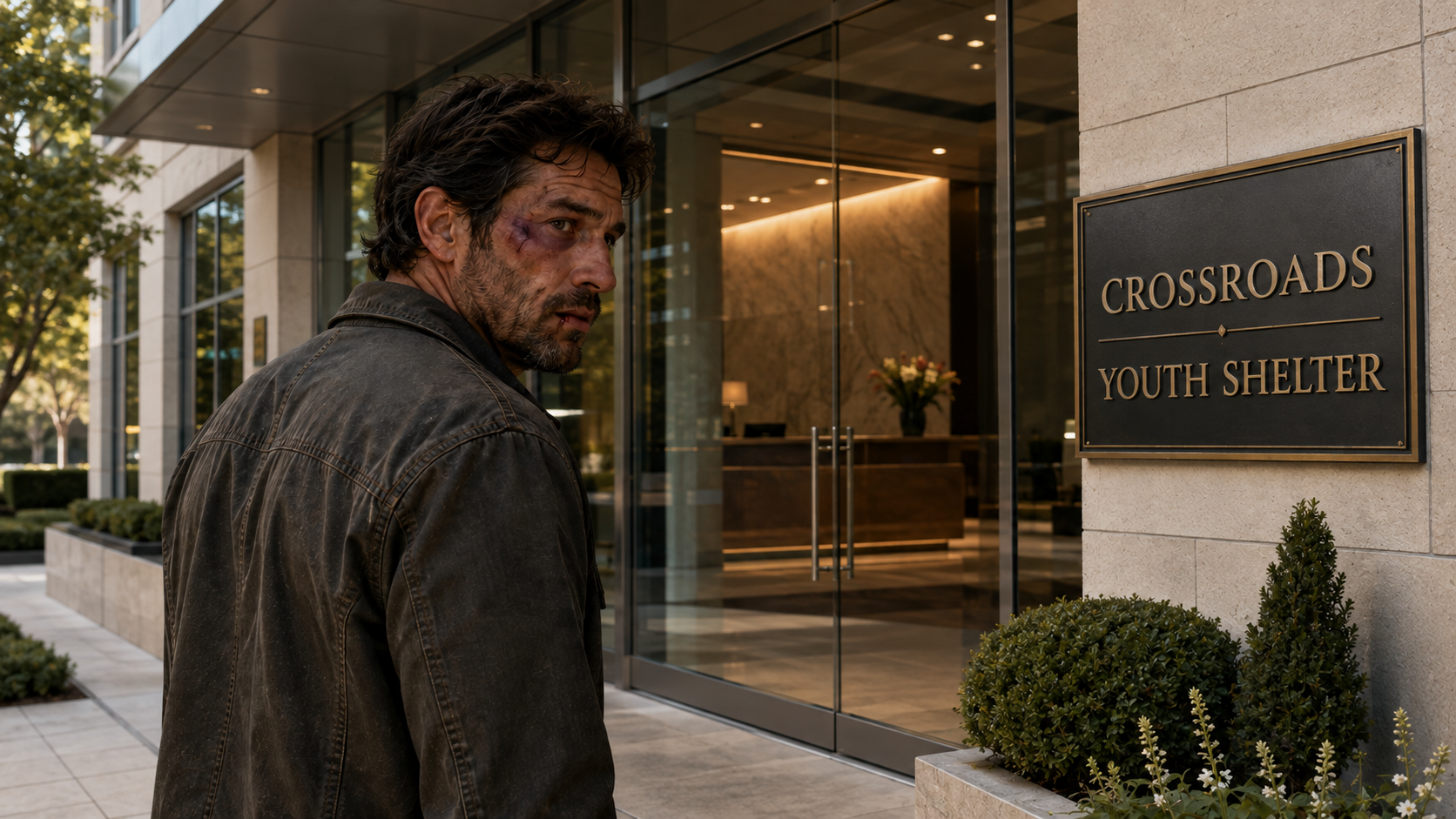
CROSSROADS YOUTH SHELTER
The same split-circle symbol from the pamphlet formed the O’s.
I slowed as I pulled in.
The place sat way back from the road, framed by iron gates and hedges trimmed so perfectly it made my teeth itch.
It looked like a private college.
Clean lines. Fresh paint. Grounds that didn’t miss a single detail.
Too perfect.
“Nope,” I muttered. “Nothing weird about this at all.”
I parked and glanced at Sasha.
“You stay,” I said, cracking the windows. The morning was cool, and I found a shaded space near the building. “Guard the fort.”
She huffed like she had opinions about that.
“I’ll be quick.”
I closed the door and headed toward the building.
The air felt different the second I stepped out.
Still.
Not quiet—
still.
Like something was holding it in place.
The front door didn’t open.
Of course it didn’t.
I pulled once. Tried again. Then looked up at the camera above the entrance.
“Hi,” I said, giving it a little wave.
A buzz sounded.
The lock clicked.
I hesitated.
Then stepped inside.
The lobby felt… wrong.
Warm, but not real. Like the temperature had been set by someone who’d read about comfort instead of actually feeling it.
Soft lighting. Deep reds. Polished stone.
Money everywhere.
A woman stood behind the counter, hands folded like they’d been trained to rest that way. She glanced at me, and I caught the flicker. Her gaze caught on my swollen eye and split lip, then dropped to the careful way I held my ribs. She noticed. Didn’t say anything.
“May I help you?” she asked.
“Yeah,” I said. “I’m looking for whoever’s in charge.”
“The director?”
“Sure. That works.”
She studied me a second too long, then picked up the phone and said something too quiet to hear. When she hung up, she gestured to the seating area.
“Please wait.”
So I did.
I sat. And waited.
No signal on my phone.
No sound except a low hum I couldn’t place.
After a minute, I realized what it was. This place wasn’t quiet. It was controlled.
The door to the left opened.
A man stepped out like he’d been designed. Tailored suit. Perfect posture. Smile that knew exactly how much to give.
“Mr. Lewis,” he said, extending his hand.
I stood slowly, shifting my weight to keep from limping too much. My ribs still screamed from yesterday’s fight.
“That’s me,” I said.
“Vincent Crowe. Director.”
His eyes flicked to my side, just for a fraction of a second, before his smile returned. “Looks like someone’s been working hard. Gym?”
His grip was firm. Confident. Like he already knew how this was going to end.
“Come with me.”
The hallway was lined with photographs.
Smiling kids. Donors. Events.
A whole life curated into something clean and acceptable.
My eyes moved from face to face until—
I stopped.
There.
Silver at the temples.
That man.
My stomach dropped.
“That’s him,” I said, pointing.
Crowe glanced at the photo. “A former benefactor.”
“He was in my house last night.”
His smile didn’t move.
“I assure you, that’s not possible.”
“I saw him.”
He met my eyes, calm. Certain.
“He’s been dead for years.”
Something in my chest tightened.
Crowe placed a hand on my shoulder, light but firm.
“Memory can be… unreliable under stress.”
Then he guided me forward like that settled it.
It didn’t.
Not even close.
His office was almost empty.
Too clean.
Too intentional.
“Sit,” he said.
I didn’t.
“You know my wife?” I asked.
He tilted his head slightly. “Rachel.”
Everything in me went still.
“Yeah,” I said. “Rachel.”
“She was… involved with Crossroads.”
“Involved how?”
A pause.
Then—
“She was on our board of directors. She also volunteered from time to time. She was one of our best.”
I let out a short, sharp laugh. “No way.”
“I assure you she was,” Crowe said, smooth as ever. “A lovely woman. We were all very sorry to hear she vanished.”
“No,” I said again, shaking my head, the movement sending a dull pulse through my ribs. “That’s not right. You’re lying. She would have told me.”
His expression softened, just enough to pass for sympathy if you didn’t look too closely.
“I understand this is difficult—”
“You know what?” I cut in, stepping toward him before my body had a chance to argue. Pain flared sharp along my side, but I pushed through it. “I think you know exactly where she is.”
That did it.
Not a reaction. Not surprise.
Just… stillness.
The kind that feels like something has shifted under your feet, even if nothing around you moves.
Crowe didn’t blink. Didn’t look away. If anything, he seemed to settle into the moment, like we’d finally arrived at the part of the conversation he’d been waiting for.
Then the door behind me opened.
Slow. Controlled. No urgency.
I turned—and everything in me dropped.
Silver at the temples.
Same man from the photograph.
Same man who had stood in my house like he belonged there.
Alive.
Very much alive.
“Mr. Lewis,” he said, his tone polite enough to belong anywhere but here. “We need to talk.”
He wasn’t alone.
The woman stepped in behind him, her posture the same as the night before—steady, weapon-ready without actually needing to show it. The larger man followed, filling the doorway like it had been built for him. And just behind them, half in shadow, the G.I. Joe-looking guy from my backyard scanned the room like he was already calculating how this would end.
I took a step back before I even realized I was moving.
“No,” I said, shaking my head. “No, we’re not doing that.”
No one rushed me.
That was the first sign I was already in trouble.
I turned to run anyway.
Made it two steps.
Pain tore through my ribs so hard it felt like something inside me shifted out of place, and that half-second was all they needed. Hands caught my arm, twisted it back, drove me down hard enough that the floor came up fast and unforgiving.
My shoulder hit first. Then the rest of me.
By the time I tried to push up, I was already pinned.
Plastic bit into my wrists, tight enough to make my fingers tingle.
I kicked, twisted, tried to get any kind of leverage, but the big guy dropped a knee into my back and drove the air out of me in one sharp, humiliating burst.
“Easy,” someone muttered, like we were having a conversation.
“Yeah,” I rasped into the floor. “You guys feel real easy.”
The woman stepped closer, calm, controlled, watching me like she was deciding how much effort I was worth.
Crowe appeared at the edge of my vision, hands still in his pockets, expression unchanged.
“Take him to West,” he said.
Just like that.
Like I wasn’t even there.
They hauled me up and walked me through a different part of the building, one that didn’t match the polished, curated version out front. The walls were plainer here. The lighting harsher. It felt like stepping behind a stage set and seeing the scaffolding holding everything up.
People passed us.
No one stopped.
No one asked questions.
No one even looked twice.
That was the moment it really settled in.
This place didn’t just hide things.
It separated them.
And I’d just been moved somewhere I didn’t count.
Outside air hit my face, colder than it should’ve been, or maybe I was just finally noticing it. They pushed me across the grounds toward a smaller building set off to the side, close enough to be connected, far enough to pretend it wasn’t.
“West Building,” the silver-haired man said, almost conversational.
Like that explained anything.
Inside, the room was exactly what you’d expect once you stopped pretending this place was anything else.
Bare.
Functional.
The chair bolted to the floor like it had no intention of letting anyone leave.
They sat me down harder than necessary, and I couldn’t stop the sound that came out of me when my ribs hit the backrest. Straps followed—wrists, chest, legs—tight and efficient, like they’d done this enough times to know exactly how much resistance to expect.
The woman stepped forward again, unhurried.
“What do you know?” she asked.
I let out something that might’ve been a laugh if it hadn’t hurt so much.
“Clearly not enough.”
Her hand cracked across the swollen side of my face before I could brace for it, snapping my head sideways and lighting up everything behind my eyes. The split in my lip opened again. Blood filled my mouth.
“Let’s try again,” she said.
The silver-haired man stayed near the wall, watching without interfering. The others spread out, taking positions that made it clear this wasn’t a conversation—it was a process.
I tested the restraints out of instinct.
Didn’t budge.
Of course they didn’t.
“What do you know about Rachel Lewis?” the woman asked.
That name hit harder than the slap.
I said nothing.
Not because I didn’t want to.
Because I suddenly understood that whatever answer they were looking for, I didn’t have it—and that made me dangerous in a way I didn’t fully understand yet.
The room shifted subtly.
A glance between the G.I. Joe guy and the silver-haired man.
A slight tilt of the head.
“Did you hear that?” one of them said.
“Hear what?”
“Outside.”
The silver-haired man’s attention sharpened just enough to notice.
“Check it.”
The woman hesitated, then followed the silver-haired man and the larger man into the hall. The G.I. Joe guy stayed behind, one hand resting near his weapon.
The lights went out.
A scuffle. A strangled grunt. Something heavy struck the floor.
When the emergency lights flickered on, the G.I. Joe guy lay crumpled near the door.
Footsteps approached behind me, measured and deliberate.
I tensed against the restraints.
“Don’t struggle,” a familiar voice said.
“Yeah,” I said, tightening anyway. “That’s not gonna—”
“Sam sent me.”
Everything in me stopped.
“What?”
Hands moved quickly at my wrists, not fumbling, not guessing—cutting clean through the plastic like it wasn’t even there.
The pressure vanished all at once, replaced by a rush of pins and needles that made my hands feel like they weren’t entirely mine anymore.
He cut through the straps across my chest and legs, then hauled me out of the chair.
“Move,” he said.
I turned as best I could.
Suit. Calm. Focused.
The same man I’d seen before. The one who didn’t fit with the others.
He didn’t explain.
Didn’t waste time.
He just worked.
We hit the hallway just as voices rose somewhere behind us, sharp and sudden.
“They’re moving—”
“Get back—”
The man in the suit stepped in front of me, drawing his weapon in one smooth motion.
Two shots.
Low.
Precise.
Controlled.
Enough to make the men behind us dive for cover.
To slow them down.
“Go,” he said.
“What about you—”
“Go.”
There wasn’t anything in his voice that invited argument.
So I didn’t.
I ran.
No plan. No direction. Just away.
Every step sent a jolt through my ribs that made it hard to breathe, but stopping wasn’t an option. Not now. Not here.
The building blurred behind me as I pushed through the doors and out into the open air again, the grounds stretching out in front of me in a way that suddenly felt a lot bigger than when I’d walked in.
Shouting behind me.
Closer.
Faster.
I pushed harder.
The Jeep came into view like something I’d almost forgotten existed, and the relief that hit me wasn’t clean—it was desperate.
I fumbled the key fob the first time, fingers not quite working, then got it on the second.
Door open.
Inside.
Engine—
Go.
Just go.
I didn’t stop driving until the place was gone behind me, swallowed up by distance and trees and whatever else this town liked to hide.
My hands shook against the wheel, my breathing still trying to catch up to something that had already happened.
The wind inside the Jeep was louder than it should have been, but I’d left the windows cracked for Sasha and hadn’t thought about it.
Then I heard it.
A faint, dry ticking behind me every time I took a curve.
I glanced down.
Glass.
Small pieces skittering out from beneath the backseat and across the floorboards.
My stomach turned cold.
I looked over my shoulder.
The rear passenger window was gone.
Shattered inward.
The realization didn’t come all at once—it crept in, slow and cold, filling in the space where something should have been.
“…Sasha?”
Nothing.
No movement.
No sound.
Just that same wrong, empty space where she should’ve been.
“No,” I said, louder this time, like saying it might change something.
I looked again.
Checked the floor. The backseat.
Anywhere but the truth sitting right in front of me.
But the seat was empty.
And the silence that filled it—
wasn’t just quiet.
It was wrong.
Around the fire
Join the conversation.
Reader comments appear only after T. G. Bonfire approves them. That keeps this space thoughtful, human, and free of noise.