Chapter 21
Did You Get His Number?
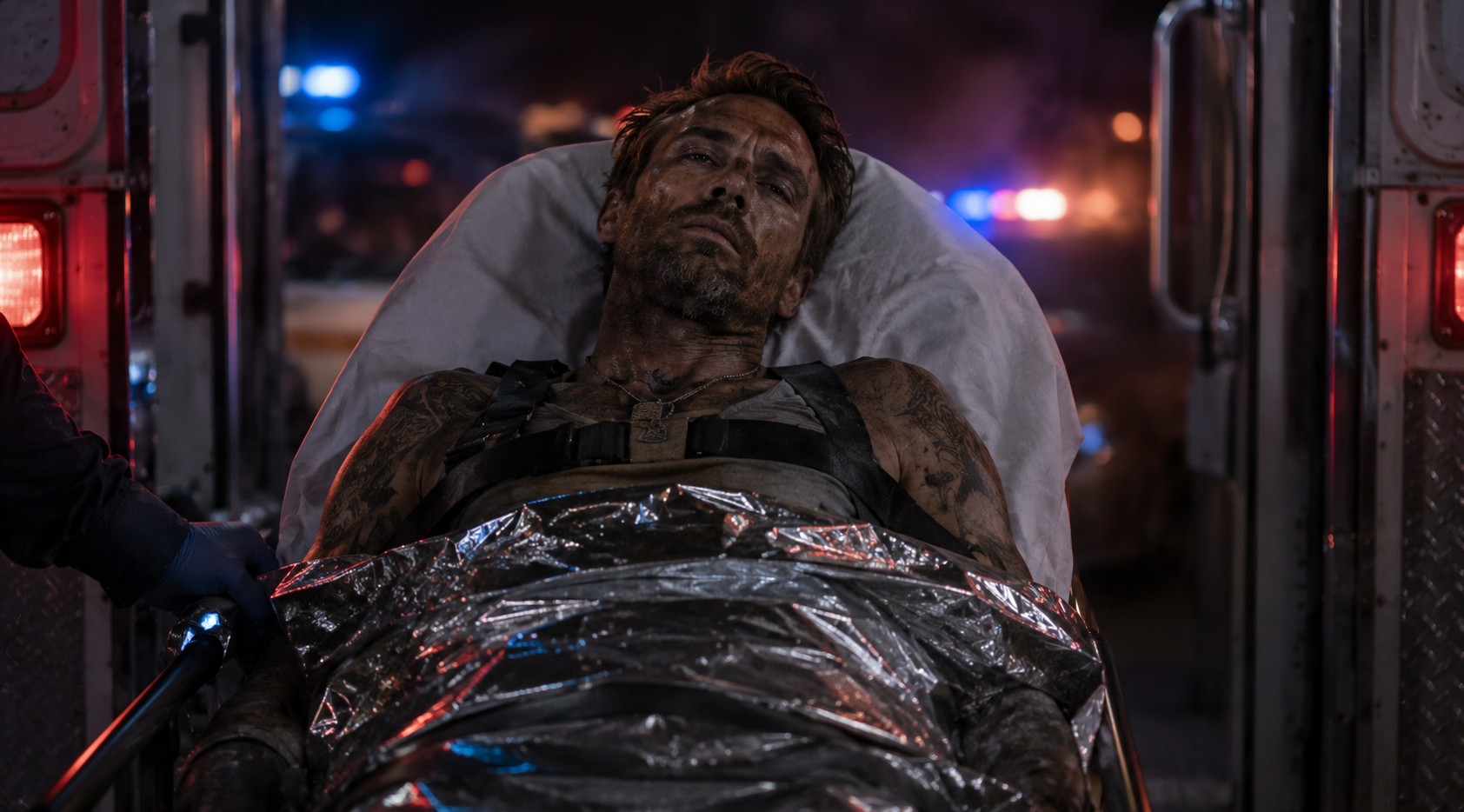
Sound came back first.
Not all at once. Not clean. It leaked in around the edges like something testing the door before it committed.
Sirens. More than one. Layered. Rising and falling over each other until they stopped sounding like an emergency and started sounding like panic.
Then voices.
Shouting. Orders. Names I didn’t recognize.
Then—
Cold.
It wasn’t the air. A thermal blanket covered me, tucked tight around my shoulders and legs, but the cold came from inside. It settled into my bones like it belonged there.
I opened my eyes.
Regretted it immediately.
Light fractured across my vision—red, blue, white—spinning, stuttering, refusing to land on anything solid. I blinked once, twice, and the world began assembling itself in pieces.
Sky first.
Dark. Open. Wrong after the barn.
Then smoke, drifting across it in long black ribbons.
Then the shape of something burning.
I tried to turn my head.
Mistake.
Pain didn’t explode.
It spread.
Cold at first—sharp and invasive—then blooming outward into something deeper and heavier, like my body was remembering what had happened all over again.
A gloved hand pressed a thick dressing against the wound in my lower right side. An IV line ran from my arm. A clear oxygen mask covered my nose and mouth.
“Easy,” someone said. “Don’t move.”
“I wasn’t—” I tried.
My voice came out thin and fogged the plastic.
“You were,” the paramedic said. “Stay still.”
I looked down.
Nylon straps crossed my chest and legs, carefully avoiding the dressing pressed against my abdomen.
A stretcher.
Of course.
“Not my best angle,” I muttered through the mask.
No one laughed.
That was how I knew it was bad.
The world sharpened in pieces.
Boots grinding into dirt.
Water cutting across the ground in long silver arcs.
The barn—
Still standing.
Barely.
Flames climbed one side like they were trying to take the rest with them. Firefighters swarmed around it, dragging hoses and shouting over the roar.
“Get another line on that side!”
“More pressure!”
“Watch that beam!”
The fire chief stood near one of the engines, directing crews away from the sagging wall.
“Keep it off the house!” he shouted. “We need that structure intact!”
The windmill turned slowly.
Same rhythm.
Same patient indifference.
I watched it for a second too long.
Then—
“Bodhi!”
Sam.
I turned toward her, slower this time, careful—as if my body might come apart if I moved too quickly.
She walked beside the stretcher, one hand gripping the rail like she wasn’t sure she was allowed to let go. Her hair had been pulled back in a way that suggested someone had tried to help and she hadn’t let them finish. Dirt streaked her face. Something darker stained one sleeve.
She was alive.
That landed harder than it should have.
“Hey,” I said.
It took more effort than it used to.
“You look like crap.”
She released something between a laugh and a breath she’d been holding too long.
“Right back at you.”
Sasha moved beside her.
Close.
Too close for the paramedic standing on that side, who kept attempting to guide her away without making the mistake of touching her.
“Ma’am, we need a little space—”
Sasha bared her teeth just enough to make the point.
“She’s good,” I said. “She’s with me.”
“That’s exactly what I’m worried about,” the paramedic muttered.
Sasha’s tail thumped once against the stretcher.
Then stilled.
Her eyes never left me.
Another voice cut through the confusion.
Loud. Sharp. Controlled.
“Secure the east field. Nobody leaves this property until they’ve been identified. Check every vehicle, every outbuilding, and every inch of that house.”
Henderson.
I found him near the edge of the firelight.
Soot covered his face. His jacket was torn, and blood had dried along one temple. His gun was holstered at his side.
He wasn’t reacting.
He was directing.
State troopers and the few local officers still answering to him moved where he pointed, spreading across the property and sealing every route leading away from the farm.
He didn’t look like a man who had just survived something.
He looked like a man who had decided surviving wasn’t enough.
Movement caught my attention from the other side of the ambulance.
“—they tried to kill me!”
Tyler.
Of course.
He was on his feet, which felt like a mistake on several levels. Someone had wrapped him in a blanket, but it did absolutely nothing to contain the nervous energy pouring out of him.
“I sell televisions!” he shouted at no one and everyone. “I don’t even like barns! Why was I in a barn?”
A paramedic tried steering him toward an ambulance.
“Sir, we need you to sit down.”
“I’m not a sir. I’m a victim.”
“That’s what I’m saying, sir.”
Tyler pointed wildly toward the burning structure.
“They had a knife. A weird knife. That can’t be legal, right? That’s like—double illegal.”
“No one said double illegal,” the paramedic muttered, already regretting every life choice that had brought him here.
Tyler kept going.
Of course he did.
“They tied me to a table! I thought I was gonna die! I had plans. Not big plans, but plans!”
I watched him.
Alive.
Loud.
Still himself enough to complain.
“Ten out of ten,” I murmured. “Would rescue again.”
Farther out, Francine and Harold sat together on the open step of an ambulance. Her head rested against his shoulder, and his hand wrapped around hers like letting go would break something that wouldn’t mend.
They looked smaller.
People always did after something like this.
A paramedic spoke quietly to them. Francine glanced up once.
Found me.
Nodded.
It was small.
But it was everything.
Beyond them, state officers were rounding up the surviving members of the Order of the Veil.
They were still wearing their robes.
Black fabric streaked with dirt, ash, and blood. Some stood silently while officers secured their hands. Others shouted from beneath their hoods, threatening people whose names apparently mattered somewhere else.
One of the robed figures knelt near a black SUV, posture rigid despite the restraints around his wrists.
A trooper grabbed the back of his hood and pulled it down.
Mayor Langford stared into the flashing lights.
Without the suit, the smile, and the town arranged around him like a private kingdom, he looked smaller than I remembered.
Another hood came down.
Chief Rourke.
He kept his eyes on the dirt.
So much for maintaining order.
Two troopers emerged from the shadow of the farmhouse with Vincent Crowe between them.
No robe. No smile.
His hands were cuffed behind him, and blood ran from somewhere above his hairline. One side of his face was blistered from the heat, but his eyes remained clear.
Calm.
Certain.
Still convinced this was merely another step.
He saw me watching.
The certainty wavered.
Only for a second.
It was enough.
A state investigator followed behind him, carrying an evidence bag. Inside it rested the black-bladed knife.
Even through the plastic, it seemed to swallow the lights around it.
Crowe was pushed into the back of an armored vehicle.
The door slammed.
Locked.
He was gone.
One of the remaining hooded figures turned toward me.
The face beneath the hood was unfamiliar.
He didn’t look afraid.
He smiled.
Like Crowe, he seemed to think this wasn’t an ending.
Only a step.
I looked away.
“Mr. Lewis.”
Henderson appeared at my side like he had always been on his way there.
Up close, he looked older.
Not weaker.
Heavier.
“I was going to ask what happened,” I said.
He exhaled through his nose.
“Couldn’t let my own men get the drop on me.”
He said it like betrayal was an inconvenience.
“Once they took you, I stayed back and followed their vehicle. Called in favors on the way. State-level people I trust.”
I shifted my gaze past him.
Black SUVs lined the edge of the property. Men and women in state jackets moved through the scene with purpose. Investigators carrying clipboards worked beside tactical officers who definitely didn’t carry clipboards.
“You trust all of them?” I asked.
“No,” Henderson said. “I trust the people who brought them.”
At least he was learning.
“Rachel?” I asked.
The word came out smaller than I wanted.
Henderson’s expression tightened.
“No sign of her. The house hasn’t been completely cleared, but she wasn’t in the barn.”
“She’s close.”
“That’s what Crowe said?”
I nodded.
Henderson looked toward the farmhouse.
“I’ll have them search it again.”
“Search everything.”
“They will.”
I watched Crowe’s armored vehicle pull away.
“What happens to him?”
“State custody. Langford and Rourke too. Too many witnesses, too many bodies, and too much evidence for anyone in this town to bury it now.”
“You sound confident.”
“I’m trying something new.”
“Where’s John?” I asked.
Sam answered.
“I saw him walk into the smoke,” she said. “Then he was gone.”
Simple.
Certain.
“Who’s John?” Henderson asked.
I watched the smoke curling into the night.
“No one,” I said. “Just my guardian angel.”
Henderson studied me.
Not dismissing it.
Not accepting it.
Just filing it somewhere behind his eyes.
“Well,” he said finally, “I’d like to thank him. And get his statement.”
“Good luck.”
Henderson glanced toward the barn.
“As for your guardian angel, most of the things that attacked us are dead. The ones that aren’t look human again.”
He didn’t sound relieved.
He sounded like a man who had inherited a problem with no clean explanation.
“Don’t know how we’re going to write that report.”
“Try fiction,” I said. “People will believe anything if you put the right cover on it.”
He almost smiled.
Behind him, one of the state officials approached.
“Captain.”
Henderson didn’t like being interrupted. It showed for half a second, then disappeared.
“I’ll be there.”
The official stepped away.
Henderson looked down at me.
“They’ll want statements. From you. From all of you.”
“They’ll want this to make sense.”
“Yes.”
“Good luck with that.”
His gaze drifted toward Langford as officers loaded the mayor into another vehicle.
“With him in cuffs, somebody’s going to suggest I run for mayor.”
“Terrifying.”
“Ask me after I clean this up.”
Then he turned and moved back into the chaos, already shifting pieces again.
The stretcher started rolling toward the ambulance.
Sam kept pace.
Sasha did too.
My eyes drifted back toward the barn.
Fire still climbing.
Water still fighting it.
For one second, the ground near the structure looked—
Wrong.
Lower.
The dirt shifted as if something underneath it had taken a breath.
I blinked.
It was gone.
Just dirt.
Just fire.
Just a barn trying to burn and not burn at the same time.
Normal.
As normal as anything got anymore.
The ambulance doors opened.
The paramedics raised the stretcher’s undercarriage and guided me inside.
Sasha tried to follow.
The paramedic blocked her.
“Dog can’t ride unless she’s a service animal.”
“She’s more useful than most people I know.”
“I don’t make the rules.”
Sam rested one hand against Sasha’s back.
“I’ll bring her,” she said. “She won’t leave my sight.”
I looked at Sasha.
Then at Sam.
“Promise?”
“Promise.”
Her hand found mine and squeezed.
“Hey,” she said.
“Hey.”
Sasha barked once.
Sharp.
Certain.
The doors began to close.
I looked past them one last time.
At the farm.
At the smoke.
At Mayor Langford and Chief Rourke being driven away.
At the vehicle carrying Vincent Crowe.
At everything that had happened and somehow hadn’t ended anything.
As the doors closed, I heard it.
Faint.
Almost nothing.
A voice underneath everything else.
“Not all.”
The monitor beside me changed pitch.
One of the paramedics said my name.
Then darkness pulled at me again.
This time, I didn’t have the strength to fight it.
Around the fire
Join the conversation.
Reader comments appear only after T. G. Bonfire approves them. That keeps this space thoughtful, human, and free of noise.