Chapter 18
Dreaming
The desert shouldn’t be wet.
That’s the first thing wrong with it.
Sand stretches in every direction, pale and endless. The kind of empty that makes a man feel like he’s been forgotten on purpose.
But every step I take sinks a little too deep, like the ground has been holding something and hasn’t decided whether to let it go.
My boots make a sound they have no business making.
Soft.
Saturated.
I look down.
Water pushes up around the edges of my soles, darkening the sand in slow, spreading circles. Not enough to flood.
Just enough to cling.
Like this place is keeping me.
The air presses in from all sides. Hot but unmoving. No wind. No relief.
Just weight.
Then the shadows shift.
I look up.
They aren’t mountains.
They move.
Giants.
Not the kind people tell stories about. Not exaggerated or monstrous in ways that make them easier to understand.
They look like men.
Same proportions. Same shape.
Just wrong in scale.
One step from them erases distance for everything else.
They don’t hurry.
They don’t need to.
“Gene.”
I turn.
Abilene stands a short distance away, like she’s always been there and I’ve only just caught up.
Texas behind her. Flat horizon. Open sky.
Except the sky isn’t right.
It bleeds.
Red into purple. Purple into something softer that doesn’t belong in a place like this.
“Abby?”
Nobody called Abilene that.
Nobody except me.
My voice feels small.
She doesn’t move toward me.
Doesn’t smile.
Doesn’t say anything.
She just watches.
Waiting.
That feeling again.
Like I’m late to something important.
I start toward her.
My foot sinks deeper.
Then the other.
The ground tightens.
Not quicksand.
Quicksand gives you a chance.
This holds.
I pull one leg free with effort, take another step, then another. Each one is harder than the last.
“Hold on.”
One of the giants shifts.
Just slightly.
It doesn’t need more than that.
It moves toward her.
“No.”
I push forward, forcing my legs through the resistance. The distance doesn’t close the way it should.
I’m moving.
But I’m not getting closer.
The giant reaches her anyway.
It bends slowly, deliberately, one hand opening. Fingers thick as tree trunks.
Abilene doesn’t run.
Doesn’t scream.
She only looks at me.
The same way she always did when she wanted to know who I was going to be.
The hand closes around her.
Careful.
Almost gentle.
That makes it worse.
“Hey!” I shout. “Put her down!”
I lunge forward, somehow covering the distance I couldn’t cross a second ago. My hands slam against the giant’s fingers.
Warm.
Solid.
Real.
“Let her go.”
I try to pry them apart.
The fingers don’t react.
Don’t tighten.
Don’t loosen.
Like I’m not there.
Like I don’t matter.
I force my hands into the gaps, straining, pushing, feeling something give.
Hope.
Just for a second.
Then the hand shifts.
I tear the fingers apart.
Empty.
Nothing inside.
I freeze.
“No.”
Something moves behind me.
I turn.
A tumbleweed tears across the wet sand with Abilene tangled at its center, turning silently as it carries her away.
She doesn’t look at me.
Doesn’t acknowledge me at all.
“Abby—wait!”
I try to run.
My feet sink.
Hard.
Up to the ankles.
Then deeper.
The ground holds.
Pulls.
Locks me in place.
“Come on!”
I drag one leg free far enough to move.
The tumbleweed picks up speed.
Of course it does.
The sky shifts again.
Red.
Purple.
Pink.
Too fast now.
Like something is flipping through sunsets, trying to find the right one.
The ground gives way.
Everywhere.
The horizon drops.
The sky tilts.
Suddenly, I’m falling.
“ABBY!”
She falls past me.
Close enough to reach.
Close enough to see.
I stretch for her.
Miss.
“ABBY!”
She disappears beneath me.
I keep falling.
The colors stretch.
Then snap.
Black.
I wake up shouting her name.
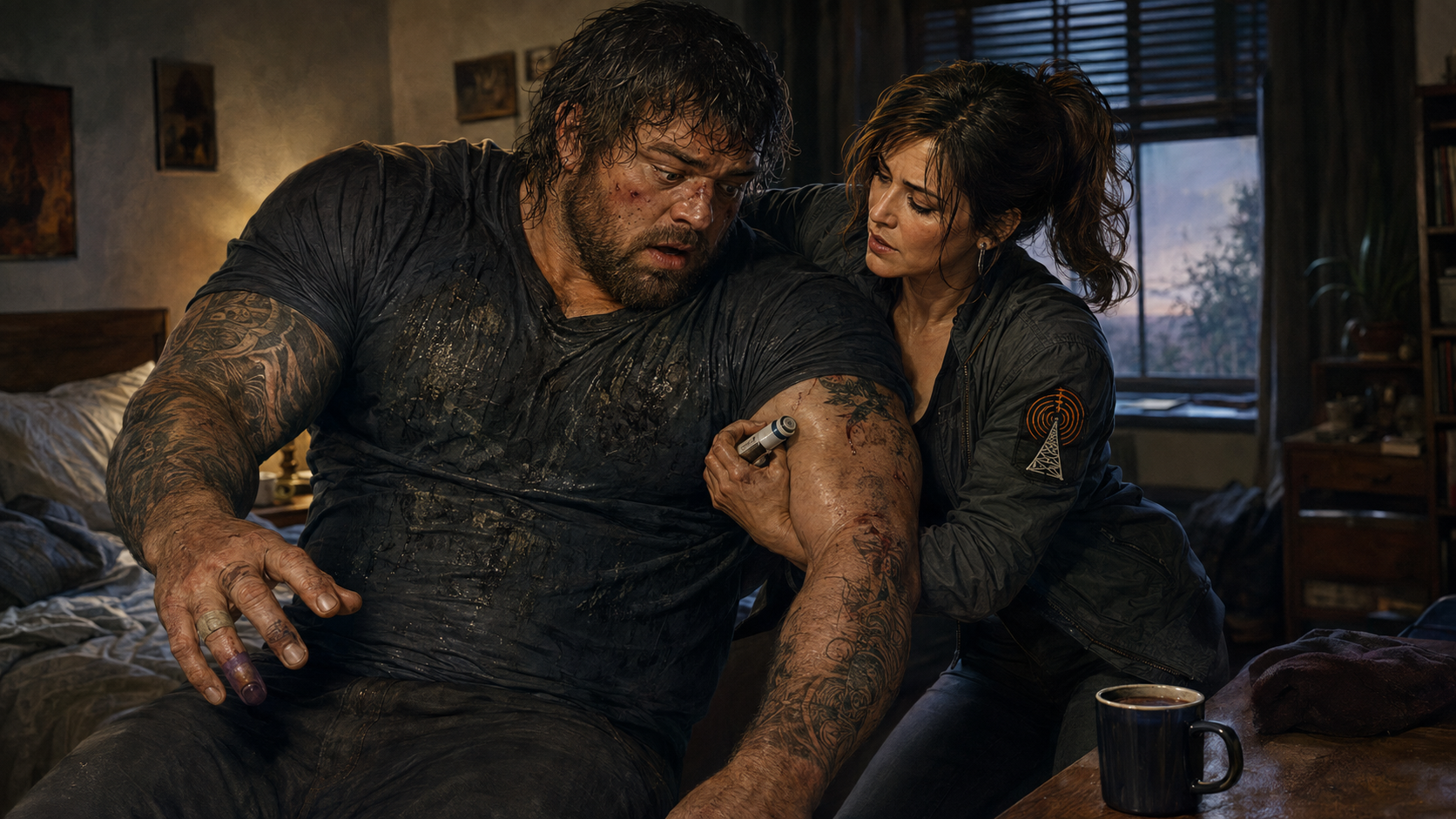
My chest heaves like I’ve been dragged back from somewhere I wasn’t supposed to leave. Sheets twist around me, damp with sweat. My hands still reach for something that isn’t there anymore.
My left hand looks especially bad.
The pinky has turned purple and swollen nearly twice its normal size. It leans toward the other fingers like it’s looking for protection.
Somebody taped it to my ring finger.
Kristy Lee, apparently.
I’m touched and irritated in equal measure.
“Wow.”
Her voice cuts through the room—dry, amused, completely unimpressed.
“I always love bringing a man home and hearing him scream another woman’s name.”
Reality returns in pieces.
Room.
Bed.
Her.
No desert.
No giants.
No Abby.
Just me, sitting there like I embarrassed myself on a cosmic level.
I scrub my good hand over my face.
“I can explain.”
“That would be impressive.”
“Bad dream.”
“Sounded enthusiastic.”
“Nightmare,” I correct.
“That better?”
“Marginally.”
I swing my legs over the side of the bed. My shirt clings to me, soaked through. My heart is still trying to figure out where it belongs.
Kristy Lee holds out a mug.
“Maybe this will help.”
I take it.
Warm.
Solid.
Real.
I take a sip.
Pause.
“Chocolate?”
“You told me you liked your coffee that way.”
“Smart man.”
“You didn’t look smart ten minutes ago.”
“Low bar.”
She leans against the wall with her arms crossed, watching me.
Not worried.
Not dismissive.
Interested.
“Who’s Abby?”
“Abilene.”
“Old girlfriend?”
“First love.”
“That sounds ominous.”
“Only I called her Abby.”
Kristy Lee’s expression changes slightly.
“So why now?”
I look into the coffee.
“That’s the problem.”
“Want to tell me why you’re dreaming about other women in my apartment?”
I exhale slowly.
This is the part where I could simplify.
Instead, I say, “It’s not just the dream.”
Her posture shifts.
“Okay. Then start talking.”
Everything.
Once I start, it doesn’t make sense to stop.
Ted.
The reunion.
Patricia telling me to stay home. Me following anyway and lasting five minutes before chasing a dead woman through the hotel.
Ginger.
Always Ginger.
Like she has a way of appearing exactly where she shouldn’t be.
“My old helmet was behind the hotel,” I say. “The one Ginger painted.”
“The one you lost?”
“Two years ago.”
“And it was sitting behind the Marquette?”
“Beside a dumpster. Waiting for me.”
“What happened to it?”
“Patricia screamed. I dropped it and ran.”
Kristy Lee says nothing.
So I keep going.
The Village.
That part slows me down.
Because the Village isn’t just a place.
It’s something I believe in.
“I was trying to do it right,” I say. “That was the point. That place meant something. It wasn’t just hiding people. It was supposed to be better.”
I shake my head.
“I got banned. From the one place trying to fix things. I didn’t just mess up. They removed me.”
The word hangs there.
Removed.
Clean.
Final.
“I put in the work. I sacrificed for that place. I believed in it.”
A beat.
“I lost it anyway.”
She doesn’t interrupt.
Doesn’t react.
So I keep going.
“The job. Trying to blow up a town that didn’t deserve it. Doing work for Ted, spending the money helping people, and pretending one cancels out the other.”
I let out a breath.
“I threw a plate of nachos across a restaurant called Freckles. Which feels like it should matter more than it does.”
Nothing.
Not even a smile.
Fair.
“The Devil’s Angels. The fight at the Backside Lounge. People getting hurt because I didn’t walk away when I should have.”
I rub the back of my neck.
“I keep telling myself I’m the guy who fixes things. That’s the role. That’s what I do.”
I look at her.
“And lately?”
I shake my head.
“Lately, I show up and everything gets worse.”
Silence.
Then I think about the helmet again.
“Somebody put it there,” I say. “They knew I’d recognize it. They knew I’d follow Ginger.”
“Which got you out of the hotel.”
“And left Patricia alone.”
The thought sits between us.
Then there’s John.
“John was waiting outside the hotel with a jacket in my size. He appeared at the Backside without anybody seeing him enter. He caught Whiskey’s punch like it was nothing.”
“He also called the station before you reached the club,” Kristy Lee says.
“I noticed.”
“That doesn’t bother you?”
“I’m deciding.”
“He doesn’t feel random,” I say. “None of this does. It feels placed.”
A beat.
“Like a guardian angel. Which I know how that sounds.”
She doesn’t dismiss it.
That helps.
“And then the dream.”
That part comes out slower.
“I couldn’t get to Abilene. Didn’t matter what I did. I was right there.”
I take a breath.
“I couldn’t save her.”
The room holds that.
I look at Kristy Lee.
I don’t dress it up.
“I feel like I’ve let everyone down.”
She lets it sit.
Then—
“The helmet.”
I blink.
“What?”
“Go back to the helmet.”
“That isn’t the important part.”
“It’s the part someone can trace.”
That stops me.
“It doesn’t fit,” I admit.
“How?”
“Wrong place. Wrong time. It got dropped into the middle of everything else.”
“Who had it?”
“I did. Then I didn’t.”
“And you don’t know who picked it up.”
“No.”
“But somebody wanted you to find it.”
“Yeah.”
She leans back.
A decision forms behind her eyes.
“That’s your thread.”
“That’s my problem.”
“It’s both.”
I stand.
The room tilts, but I stay upright.
“I need to go.”
“Whoa.” She pushes away from the wall. “You’re not going anywhere.”
“I just told you—”
“You told me a lot of things. None of them suggest you should make decisions right now.”
“I don’t have time.”
“You also don’t have a great track record of fixing things right now.”
That hits.
Hard.
“Let me look into it,” she says.
“You?”
“Yes, me.”
“You spin records for a living.”
“And you blow things up. We all contain multitudes.”
“I’m going.”
“You’re a bull in a china shop right now.”
“That’s not how this works.”
“It is today.”
“No.”
“Gene.”
“I’m going.”
She studies me.
Then nods.
“Okay.”
That should worry me.
It doesn’t.
I take one step.
Then another.
Something clicks against my arm.
Fast.
Sharp.
Clean.
I look down at the spring-loaded injector in Kristy Lee’s hand.
“Did you just tranquilize me?”
“Sedate.”
“You keep tranquilizers beside the coffee?”
“You’re not a horse, Gene.”
“That didn’t answer the question.”
“Wish it didn’t have to be like this.”
My legs soften.
I make it one more step.
Then the floor starts coming toward me.
Kristy Lee catches me on the way down.
“Mr. Accountability,” she murmurs, almost gently. “Sometimes that means letting someone else handle it.”
Darkness takes me.
Kristy Lee’s Interlude
Kristy Lee here.
I’m hijacking the story for a minute.
Gene is unconscious, which means he can’t stop me. He’ll complain later. Men get territorial about strange things.
Narration, apparently, is one of them.
First, I check his pulse.
Steady.
Breathing is normal. Pupils responsive. The dose is correct.
Despite what Gene thinks, I don’t guess.
I clip a monitor onto his finger and connect it to my phone. If his pulse or breathing changes, I’ll know.
It won’t.
Some people leave the Army with a trade.
I left with phone numbers.
I make a call.
“Yeah. I need access.”
A pause.
“No. Now.”
I disconnect.
The Marquette Hotel tries very hard to look like it doesn’t have secrets.
Glass doors. Warm lighting. Polished floors reflecting just enough of you to make you feel like you belong there. Like whatever you carried inside wasn’t heavy enough to matter within those walls.
I walk in like I don’t need permission to be anywhere.
The front desk clerk looks up with a smile he has practiced enough times to make automatic.
“Welcome to the Marquette.”
“I need access to your security footage.”
The smile holds for half a second.
Then reality catches up.
“I’m sorry, but that isn’t something I can provide without—”
“Call this number.”
I slide a card across the counter.
Slowly.
Deliberately.
People mistake speed for authority.
Real authority rarely hurries.
He doesn’t pick up the card immediately. He looks at me instead, trying to decide who I am, whether I’m bluffing, and how much trouble saying no might cause him.
“What is this?” he asks.
“Your way of not making a mistake.”
That doesn’t answer his question.
It isn’t supposed to.
He picks up the card and turns it over, as if something written on the back might make sense of this.
There’s nothing.
Only a number.
He hesitates.
Then reaches for the phone.
Dials.
Waits.
I don’t shift my weight. Don’t check my phone. Don’t fill the silence for him.
The outcome of this call was decided before I entered the building.
“Yeah,” he says when someone answers. “Hi, I’ve got a—”
He stops.
Listens.
His posture changes first.
Straightens.
Then his expression follows.
“Yes, sir.”
A pause.
“Yes, I understand.”
Another.
“No, she’s here now.”
His eyes flick toward me.
Something like recognition settles behind them.
Or maybe realization.
“Yes, sir.”
He hangs up slowly and sets down the receiver with more care than he used when picking it up.
Then he adjusts his jacket.
Smooths the front.
A reset.
When he looks at me again, the smile is gone.
“Ma’am, if you’ll come with me.”
“There we go.”
The security room doesn’t bother pretending.
No polished surfaces. No curated lighting. Only dim fluorescents and the low hum of machines doing exactly what they were built to do.
Watch.
A wall of screens cycles through different angles of the same lie.
Everything is under control.
A technician sits before the monitors.
“What time frame?” he asks.
“Rear service lot. Start thirty minutes before the fire alarm.”
He finds the camera and scrubs backward.
“Tell me when.”
“Stop.”
There.
Gene stumbles through the service door and into the rear lot.
Even on grainy security footage, he looks terrible.
He walks several yards, kicks something, then bends down.
The helmet.
He picks it up and turns it in his hands.
“Play.”
Gene stands there studying it.
Then his head snaps toward the hotel.
Patricia’s scream won’t be on the recording, but I know that’s what he heard.
He drops the helmet and runs through the service door.
“Keep going.”
The helmet lies beneath the security light.
One minute.
Two.
Nobody approaches it.
Then the service door opens.
A man in a dark coat steps into the lot.
He doesn’t look around.
Doesn’t hesitate.
He walks directly to the helmet and picks it up like he came for that and nothing else.
“Stop.”
The technician freezes the image.
“Give me the clearest frame you can.”
He works the controls. The picture sharpens enough to show the man’s build and part of his face.
I don’t recognize him.
That doesn’t matter.
Men who move like that aren’t random.
“Follow him.”
The technician switches feeds.
The man crosses the lot without checking whether anyone watches him. He reaches a dark sedan, opens the rear door, and places the helmet inside.
Then he gets behind the wheel.
“Hold it there.”
The angle catches most of the license plate.
“Pull the clearest plate frame.”
The technician isolates it.
Not perfect.
Enough.
I photograph the screen and send the plate with two words.
Run this.
The technician glances at me.
“Who are you?”
I ignore him.
My phone chimes less than a minute later.
North County Executive Services.
A company with no public employees, no listed officers, and a mailing address inside an office suite owned by one of Ted Polmey’s holding companies.
Not Ted directly.
Men like Ted don’t put their names on useful things.
But close enough to see the shape.
An address follows.
Something real.
Something I can pull.
“Thank you,” I tell the technician.
I mean it.
He doesn’t respond.
He’s still staring at the screens, trying to determine when this stopped being his room.
Outside, the air feels less controlled.
More honest.
I lean against my Prius and check Gene’s monitor.
Pulse steady.
Still breathing.
Still unconscious.
Good.
I read the address again.
A thread.
Not the whole story.
Enough to begin.
I slip the phone into my pocket and get behind the wheel.
“Okay, Teddy.”
The engine turns over.
Gene can have his story back when he wakes up.
For now, I have an address.
Around the fire
Join the conversation.
Reader comments appear only after T. G. Bonfire approves them. That keeps this space thoughtful, human, and free of noise.