Chapter 9
Chores
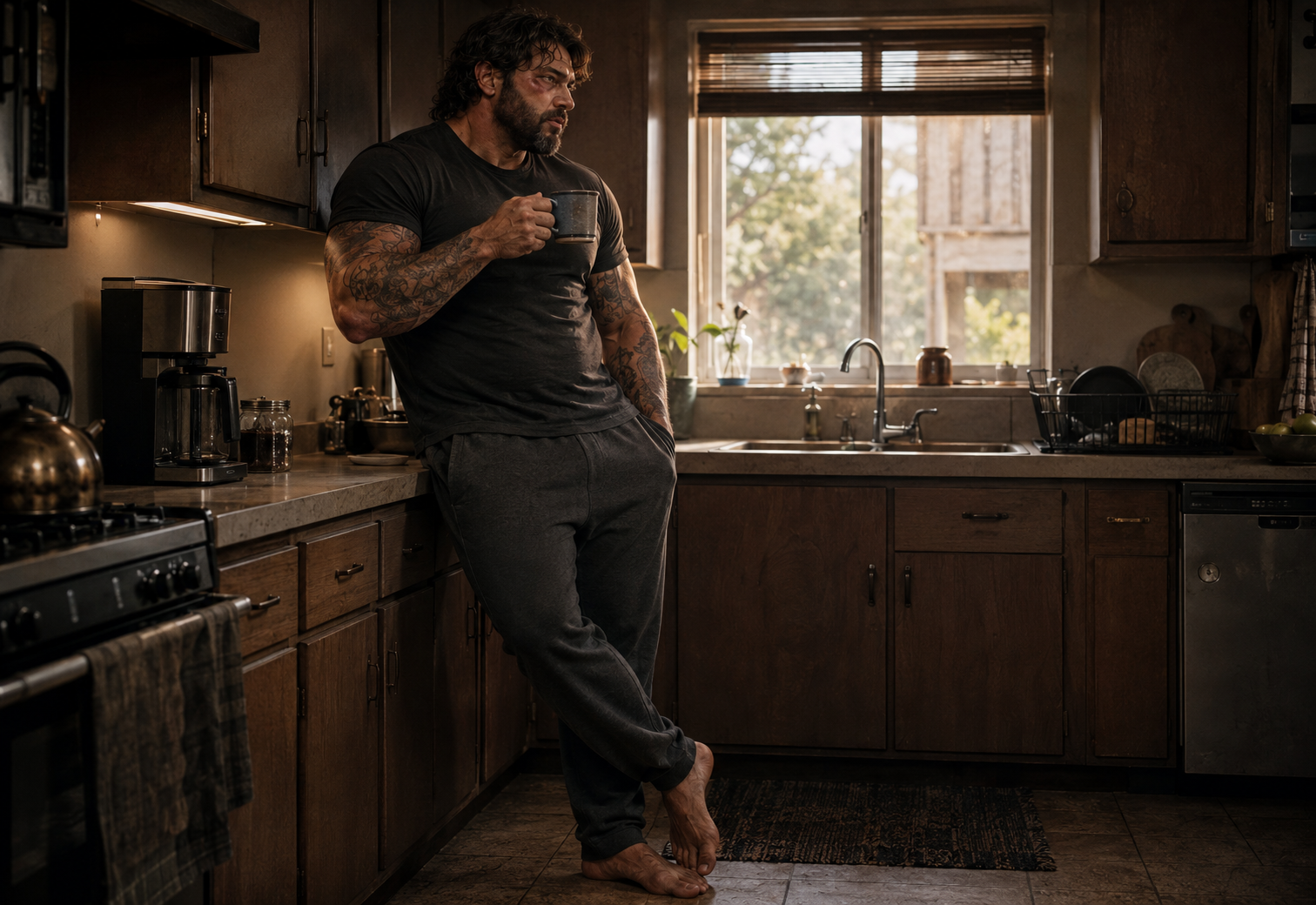
Sleep comes easy.
That’s one talent nobody ever gives me credit for. My head can hit a pillow in the middle of a riot and I’m gone before the second bottle breaks. No tossing. No turning. No staring at the ceiling wondering where life went wrong. My body shuts down like a business avoiding taxes.
Morning, unfortunately, is a different kind of honest.
It arrives in layers.
A truck grinding its gears somewhere out on the road. A car door slamming hard enough to suggest divorce. A dog barking like it has opinions. Then the low, steady hum of people leaving their homes to go make money for somebody richer than them.
Civilization is awake.
Off they go to jobs they hate so they can pay bills they resent and tell themselves they’re one promotion away from happiness.
I tend to be a little cynical before coffee.
I shuffle into the kitchen, ribs sore, left eye swollen, lip split, and go through the motions like a priest preparing sacrament.
Cup.
Machine.
Water.
Grounds.
Then the important part.
I open the refrigerator, break off one square from the Hershey bar I keep tucked behind the butter, and drop it into the bottom of the mug.
Don’t start with me.
It works.
Coffee pours over the chocolate. The square softens and disappears into something respectable. Splash of milk. Spoonful of sugar. Stir.
Perfection.
People always act strange when they hear about that. Like I’m describing some private ritual they shouldn’t have witnessed.
Meanwhile, they drink flavored syrups named after desserts and pretend I’m the weird one.
I stand over the sink, take my first sip, and let the day gather around me.
Pain in the ribs.
Ache in the jaw.
Ted waiting somewhere in the near future.
Queens County wanting another crack at me.
Kristy Lee sitting in my head more than she has any right to.
But my mind goes where it always goes when things get noisy.
Family.
Not blood.
Blood has never impressed me.
Family is who still needs you when the world gets mean.
I take another sip and look through the small window over the sink at the yard beyond.
Too many people need us lately.
That’s the truth of it.
The Village has grown faster than anyone expected. More women coming in. More kids. More stories nobody should have to tell twice. Every spare room is full. Every couch spoken for. Mattresses on floors. Closets turned into nurseries. Storage rooms turned into bedrooms. Folks who once needed help now helping the next person through the door.
That part makes me proud.
The rest makes me tired.
Most women who come through don’t stay with me.
Can’t blame them.
If you’ve just escaped some loud, controlling son of a bitch, the last thing you want is to be parked in a strange man’s house with a face like mine and a voice that sounds like bad decisions.
Usually, Patricia or Pam finds them somewhere else.
Somewhere softer.
But space is tight now.
So sometimes they end up here.
Temporary.
That’s the word everybody likes.
Temporary.
As if pain respects schedules.
Vanessa is one of those cases.
She arrived with bruises she claimed came from a door and a smile so practiced it made my skin crawl. Some people smile because they’re happy. Some smile because they think it keeps them alive.
Her son Jesse came with her.
Nine years old.
Too thin.
Too alert.
Kids that age are supposed to be careless. Loud. Stupid in cheerful ways.
Jesse listens for things.
Footsteps.
Changes in tone.
Cabinet doors closing too hard.
That kind of child notices weather patterns indoors.
I know the type because I used to be one.
I drink again and feel my thoughts drifting backward, where I usually try not to let them go.
My old man wasn’t around.
Maybe that sounds cleaner than it was.
“Wasn’t around” makes it seem like he had a scheduling conflict.
Truth was, nobody ever seemed entirely certain who he was. My mother offered different versions depending on her mood, the company, and how much she’d had to drink. Sometimes he was a trucker. Sometimes a musician. Sometimes a man with land in another state who was going to come back one day.
He never did.
What we had instead was a parade.
Men through the front door. Men out the back. Men sleeping on couches. Men eating our food. Men calling me “buddy” like that was rent.
Some were harmless.
Some were lonely.
Some were cruel.
You learn early which kind a man is by the way he sets down his keys.
My mother loved in bursts and failed in patterns.
Some nights she held me like I was the only thing she’d ever done right.
Some nights she sent me to my room and told me not to come out, no matter what I heard.
I heard plenty.
I was too small to stop any of it.
That kind of helplessness doesn’t leave. It just grows up with you.
So I got funny.
Funny kids get overlooked less.
Funny kids can change the temperature in a room.
Funny kids can make grown men laugh long enough not to swing.
That trick works until it doesn’t.
I finish half the coffee and stare into the sink.
The memories keep coming.
Years later, Abilene came back into my life.
Abby by then.
I’d known her in school. Construction-paper hearts. Tongue caught between her teeth while she cut along the line.
She grew into someone who hated the name Abilene, so naturally I used it every chance I got. Called her Texas. Tex. Lone Star. Amarillo if I was feeling romantic.
She’d roll her eyes and smile like she hated me just enough to stay interested.
First woman who ever made me feel chosen.
That’s a dangerous feeling when you’ve gone without it.
I built whole futures off a few smiles and the way she’d reach for my hand in public.
I thought I’d found love.
Really, I’d found attention and put a wedding ring on it in my head.
She left the day I planned to ask her to marry me.
No screaming match.
No dramatic betrayal.
Just gone.
Later, I learned I’d been sharing her with half the county while thinking I was special.
Humiliation hurts different than heartbreak.
Heartbreak says you lost something.
Humiliation says you never had it.
I got drunk.
Then I enlisted.
Patriotism had nothing to do with it.
I was young, angry, and needed somewhere to put all that energy before it turned inward.
The Army suited me more than it probably should have.
Rules.
Schedules.
Beds made tight enough to bounce coins.
Nobody asking how you felt.
You did the job or got yelled at.
Simple.
Then they discovered I had a knack for explosives.
Some men are gifted with music.
Some with numbers.
Me, I could look at a structure and know where to touch it so the whole thing remembered gravity.
They trained me.
I got good.
Maybe too good.
Good enough to know better than to trust a crate I’d left unattended.
That part hurts worse than the ribs.
Back then, I liked the precision of it. The certainty. Set the charge right, run the line right, wait for the signal, and the world obeyed math.
Life had never obeyed me before.
I lasted longer than most people expected.
Would’ve lasted longer still if I’d minded my own business.
There was an officer. Rank higher than mine, character lower than dirt. Mean with the weak. Polite with witnesses.
One night, I saw him handling a woman the way men used to handle my mother.
Maybe his wife.
Maybe his girlfriend.
Maybe just somebody who’d run out of luck.
Didn’t matter.
I was older now.
Big enough to do something.
So I did.
Hit him hard enough to introduce him to the floor.
Turns out the military frowns on freelance justice.
I got sent home with less honor than I’d arrived with.
I got drunk again.
That part was becoming tradition.
Then Ted Polmey found me.
Or maybe I found him.
Depends who’s telling it.
Ted didn’t care about records, temper, or moral complications. He cared if you could do a job, keep your mouth shut, and show up on time.
I was two out of three.
He paid well.
Gave me purpose.
Also gave me enough rope to hang myself, which is how certain men show affection.
Years later, I met Patricia Brown.
Patty Kakes to the paying public.
Most people looked at Patricia and saw legs, attitude, and trouble in expensive heels.
I saw the smartest person in every room pretending not to be.
She saw through me immediately, which I resented.
Then respected.
She was the one who taught me there were women leaving places like the Backside Lounge every week with nowhere to go but back to the men who broke them.
She said I was always cleaning up after damage.
Asked if I’d ever considered preventing some.
That stung because it was true.
The Village started small.
One apartment.
One mattress.
A lock that worked.
Groceries in a cabinet.
Cash hidden in a flour jar.
Then another place.
Then another.
People helping people.
Women becoming staff after becoming survivors.
Kids sleeping through the night for the first time in years.
I help fund it with money earned doing things I wouldn’t list in church.
Life is full of contradictions.
I drain the cup and rinse it clean.
No wisdom appears in the bottom.
I go into the bathroom and look in the mirror.
The face staring back at me looks like it was assembled from spare parts.
Purple under one eye.
Split lip.
Stubble going gray in places I haven’t authorized.
Lines around the mouth that weren’t there a few years ago.
Who the hell are you? I think.
The man in the mirror looks just as curious.
I look away first.
From the kitchen comes the clink of a spoon against ceramic.
Milk pouring too fast.
Then a cartoon voice shrieking something impossible.
Jesse is up.
I step into the kitchen.
He sits at the table in pajama pants and a superhero T-shirt, cereal bowl in front of him, eyes locked on a television balanced on the counter.
Milk on his chin.
Milk on the table.
Milk somehow on one sock.
“Morning, buddy.”
“Hey, Gene.”
He doesn’t look at me.
Just keeps eating.
“Slow down,” I say. “That cereal already surrendered.”
Nothing.
The cartoon on the screen features what appears to be a cloud arguing with a cat wearing sunglasses.
I’m officially too old.
I hear movement upstairs.
Vanessa.
That means she’ll come down soon, apologizing for taking up space, offering to clean things that are already clean, thanking me too much for too little.
People fresh out of bad situations think gratitude is rent.
Pam will be by later.
Patricia too, maybe.
They’re better at this part than me.
I provide rides, locks, repairs, money, intimidation, and the occasional casserole.
Emotional support remains outside my skill set.
I cross to the pegboard by the back door and scan the keys.
Truck.
Sedan.
A car I should’ve sold.
Van.
The microwave clock tells me I’ve got a few hours before Portia’s.
Enough time to make the rounds if I don’t linger.
I take the van keys with the red-dice keychain.
“You taking the bus?” Jesse asks.
Now he looks at me.
“Yep.”
“Doing Batman stuff?”
I smile despite myself.
“Yeah. Gotham’s backed up. Called in reinforcements.”
He nods seriously, accepting the burden of civic duty.
Then he says, “You’re one of the good guys, Gene. I want to be like you when I grow up.”
That one lands square.
Harder than Tavarius.
Harder than Tequan.
Because if a kid like Jesse thinks that, then I’d better try a little harder to deserve it.
“You be better than me,” I say. “Aim high.”
He returns to his cereal like he hasn’t just rearranged my insides.
I step out the back door into the cool morning air.
Pause at the bottom of the steps.
Look back at the house.
At the people inside.
At the thing we’re trying to build in a world mostly interested in tearing down.
Then I think of Ted.
Of Queens County.
Of whatever fresh disaster is lining up with my name on it.
I head for the van anyway.
Because no matter what else is waiting—
The rounds still have to be made.
Around the fire
Join the conversation.
Reader comments appear only after T. G. Bonfire approves them. That keeps this space thoughtful, human, and free of noise.