Chapter 12
By Their Fruits
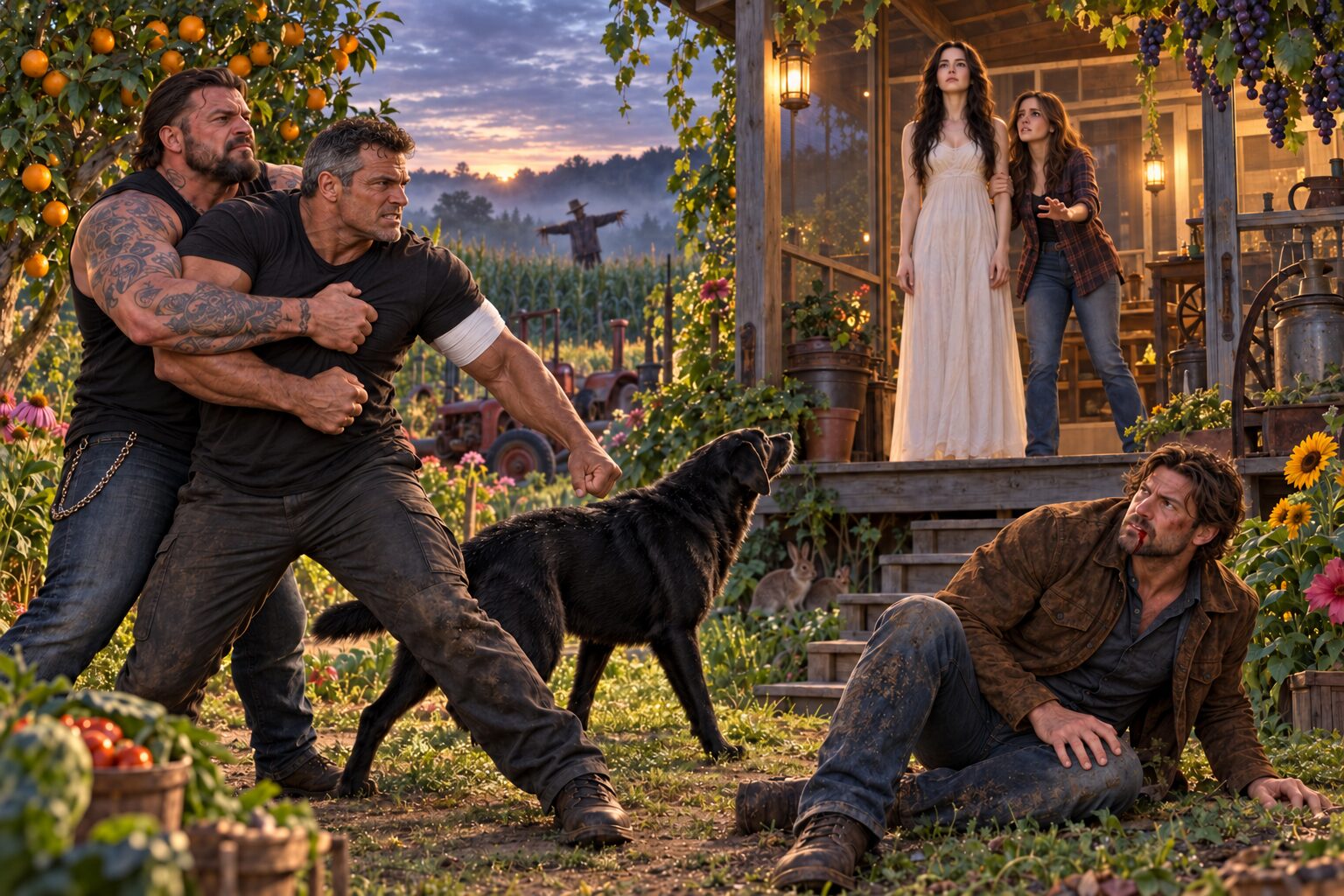
I woke with my hands up.
For one terrible second, the tractor-trailer was still coming.
Horn screaming.
Headlights filling the windshield.
Metal folding in on itself.
I sucked in a breath and nearly punched the back of Gene’s seat trying to escape something that wasn’t there.
The van sat motionless.
Dark except for the dashboard glow and headlights shining against a pair of iron ranch gates wrapped in dead vines.
No collision.
No screaming metal.
Just the quiet idle of the engine and the sound of someone snoring.
Gene.
Of course it was Gene.
I lowered my hands.
Sweat cooled against my neck. My pulse still hammered from whatever Rachel had placed inside my sleep.
Outside, the world looked dead.
Cornfields stretched into darkness on both sides of the narrow dirt road. Center-pivot irrigation rigs stood motionless among dry, sagging stalks. The plants whispered against one another in the wind like old women hiding gossip behind church fans.
Bodhi slept against the side window. Sasha lay curled at his feet. Kristy Lee rested with her head against Gene’s shoulder.
Rachel sat behind the wheel.
Perfectly still.
The dashboard clock read 3:58 a.m.
“Why are we stopped?”
Nobody answered.
Gene snorted awake long enough to mumble, “Please say breakfast.”
Rachel never looked away from the gates.
“We can’t enter yet.”
My head throbbed.
“Why not?”
“The witching hour hasn’t ended.”
Gene groaned.
“I knew I hated this place.”
“Crossing before four isn’t safe,” Rachel said.
“Crossing into what?”
Her fingers tapped softly against the steering wheel.
“Who knows what world we’d find on the other side?”
I rubbed my face.
“You people say things like that and then act surprised when I think you’re insane.”
Rachel looked at me in the mirror.
“Do you want to talk about it?”
“About what?”
“Your dream.”
The van went silent.
Her eyes held mine.
“Tractor-trailers are frightening.”
A knot tightened in my stomach.
“Must be especially hard for someone like you,” she continued, “getting this far away from control.”
Bodhi stirred.
Kristy Lee opened her eyes.
Gene sat up slowly.
I stared at Rachel.
“How did you know what I dreamed?”
She shrugged.
“Party tricks.”
Gene pointed at her sleepily.
“That right there is exactly what serial killers say before the opening credits.”
Rachel ignored him.
“There’s something else you should know.”
The way she said it brought everyone fully awake.
“What?”
Her attention returned to the gate.
“It’s about Nain.”
“Nathan.”
A small smile touched her lips.
“He hated that name.”
“That doesn’t answer me.”
The smile disappeared.
“He didn’t make it.”
My ears rang.
“What?”
“The Order got him.”
“No.”
The answer came automatically.
Rachel remained silent.
I leaned forward between the seats.
“No. How would you know that?”
“I felt him go.”
“You felt him.”
“Yes.”
“He was alive when we left.”
“He stayed behind so you could escape.”
“You were in the van with us.”
“I don’t need to see something to feel it.”
“That’s convenient.”
Gene looked down at the floor.
Kristy Lee stared through the side window, jaw tightening as she fought whatever emotion was trying to surface.
Bodhi placed one hand against Sasha’s back.
I kept my attention fixed on Rachel.
“You’re lying.”
She looked at me then.
No anger.
No defensiveness.
Only that calm, sympathetic expression I had begun to hate.
“I’m sorry, Dan.”
“Don’t.”
“He chose to save you.”
“I said don’t.”
“He knew what it would cost.”
“Stop talking.”
The dashboard clock changed.
4:00.
Wind struck the van from every direction.
The iron gates groaned and began opening on their own.
Wind chimes erupted somewhere beyond the fields. Not one or two. Dozens. Maybe hundreds. Their music swept across the property in a strange, uneven chorus.
The dead corn bent violently away from the road.
Something moved between the rows.
Too large to be an animal.
Gone before I could decide what I’d seen.
Gene leaned toward the windshield.
“Absolutely not.”
Rachel placed the van in gear.
“You have to trust me, Dan.”
I stared at her.
“You’re not in control here.”
The van rolled through the gates.
The moment we crossed the boundary, the air changed.
Outside the property, the crops were brittle and exhausted. Dry soil. Sagging stalks. Drought-stressed land farmers stared at while quietly calculating how many years remained before the bank took everything.
Inside—
Life.
The corn stood taller than the van.
Green.
Thick.
Heavy with ears.
Warm air moved through the rows carrying the smell of wet soil and growing things.
The wind chimes softened.
Not silent.
Welcoming.
The iron gates closed behind us.
I looked back through the rear window.
On the other side of the fence, the fields remained dead.
Bodhi sat forward.
“Did anybody else see that?”
“Nope,” Gene said. “And neither did you.”
The dirt road curved deeper into the property. Old fence posts leaned sideways like tired drunks. Fruit trees appeared between the cornfields. Their branches sagged beneath peaches, apples, and pears despite the fact no sane orchard would produce all three at once.
Flowers grew along the ditches.
They opened as the van passed.
Not because of the headlights.
They turned toward us.
Toward Rachel.
Somewhere among the chimes, one sour note rang out.
Sasha raised her head.
A low growl vibrated through her.
“What is it, girl?” Bodhi whispered.
Rachel glanced back.
The growling stopped.
Sasha didn’t relax.
We rounded another bend and found the house.
Or what I assumed had once been a house.
Rusted tractors sat half-buried in weeds beside washing machines, wagon wheels, broken furniture, piles of scrap metal, and enough discarded machinery to rebuild civilization after three separate apocalypses.
Tin ornaments spun from tree branches.
Lanterns hung from fence posts.
Weeping willows surrounded the house, their long branches swaying despite the wind having gone still.
The ranch looked less like a home than a place time had forgotten to collect.
Gene stared through the windshield.
“Oh yeah. This is definitely how horror movies start.”
Rachel parked.
For a moment, nothing happened.
Then the porch light came on.
An older woman stepped outside wearing a faded robe and house slippers. Long gray hair hung down her back in a thick braid.
She stared directly at Rachel.
Not at the battered van.
Not at the blood on our clothes.
At Rachel.
Concern crossed her face.
Real concern.
“Well now,” she murmured. “Back so soon?”
Rachel stepped from the van.
The chimes sang louder.
Several flowers near the porch leaned toward her.
The woman descended one step and stopped.
Her expression changed.
“There’s darkness on you now, girl.”
Nobody joked.
Nobody moved.
Rachel gave the faintest nod.
“I’m hoping to get rid of it.”
The woman studied her.
Not suspicious exactly.
Uncertain.
Like she recognized the face but couldn’t reconcile it with the shadow standing behind the eyes.
“That bad?” she asked.
Rachel glanced toward the fields.
“Worse.”
The woman crossed herself.
Up close, she looked older than I’d first thought.
Not weak old.
Worn old.
Like someone who had spent a lifetime surviving things that refused to kill her out of pure stubbornness.
Rachel gestured toward me.
“Dan, this is Zelena.”
Zelena looked me over.
Her gaze lingered near the center of my chest.
Not my face.
Not the blood on my arm.
Something deeper.
Then she looked back at Rachel.
“He gonna be all right?”
“I’m hoping.”
Rachel touched my arm.
“It’s okay. She’s family.”
Bodhi blinked.
“What?”
Rachel looked at him almost apologetically.
“The closest thing I have to one.”
That landed hard.
I watched Bodhi absorb it.
The hurt.
The confusion.
The realization that entire sections of his wife’s life had existed behind locked doors.
He covered it quickly.
Not quickly enough.
Zelena clapped her hands once.
“Well, standing out here like a bunch of ghosts ain’t helping anybody. Get inside before the mosquitoes carry Gene away.”
Gene pointed at her.
“See? Finally, someone recognizes my value.”
I frowned.
“How do you know his name?”
Zelena walked toward the house.
“Party tricks.”
Gene looked at Rachel.
“You people need new material.”
Inside, the house somehow looked worse.
Boxes.
Newspapers.
Tools.
Parts.
Clocks.
Books stacked on chairs.
Half-repaired radios covering the dining table.
The place looked one strong sneeze away from becoming an insurance claim.
We moved through narrow paths between the clutter while Sasha sniffed everything with violent enthusiasm.
“Good Lord,” Gene muttered. “Hoarders would walk in here and suggest dialing it back.”
“Henry keeps things,” Zelena said.
“Things appear to be winning.”
The clutter eventually opened onto a screened porch at the back of the house.
I stopped.
Beyond it stretched acres of impossible abundance.
Not a garden.
An ecosystem.
Fruit trees disappeared into the darkness. Rows of vegetables covered the rolling ground. Flowers grew taller than my waist. Herb gardens surrounded ponds reflecting the first faint hint of light in the eastern sky.
Grapevines bent beneath heavy clusters.
Evergreens rose beside palms.
And twenty yards from the porch stood an orange grove.
In Kansas.
Outdoors.
I pointed.
“Those are orange trees.”
“Good eye,” Gene said.
“Orange trees don’t grow in Kansas.”
Zelena shrugged.
“Don’t tell them. They’re sensitive.”
Sasha rushed past us into the garden.
Bodhi tensed.
“Sasha!”
The dog disappeared between two rows of flowers, barking happily at something none of us could see.
“Don’t worry,” Zelena said. “Ain’t nothing out there gonna hurt her.”
Bodhi relaxed.
Zelena considered that.
“Except maybe the bullfrogs.”
“The frogs?”
“Big as she is.”
Bodhi hurried after his dog.
Gene watched him go.
“Anybody got a beer for this city boy?”
The others drifted farther onto the porch.
I stayed near the railing, staring across the impossible paradise.
A rabbit emerged beneath the flowers and sat beside the steps.
Watching me.
Another appeared behind it.
Then another.
The nearest blossoms slowly turned toward my hand resting on the railing.
One opened.
Then the next.
Then every flower along the porch bloomed in a line moving toward me.
I jerked my hand away.
The movement stopped.
“Wind,” I muttered.
There wasn’t any.
I looked toward the cornfield.
The scarecrow near the first row leaned forward.
Not much.
Just enough that its crooked head appeared to bow.
When I blinked, it stood upright again.
A child watched me from between the stalks.
Small.
Barefoot.
Motionless.
Our eyes met.
Then the child stepped backward and disappeared into the corn.
I looked around.
Nobody else seemed to have noticed.
“What exactly is this place?”
Zelena smiled.
“Home.”
“It looks like the Garden of Eden crashed into a flea market.”
“That’s because Henry doesn’t throw anything away.”
“Who’s Henry?”
“My husband.”
“Where is he?”
“Tinkering.”
Gene nodded solemnly.
“That could mean literally anything here.”
Warm air moved across the property carrying the scent of peaches and wet earth.
The flowers nearest me turned again.
I stepped away from the railing.
Bodhi returned with Sasha close beside him.
The dog had something green smeared across her nose and looked happier than she had since California.
Then she noticed Rachel.
Her tail stopped moving.
Bodhi walked to his wife.
“You never told me about any of this.”
Rachel folded her arms.
“There are things I couldn’t tell you.”
“This whole time you had family?”
“It isn’t that simple.”
“What about Francine and Harold? Do they know about this?”
“Not exactly.”
Bodhi gestured toward the garden.
“But these people are close enough to be family.”
“Yes.”
“And I didn’t know they existed.”
“I had reasons.”
He laughed once without humor.
“Of course you did.”
Something sharp moved through me.
Rachel had lied to all of us.
Every answer created three more questions, and Bodhi kept accepting that confusion as proof that the answers mattered.
I rubbed my face.
“I’m tired of this.”
Rachel looked at me.
“Of what?”
“Riddles. Secret relatives. Magic gates. Impossible gardens. Everybody acting like confusion is evidence of something holy.”
“You think this is nonsense?”
“I think it’s manipulation.”
Bodhi stepped between us.
“Watch it.”
I laughed.
“There it is.”
“What’s that supposed to mean?”
“Every time someone questions her, you come running.”
“She’s my wife.”
“You don’t know that.”
Bodhi’s face hardened.
Rachel placed one hand lightly against his back.
“He’s frightened,” she said.
Bodhi stared at me.
“You’re frightened.”
The words came out in her rhythm.
Her language.
Another wrong song wearing someone else’s voice.
I pointed at Rachel.
“That thought didn’t come from you.”
“Don’t tell me what I think.”
“You don’t even hear it, do you?”
Bodhi stepped closer.
“And every time someone tries helping you, you act like a spoiled child.”
The words hit harder than they should have.
Mostly because part of me believed them.
I stepped into him.
“You’ve spent years waiting for a woman who walked away. Now something wearing her face shows up and you’re too desperate to ask whether it’s really her.”
Bodhi shoved me.
Not hard.
A warning.
I could have stopped.
Should have stopped.
Instead, everything inside me broke loose.
Mama.
Marcus.
Jeb.
Nathan.
The ranch burning behind us.
Rachel’s voice telling me I wasn’t in control.
I drove Bodhi backward into a stack of old feed buckets.
Metal crashed across the porch.
He hit me across the ribs.
I answered with a fist against his jaw.
Not football.
Not self-defense.
Nothing noble.
Just grief looking for somewhere else to live.
We fell into the yard.
Bodhi caught me once beneath the eye.
I grabbed the front of his shirt and threw him into the porch steps.
Sasha barked wildly.
Kristy Lee moved forward.
Rachel caught her arm.
Only for a second.
Long enough to stop her.
Long enough to let the fight continue.
Gene finally wrapped both arms around my shoulders and dragged me backward.
“Okay, Rocky. That’s enough.”
Bodhi wiped blood from his lip.
His chest rose and fell hard.
Sasha placed herself in front of him, growling at me.
Then her attention shifted to Rachel.
Rachel stood on the porch.
Watching.
No fear.
No surprise.
No concern for the husband bleeding below her.
Observation.
Like she had conducted an experiment and was studying the result.
The anger drained out of me.
Shame rushed in behind it.
I looked at Bodhi.
At the blood on his mouth.
At my own shaking hands.
“I’m done.”
No one answered.
I walked away.
Across the junk-filled yard.
Past the bowed scarecrow.
Past the rabbits watching from beneath the porch.
No one tried to stop me.
That should have felt like victory.
It didn’t.
The eastern sky remained dark, though a thin gray line had appeared along the horizon.
I climbed into the driver’s seat and reached for the keys.
Nothing.
I checked the ignition again.
Empty.
Rachel.
Of course.
I searched the console.
The cupholders.
Beneath the seats.
Nothing.
I slammed my fist against the steering wheel.
“Damn it!”
The horn barked once.
Loud.
Absurd.
Like a rooster too big for its britches.
I dropped my forehead against the wheel and tried to breathe through the frustration.
That was when I noticed something fluttering beside the passenger seat.
A magazine.
No.
A book.
Thin and glossy like one of those commemorative editions companies produced when important people retired.
My face stared back at me from the cover.
DAN CALLAHAN FOUNDATION RAISES RECORD FUNDS FOR CHILDREN’S HOSPITAL
I picked it up.
“What the hell?”
The first photograph showed me shaking hands with a senator.
The next showed me golfing with three businessmen whose companies I had once helped take public.
Charity galas.
Television interviews.
Expensive suits.
Perfect smiles.
Mama stood beside me at a fundraiser, alive and proud.
Nathan sat courtside at a basketball game, laughing at something I’d said.
I turned another page.
More money.
More awards.
More buildings with my name on them.
A perfect life.
The life I’d built before California.
The longer I stared, the worse it felt.
Something was wrong with my eyes in every picture.
Empty.
Not sad.
Not broken.
Absent.
Like that version of me had spent years slowly disappearing behind his own smile.
A rabbit appeared beside the open van door.
It stared at the photograph.
Then at me.
“You don’t like him much either, huh?”
The scarecrow near the cornfield had turned toward the van.
I told myself it was the wind.
There still wasn’t any.
The barefoot child stood at the edge of the corn.
Watching me.
This time I saw something clutched against the child’s chest.
Scissors.
A bottle of glue.
Several photographs.
The child smiled.
Then stepped backward into the rows.
“Probably one of the Strays.”
I nearly jumped out of my skin.
An older man stood beside the van holding a coffee mug.
I hadn’t heard him approach.
He wore suspenders over a faded work shirt, heavy boots, and a gray beard that covered most of his face. Older than Zelena, but steadier somehow.
The kind of face built by weather and patience.
I held up the book.
“What is this?”
He accepted it and turned several pages.
“Huh.”
That was it.
Just huh.
“You don’t find this strange?”
“Round here?”
He chuckled.
“Not particularly.”
He handed it back.
“Little one probably thought you needed to see yourself.”
“The child in the corn made this?”
“Looks that way.”
“How?”
“Carefully, I expect.”
“That doesn’t explain anything.”
“Nope.”
I climbed from the van.
“I want answers.”
The old man drank his coffee.
“Most people do.”
“Right now.”
He studied me over the rim of his mug.
Not intimidated.
Not impressed.
Just thoughtful.
Finally, he nodded toward the darkness beyond the house.
“Alright, Hot Head.”
He turned and started walking.
“How ’bout you come with me?”
Around the fire
Join the conversation.
Reader comments appear only after T. G. Bonfire approves them. That keeps this space thoughtful, human, and free of noise.