Chapter 13
What Shall It Profit?
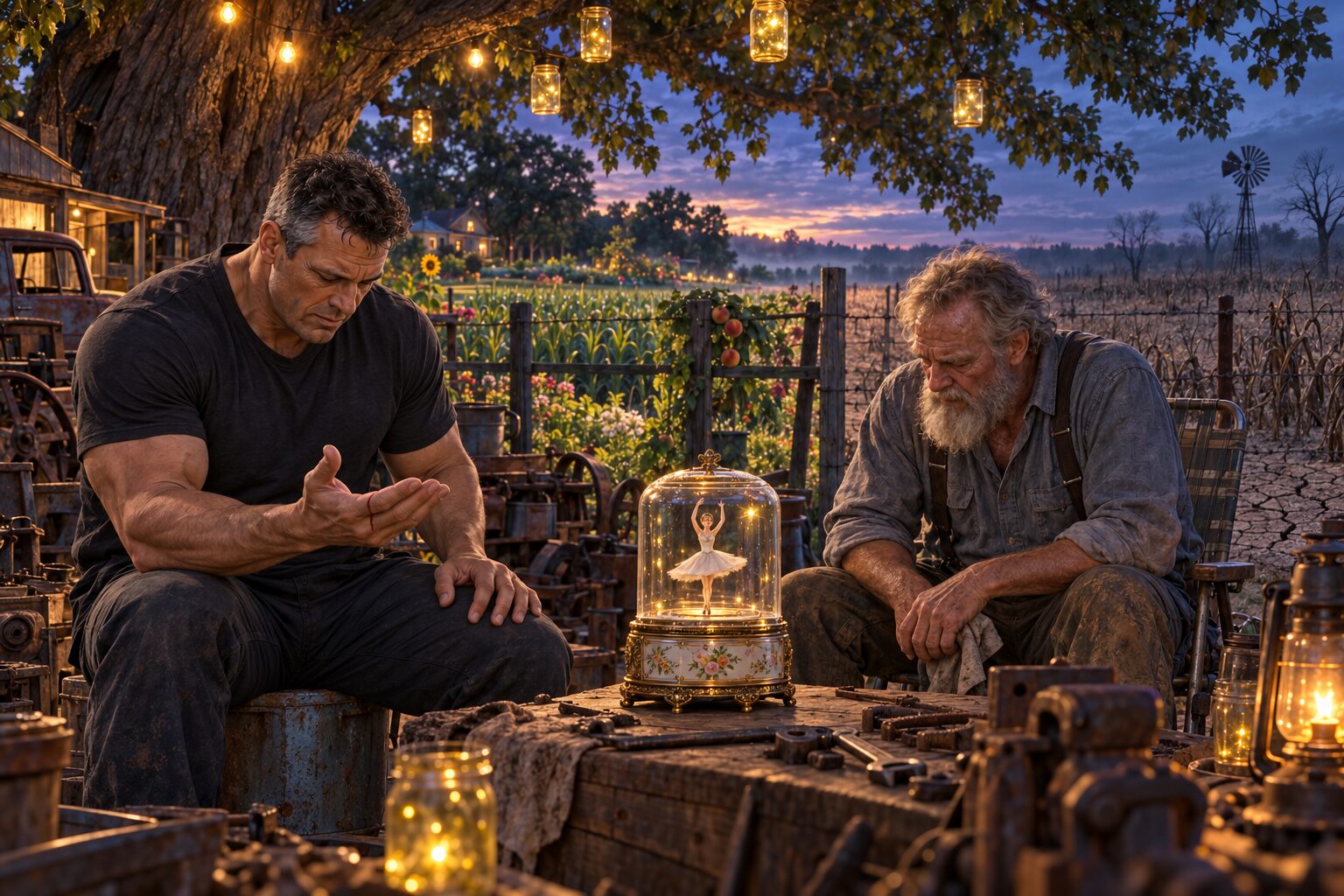
I followed Henry across the yard beneath a sky so black it looked endless.
The ranch had gone quiet behind us. The voices near the house faded into crickets and the hollow groan of wind moving through corn.
Henry led me toward the edge of the property.
The difference became impossible to ignore.
On our side of the fence, Zelena’s corn stood green and heavy. Peach trees bent beneath ripe fruit. Flowers crowded every patch of open soil.
Five feet away, Pepper’s field looked dead.
Brittle stalks.
Cracked earth.
Leaves curled inward as if trying to preserve the last moisture inside them.
Henry noticed me looking.
“Pepper says we steal his water.”
“Do you?”
Henry scratched his beard.
“Depends who you ask.”
“I’m asking you.”
He pointed toward the neighboring farmhouse somewhere beyond the darkness.
“Man insulted Miss Z’s peach cobbler fifty years ago. Hasn’t had a decent harvest since.”
I stared at him.
Henry shrugged.
“Some wounds don’t heal proper.”
“That doesn’t sound like an answer.”
“It’s the only one you’re getting before coffee.”
He stopped beside a cluttered work area beneath an enormous cottonwood. Hanging lights had been strung through its branches. Mason jars filled with fireflies dangled between them, pulsing like sleepy lanterns.
The place should have felt magical.
Instead, I felt exhausted.
Henry began digging through a pile of scrap.
Metal clanged.
Something toppled.
He muttered at it.
I paced while he rummaged.
My fingers tightened around the glossy photo book from the van.
My false life.
Mama alive.
Nathan alive.
Me shaking hands, raising money, smiling beneath my own name.
Everything returned to me except the part that made any of it real.
“You gonna keep wearin’ a trench in my dirt,” Henry asked, “or you wanna sit?”
I ignored the lawn chair.
“What is this place?”
Henry continued digging.
“What are you?” I demanded. “What is Zelena? Who are those children? Why is there an orange grove growing outdoors in Kansas?”
Henry emerged holding a broken ballerina music box.
The thing looked ancient.
Cracked porcelain.
Clouded glass.
One arm missing from the dancer.
Rust covered the winding key.
“Try it.”
“I’m not here to play with toys.”
“Humor an old man.”
He pushed the box toward me.
I sighed and wound the key.
Nothing happened.
“Congratulations. It’s broken.”
“Yep.”
Henry took it back and closed both hands around it.
At first, I thought he was joking.
Then his arms tightened.
Veins rose beneath his skin. His jaw clenched hard enough to crack teeth. Sweat formed along his temples.
The hanging lights flickered.
Wind moved through Zelena’s corn.
Henry twisted his hands around the box as if wrestling something invisible.
I frowned.
“You all right?”
He didn’t answer.
The old man looked like he was trying to lift a truck with his bare hands.
Then—
He stopped.
Henry bent forward, breathing hard.
“Whew.”
He wiped his forehead against his sleeve.
“Music boxes still kick my ass.”
He handed it back.
I rolled my eyes.
Then looked down.
The cracks were gone.
The glass shone.
The paint gleamed.
The porcelain ballerina stood whole beneath the cover, both arms raised gracefully above her head.
I stared at it.
Very carefully, I turned the key.
Soft piano music filled the yard.
The ballerina spun.
Perfect.
“No.”
Henry grinned.
“That’s usually the first response.”
“You switched it.”
“Nope.”
“That’s impossible.”
“Boy, you’re traveling with Rachel and impossible still sneaks up on you?”
A sudden sting cut across my palm.
I hissed and dropped the box into Henry’s hands.
Blood appeared along a thin split in my skin.
The cut hadn’t been there a second earlier.
“What the hell?”
Henry looked at my hand.
“Oh.”
“Oh?”
“Sorry about that. Guess I could’ve warned you.”
“Warned me about what?”
He handed me a handkerchief.
“The cost.”
I wrapped it around my palm.
“You cut me?”
“Not intentionally.”
“Then what did?”
Henry lowered himself into one of the lawn chairs with a grunt.
“The box.”
I stared at him.
“The box cut me.”
“Not exactly.”
“You’re going to need to do better than that.”
Henry motioned toward the other chair.
“Sit down, Hot Head.”
I remained standing.
He shrugged.
“Bleed standing up if you prefer.”
Reluctantly, I sat.
The music box continued playing between us.
Henry watched the ballerina turn.
“I can fix things.”
“I gathered.”
“But every gift has a price.”
I looked at my palm.
“You fixed the cracks, so I got one?”
“Something like that.”
“You knew someone would be hurt.”
“I knew somebody might get a scratch.”
“That isn’t the same answer.”
“No.”
“Could it have been worse?”
“Not for something that small.”
Henry leaned forward, resting his forearms across his knees.
“When I was eleven, me and Bobbie Jameson were out in a field messing with an old hay baler. Thing hadn’t worked in years. Bobbie’s daddy kept saying he’d haul it away, but he never did.”
The music played between us.
“I put my hand on that machine and felt something. Certainty, I suppose. Every broken piece announced itself. Every bent pin. Every rusted gear. I knew exactly what the baler needed.”
“What happened?”
“I fixed it.”
Henry stared toward Pepper’s dead field.
“The engine started. Gears turned. Whole machine roared back to life.”
His hands slowly closed together.
“Bobbie lost an arm.”
I looked at him.
“The baler caught him?”
Henry nodded.
“He nearly bled out before I got him home.”
“That was an accident.”
“No.”
“You were children playing with farm machinery.”
“I repaired something that should’ve stayed broken. The world balanced its books.”
“You don’t know that.”
“I spent the next seventy years proving it.”
The fireflies pulsed above us.
“The bigger the repair,” Henry continued, “the bigger the injury. Fix a clock, somebody loses an hour of sleep. Mend cracked glass, somebody gets cut. Fix an engine and bones might break.”
“You can’t control who pays?”
“No.”
“Then why would you ever use it?”
Henry looked toward the impossible garden.
“Why does anybody use power?”
I waited.
He smiled sadly.
“Because they convince themselves the result is worth what happens to somebody else.”
My palm throbbed beneath the handkerchief.
“You used it on that box just to prove something to me.”
“Yep.”
“You could’ve asked permission.”
“Would you have given it?”
“No.”
“Then you’d still think I switched the boxes.”
I stood.
“That doesn’t make it right.”
“Nope.”
His willingness to agree took some of the force from my anger.
Henry leaned back.
“Power and goodness ain’t the same thing, Dan. Best you learn that now.”
John’s warning returned to me.
Warmth is not always holy.
I looked toward the garden behind the house.
“Zelena grows things.”
“Better than anybody.”
“And Pepper’s crops die to pay for it.”
“Pepper’s crops. Grass along the county road. Trees two farms over. Depends how much she grows and how hard she pushes.”
“She knows?”
Henry gave me a look.
“Miss Z knows everything happening on this land.”
“And she keeps doing it.”
“Sometimes.”
“Because he insulted her cobbler?”
Henry smiled.
“That part might’ve been a joke.”
“Might have?”
“Pepper did insult her cobbler.”
I shook my head.
“This is insane.”
“Now you’re catching on.”
I stared across the boundary.
Life overflowing on one side.
Death spreading across the other.
“What are you?”
“Mechanic, mostly.”
“I’m serious.”
“So am I.”
“Are you related to Rachel?”
Henry scratched his beard.
“Not directly.”
“She called Zelena family.”
“Family means more than blood around here.”
“Then what does blood mean?”
That wiped the humor from his face.
Henry regarded me carefully.
“Some families run closer to the beginning than others.”
“The beginning of what?”
He glanced toward the garden.
Orange trees.
Grapevines.
Flowers blooming beneath a moonless sky.
“The first Garden.”
I stared at him.
“You mean Eden.”
“That’s what folks call it.”
“And Rachel’s family can trace themselves back to Adam and Eve?”
“Not Adam.”
The answer came quietly.
I waited for more.
None came.
“Then who?”
“That story ain’t mine to tell.”
“Convenient.”
“Truth usually is when somebody else owns it.”
I looked toward the house.
“Rachel is part of this…what? Pure bloodline?”
Henry grimaced.
“Ain’t no blood pure.”
“Then what do you call it?”
“The First Line.”
The words settled strangely inside me.
“Rachel belongs to it?”
“Her family does. The gift runs strong when blood stays close to the beginning.”
“And everyone else?”
“Branches grow.”
Henry gestured toward the fields.
“They twist. Separate. Cross with other branches. Most folks get far enough from the root that nothing remains except an occasional strange dream or a feeling they can’t explain.”
“But some keep their powers.”
“Pieces of them. Changed by generations. Usually smaller. Sometimes stranger.”
“The Strays.”
Henry nodded.
“That’s what we call ourselves.”
“You and Zelena too?”
“Powerful ones, but Strays all the same.”
“And the children?”
His expression softened.
“Eventually their gifts show themselves. A little girl predicts something she shouldn’t know. A boy touches a dead radio and hears voices. Another child tells his mother what the dog’s thinking.”
“What happens?”
“What always happens when people get scared.”
Henry looked toward the distant house.
“Some try to beat it out of them. Some pray harder. Some call doctors. Some call preachers. Some decide their child belongs to the Devil.”
“And they come here.”
“If they survive long enough.”
Something moved in the corn beyond the work area.
A pale figure stood between the stalks.
Teenage boy.
Too thin.
Barefoot.
A rabbit sat beside him like they were discussing the weather.
“You’ve got somebody watching us.”
Henry looked over.
“Oh. That’s Jasper.”
“Jasper made the book?”
“No. Different little one.”
The boy stepped forward.
“What does Jasper do?”
“Talks to animals.”
“You’re kidding.”
“Nope.”
I pointed toward the rabbit.
“He’s talking to that?”
“Ask the rabbit.”
I almost smiled.
Almost.
“What’s the cost?”
Henry’s humor faded.
“Human minds ain’t built to hold all that noise. Think about every bird, mouse, insect, horse, dog, and coyote talking at once.”
“He can’t shut them out?”
“Not always.”
Henry tapped the side of his head.
“Starts crossing the wiring. Sometimes he hears animals that aren’t there. Sees things. Gets confused about which thoughts belong to him.”
“What do you do?”
“Keep him safe. Sometimes he needs more help than we can give here.”
Jasper raised one hand.
I waved back uncertainly.
The rabbit appeared to look up at him.
Jasper laughed.
Then they disappeared into the corn together.
I rubbed both hands over my face before remembering the cut.
“This can’t be real.”
Henry pointed toward the book beside my chair.
“That real?”
I looked at it.
Mama smiling beside me.
Nathan laughing courtside.
Every person I’d lost returned to the pages.
“Who made it?”
“One of the younger Strays. She finds the lives people wish they could have.”
“You mean alternate lives?”
“No.”
“Possible futures?”
“Nope.”
“What, then?”
“Lies.”
I stared at him.
Henry nodded toward the book.
“Every picture in there is something you want. Your mama alive. Nathan alive. You back inside a world you understood. Rich. Respected. Safe.”
My jaw tightened.
“She can make that happen?”
“No.”
“Then what’s the point?”
“Temptation.”
The word landed heavily.
“She shows you a door that doesn’t exist and waits to see if you’ll spend your life trying to open it.”
I picked up the book again.
The photographs looked perfect.
That was the problem.
False was still false.
Even if it gave Mama back.
Even if Nathan survived.
Even if the entire world applauded when I entered a room.
“She made me look empty.”
“No,” Henry said. “You did that part yourself.”
I looked at him sharply.
“You wanted the lie. You just didn’t believe it.”
“I didn’t ask for any of this.”
“You were trying to leave.”
“That isn’t the same as quitting.”
Henry said nothing.
I stood.
“No. Don’t do that wise-old-man nonsense where you stay quiet and expect it to mean something.”
“You walked away from football.”
“I retired.”
“You left while folks still wanted more.”
“I gave them fifteen years.”
“You walked away from business.”
“I had enough money.”
“You left while everybody still called you brilliant.”
“I got tired of feeling empty.”
“Then you built a ministry.”
“Because I wanted to help.”
“You built it like a business. Investors. Speaking tours. Expansion plans. Numbers proving how much good you’d done.”
My anger rose.
“You don’t know anything about Lost River.”
“I know you.”
“No, you don’t.”
Henry held my stare.
“Every time life hands you something you can’t win, you find yourself another game.”
The words struck cleanly.
I looked away.
“You know how to finish a season,” he continued. “You know how to leave the field while folks are still cheering.”
He nodded toward the ranch house.
“You don’t know how to stay after the cheering stops.”
I wanted to argue.
Wanted to explain every decision I’d ever made until he understood that I wasn’t a coward.
Then I looked at the book.
At my perfect smiles.
At the emptiness behind my eyes.
“They need someone who stays,” Henry said.
I swallowed.
“You think that’s me?”
“No.”
He smiled faintly.
“I think it’s who you’re supposed to become.”
Before I could answer, the front door burst open.
Gene exploded onto the porch.
“THAT THING WAS THE SIZE OF A DAMN BEAVER!”
Kristy Lee came out behind him laughing.
“It was a rat!”
“It was a demon!”
“A demon with whiskers?”
“There was also a snake!”
Zelena appeared in the doorway holding a wooden spoon.
“Quit frightening my animals!”
“They started it!”
Henry sighed.
“Better get Jasper.”
“Jasper ain’t gonna help,” Zelena called. “Last time he talked to the rats, they taught him to curse in Portuguese.”
I blinked.
Gene pointed accusingly toward the house.
“One of y’all has mutant country rats!”
While they argued, I noticed movement beyond the screen door.
Rachel sat at an upright piano.
Bodhi stood beside her.
Neither had followed Gene outside.
I left Henry to deal with the hysterical biker and returned to the house.
Soft music drifted through the clutter.
Different from the music box.
Gentler.
Rachel’s fingers moved gracefully across the keys.
Bodhi leaned against the piano.
“You never told me you could play.”
“I used to.”
“Francine told me.”
Rachel’s fingers hesitated.
One wrong note entered the melody.
Small.
But real.
Bodhi heard it too.
“She said you played for hours when you were little.”
Rachel stared at the keys.
“She remembers?”
“Of course she remembers.”
Bodhi smiled.
“She also told me about the time you made the piano play by itself after you ran away.”
Rachel stopped playing.
For half a second, something empty appeared in her expression.
Not pain.
Not memory.
Absence.
Then the mask returned.
She pointed toward the mantel above the piano.
Photographs lined its surface.
Children.
Teenagers.
Young adults.
Different faces from different decades.
“All Strays,” Rachel said softly.
Bodhi followed the change in subject.
He noticed it.
I could tell he noticed.
But he let her lead him away from the question.
“They all stayed here?”
“Some did. Some left. Some came back.”
She indicated a photograph of a dark-haired girl with sad eyes.
“She can travel through time.”
I stepped into the room.
“What?”
Rachel glanced toward me.
Not surprised.
Of course not.
“Only after tragedies,” she explained. “She can visit the days immediately following terrible events.”
“Why would anyone want to do that?”
“She’s searching for her mother.”
Rachel’s voice softened.
“She believes that if she visits enough broken places, eventually she’ll find her.”
Silence settled over the room.
Rachel looked down.
“I know how she feels.”
Her voice trembled.
Her shoulders softened.
Loneliness filled her face so completely that, for one moment, I believed it.
Maybe that was what she wanted me to see.
“I wish I knew my real mother too,” she whispered.
Zelena entered carrying a stack of bowls and wiping her hands on a towel.
“You will, dear.”
Rachel looked up.
Zelena smiled gently.
“We’ll get the word out.”
Then she noticed me.
Her attention settled against the center of my chest again.
Recognition moved through her expression.
Or perhaps concern.
“Wash up,” she announced. “Breakfast is ready.”
Bodhi and Rachel turned toward me.
Rachel met my eyes.
Calm.
Knowing.
Like she had felt me standing there the entire time.
Something became clear.
I wasn’t the only one watching her.
The ranch was watching too.
Outside, the wind moved.
The chimes sang softly.
And somewhere beyond the walls, hidden among the corn, something bowed.
Around the fire
Join the conversation.
Reader comments appear only after T. G. Bonfire approves them. That keeps this space thoughtful, human, and free of noise.