Chapter 18
No Autographs, Please
My lungs still burned from Shirley’s. Every breath scraped, and the paramedic’s oxygen mask had left a clean oval in the soot covering my face. She’d wanted me in an ambulance.
I told her Tyler didn’t have time for that.
Hope showed up with sirens.
I didn’t trust it. Didn’t believe in it. But that didn’t stop it from sliding in beside me anyway as the first cruiser pulled in behind us, red and blue lights cutting through the trees like something the woods didn’t know how to understand.
Then another cruiser joined.
Then another.
By the time we turned onto the long road leading to Crossroads, we weren’t a car anymore—we were part of something bigger. A line of authority stretching back out of sight. Engines humming. Radios talking over each other. Urgency building in a way that felt almost… righteous.
Like this was the moment everything turned.
I leaned my head back against the seat and let out a slow breath. It turned into a cough that pulled hard against my ribs. I tasted smoke all over again.
“This is it,” I said. I don’t know if I meant it. Or if I just needed to.
Henderson didn’t look at me. His hands stayed locked on the wheel. “We’ll see.”
That was it.
But it was more than he’d been giving me.
The radio kept spitting voices—units calling in, asking for direction, confirming positions. Words like perimeter, containment, secure the scene.
Official words.
Comforting words.
Dangerous words.
And underneath all of it—threaded through the static—I caught pieces of something else.
“…fire reported on—”
“…multiple disturbances—”
“…units needed downtown—”
“…juveniles involved—”
My stomach tightened.
It wasn’t just here. It was everywhere.
Every place I’d been. Every place I’d touched.
Like something had followed me through town, kicking over every door I’d walked past.
“What’s that?” I asked, nodding toward the radio. “What aren’t they saying out loud?”
Henderson didn’t answer right away.
“They’re busy,” he said finally.
“That’s not what I asked.”
Another pause.
Then, quieter—“It’s not contained.”
I let that sit for a second.
Not contained.
Yeah. That felt right.
I flexed my bruised fingers. The abrasions around my wrists stung, grounding me in the pain. “I told you everything,” I said. “The fake FBI. Francine. What they’re doing in there.”
“I heard you.”
“That’s not the same as believing me.”
“No,” he said. “It’s not.”
The trees started to thin.
Crossroads came into view.
And for a second—just a second—it looked exactly the same. Clean. Quiet. Perfect. Like nothing in the world could touch it.
Like the rest of the town wasn’t burning around it.
Something cold settled in my stomach.
“They’re not running,” I said.
Henderson slowed the car. “No,” he said. “They’re not.”
Two black sedans sat near the entrance.
Engines off.
Windows tinted.
Waiting.
My chest tightened. “That’s not good.”
Henderson exhaled once through his nose. “No. It’s not.”
“Whose cars are those?”
He didn’t hesitate this time.
“The mayor’s.”
And just like that, hope didn’t disappear—
—but it got smaller.
Thinner.
Like it was already starting to fold in on itself.
The convoy rolled into the lot and spread out like it had done this a hundred times before. Doors opened. Officers stepped out. Hands near weapons, but not drawing.
Not yet.
That’s when I knew.
This wasn’t a raid.
Not anymore.
Henderson killed the engine—but didn’t move.
For a second, he just sat there, staring at the front doors like he was trying to see through them.
Then he reached into his pocket.
He caught my wrist and pulled my arm down beside the passenger seat. I didn’t understand what he was doing until he threaded a heavy plastic restraint through the metal seat rail.
“What the hell—”
“Hold still.”
“I’m not holding—”
The restraint cinched around my already-abraded wrist with a sharp, final click. Pain shot up my arm.
“Are you serious right now?” I twisted and pulled, but the seat rail didn’t move. “You’re tying me to the car?”
That got him to look at me.
Really look at me.
“I don’t know what I’m walking into,” he said.
“That’s exactly why I should be with you.”
“No,” he said, calm and solid. “That’s exactly why you shouldn’t.”
I yanked against it again. The plastic bit deeper into my skin. “You think this is safer?”
“I think it keeps you out of sight,” he said. “And right now, that might be the only thing keeping you breathing.”
“That’s not an answer.”
“It’s the only one you’re getting.”
He opened the door and stepped out into the lights.
And just like that—
I was out of it.
Stuck.
Watching.
The front doors opened.
And everything shifted.
Vincent Crowe stepped out first like he was walking into a charity event instead of whatever this was. Calm. Smiling. Like none of this surprised him.
Behind him—Mayor Langford.
And behind the mayor—Chief Rourke.
My stomach dropped.
“No,” I said. “No, no, no…”
This wasn’t chaos.
This wasn’t a response.
This was a meeting.
Handshakes.
That’s what got me.
Not the cops. Not the mayor. Not even Rourke standing there like this was just another day at the office.
It was the handshakes.
Casual. Familiar. Easy.
Like everybody already knew everybody.
Like this wasn’t a response—
—it was a continuation.
I twisted around as far as the restraint would let me, trying to hear something, anything, but the distance swallowed the words.
Didn’t matter.
I could see enough.
Henderson stood just outside the circle. Not relaxed. Not part of it. But not fighting it either.
Mayor Langford turned to him.
Said something.
Henderson answered—short, controlled.
The mayor stepped closer. Said something else, quieter this time. Something meant just for him.
Henderson didn’t move.
But something in him… shifted.
It was small.
Barely anything.
But I saw it.
And once you see something like that—you don’t unsee it.
More cruisers pulled in. More officers. The whole place filled up fast, like the town had decided this was where everything ended.
And then—
just like that—
everything softened.
Weapons lowered.
Postures changed.
The edge disappeared.
The mayor gestured toward the building.
And every single officer started moving inside.
Not clearing rooms.
Not shouting commands.
Just walking.
Invited.
“Don’t,” I said under my breath.
I pulled against the zip tie. It cut deeper into my skin. “Don’t go in there.”
But they went.
Of course they went.
Henderson was the last one still outside.
He hesitated.
Just for a second.
Then he looked out across the lot—
—and right at me.
I held his gaze.
Do something.
Say something.
Don’t do this.
He turned.
And followed them inside.
The doors closed behind him.
And just like that—
it went quiet.
No sirens.
No shouting.
No movement.
Just wind in the trees and the ticking of the engine cooling under the hood.
I swallowed hard.
“That’s bad,” I said. “That’s really bad.”
I tested the restraint again. Nothing. Solid. I could’ve ripped my arm off and that thing still wouldn’t have snapped.
I leaned forward, pressing my forehead against the dashboard, trying to think.
Trying to find a way out.
An angle.
Anything.
Then I heard it.
A scream.
Faint.
Distant.
But wrong in a way that made my whole body lock up.
My head snapped up.
Another one.
Closer.
Higher.
Younger.
Kids.
“Oh no,” I whispered.
I twisted in my seat, straining toward the side mirror, then the rearview.
Movement.
Behind the building.
At first it was just shapes.
Then it wasn’t.
Kids.
Running.
Not organized. Not lined up. Not escorted.
Running.
For a split second—just one—
hope came back.
They’re getting out.
They’re actually getting out—
Then the doors burst open.
Police poured out.
Not panicked.
Not rushed.
Controlled.
And they didn’t run to help.
They moved to stop them.
I stared. “No… no, that’s not—”
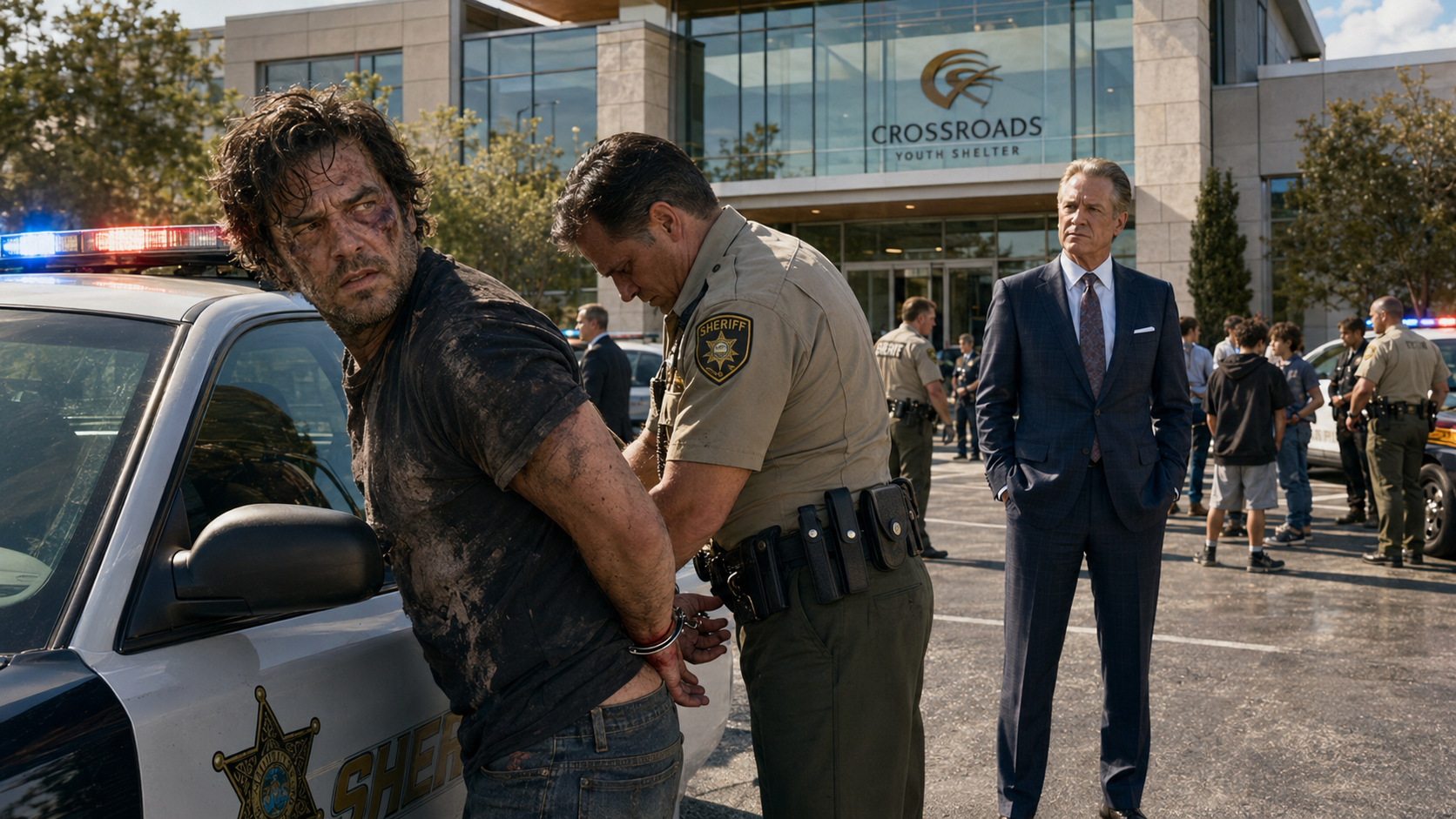
An officer grabbed a teenage boy and slammed him face-first onto the hood of a cruiser.
The sound rang across the lot.
The kid cried out.
Another officer twisted his arms back—hard—and snapped cuffs on him like it was muscle memory.
A girl tried to sprint past them.
She made it three steps.
Someone took her legs out from under her.
She hit the pavement hard enough I felt it in my chest.
“Get down!” an officer shouted.
“I didn’t do anything!” she screamed.
“Down!”
He forced her face into the asphalt.
Cuffs.
Done.
Like that.
My grip tightened on the wheel. “What are you doing?” I shouted, even though no one could hear me. “They’re kids!”
More officers flooded the back lot.
More hands.
More shouting.
Kids scattered—some running, some freezing, some dropping immediately like they’d been trained to.
And then I saw something worse.
Staff.
Crossroads staff.
Moving through the chaos.
Not stopping it.
Helping.
Pointing.
Directing.
“That one.”
“That one too.”
“He tried to run—grab him.”
Something inside me dropped out.
“This isn’t a rescue,” I said.
No one corrected me.
Because no one could.
A pair of officers shoved two kids side by side against a cruiser, forearms pressed into their backs while another read something neither of them was hearing.
A younger kid—ten, maybe eleven—stood off to the side, frozen.
Didn’t run.
Didn’t move.
Just… stared.
An officer walked up to him slow, like he was approaching something unpredictable.
“On your knees,” the officer said.
The kid didn’t react.
“On your knees!”
He flinched—but stayed standing.
The officer grabbed him and forced him down.
The kid started crying.
I looked away for a second, jaw locked so tight it hurt.
“This is wrong,” I said. “This is completely—”
The mayor raised a bullhorn. “Maintain order.”
The voice cut clean through everything.
Calm.
Amplified.
Controlled.
I turned back.
The mayor stood near the front, flanked by Crowe and Rourke, watching it all like this was exactly what he’d planned.
“Detain anyone attempting to leave the premises,” he said. “This is an organized disruption. We will handle it accordingly.”
Disruption.
That’s what he called it.
I let out a breath that almost turned into a laugh. “Of course you did.”
Henderson stepped into view beside him.
And for a second—
just a second—
I thought this was where it changed.
Where he stepped in.
Pushed back.
Said something.
Did something.
He didn’t.
He just stood there.
Watching.
Same as me.
Just on the other side of it.
An officer broke away from the group and started walking toward the car.
Toward me.
“Well,” I muttered, sitting up a little straighter. “Here it comes.”
He reached the door, yanked it open, and looked at the restraint connecting my wrist to the seat rail, “Convenient,” he said.
I met his eyes. “You’re arresting the wrong people.”
He didn’t respond.
Just pulled out a pair of cutters, snapped the zip tie—
—and grabbed my arm.
“Out of the car.”
“I didn’t do anything.”
“Out.”
I stepped out on legs that didn’t feel steady anymore.
The noise hit me all at once.
Shouting.
Crying.
Radios.
Metal ringing under the weight of bodies being forced down.
I looked past him.
Kids lined up against cruisers.
Cuffed.
Crying.
Some staring straight ahead like something inside them had already shut off.
I shook my head. “This is insane.”
“Turn around.”
I hesitated.
Just for a second.
Then I did.
Cold metal closed over the raw bands around my wrists.
Click.
Pain flashed through both hands.
Small sound.
Final.
“You are under arrest,” he said.
I looked past him for Henderson.
He stood beside the mayor, jaw locked, staring back at me.
He didn’t intervene.
But he didn’t look away either.
He tightened his grip and started walking me forward.
“For what?” I asked.
The officer barely glanced at me.
“Inciting panic. Interfering with an active investigation. Criminal trespass. Attempted robbery. Witness intimidation. Bribery of public officials. Theft of services. Assault. Threatening a school administrator. Conspiracy with an armed suspect.”
I stared at him.
“That’s not a list of charges,” I said. “That’s a nervous breakdown.”
“Several sworn statements disagree.”
“None of that happened.”
He tightened his grip and started walking me forward.
“Then you’ll have plenty to talk about.”
Across the lot—
the mayor was watching me.
Waiting.
Our eyes met.
And he smiled.
Not big.
Not dramatic.
Just enough.
Enough to let me know—
this wasn’t chaos.
This wasn’t a mistake.
He didn’t look like a man watching a criminal get arrested.
He looked like an author reaching the ending he’d planned.
Behind me, a kid screamed.
In front of me, the doors to Crossroads stood open.
Waiting.
And as they walked me toward them, something finally settled into place in my head.
Clear.
Solid.
Unavoidable.
This wasn’t falling apart.
This was working exactly the way it was supposed to.
And I was exactly where they wanted me to be.
Around the fire
Join the conversation.
Reader comments appear only after T. G. Bonfire approves them. That keeps this space thoughtful, human, and free of noise.