Chapter 4
Life Goes On
I exercise.
I know.
Sounds like the worst pickup line in the history of dating.
“Why should I pick you?”
“I exercise.”
Yeah. Not exactly closing material.
I’m not the guy at the gym strutting around, checking angles, worrying about whatever Invisible Lat Syndrome is supposed to be. My lats are fine. I can fit through a normal-sized door.
I exercise because I need to move.
Because three years ago I stood on a dirt road watching my wife’s car get hauled onto a flatbed while Sergeant Charles Henderson studied me like I was the last word he couldn’t fill in.
And he doesn’t like unfinished puzzles.
After that, stillness stopped being neutral.
I tried everything.
Meditation.
Alcohol.
Sitting in a chair, staring at the front door like it might open if I wanted it badly enough.
It didn’t.
So I started moving.
Weights.
Running.
Bike rides that went longer than they were supposed to, until my lungs burned and my legs stopped arguing.
Pick it up.
Put it down.
Again.
There’s something honest about it. No interpretation. No questions. Just effort and gravity.
As long as I keep going, the noise stays behind me.
Most days, that’s enough.
Think shark rules.
Stop moving—
and things catch up.
Don’t get me wrong. I still eat pizza. And more than a few of my rides have a way of ending at Shirley’s Squirrely Ice Cream Parlor.
This isn’t discipline.
It’s containment.
I tried containment another way once.
A few months after Rachel disappeared, the police released her Honda. The insurance company declared it a total loss and offered to haul it away.
I paid to keep it.
I told myself the police might need to examine it again. That some overlooked scratch or strand of hair might explain where Rachel had gone.
The truth was simpler.
It was the last place she might have been, and I wasn’t ready to let a salvage yard turn it into a cube.
A flatbed delivered what was left of the Honda to my house. The driver backed it into one side of the garage, lowered it onto the concrete, and left me alone with it.
Crushed hood.
Broken windshield.
Bloodless airbags hanging from the dashboard.
The little panda bear still dangling from the rearview mirror.
I closed the garage door.
A week later, I opened it again.
The Honda was perfect.
Not repaired.
Perfect.
The hood was smooth. The windshield was whole. The airbags were tucked inside the dashboard as if they had never deployed. Even the scrape beneath the passenger-side door—the one Rachel put there with a grocery cart and blamed on “aggressive parking-lot design”—was gone.
Midnight-blue paint gleamed beneath the garage lights.
The panda bear swung gently from the mirror.
I closed the door.
Counted to ten.
Opened it again.
Still perfect.
I slid behind the wheel and turned the key.
The engine started on the first try.
A miracle should feel like hope.
This felt like someone had broken into my grief and rearranged the furniture.
I decided to get rid of it.
I offered it to every charity in town. No one would take it.
The churches said no.
The high school needed cars for driver’s education. They didn’t need that one.
I called a gun club outside town and offered it for target practice. These were men who shot washing machines for entertainment.
They said they had enough targets.
My agent tried putting it in a charity auction. A nearly new Honda owned by a bestselling children’s author, with signed books in the trunk.
Not one bid.
I listed it for sale.
Nothing.
I lowered the price.
Nothing.
Eventually, I offered it for free.
Still nothing.
Every refusal came with a reasonable explanation.
Taken together, they weren’t reasonable at all.
Finally, I drove the Honda beyond the town limits and left it in an old gravel turnout. I put the keys on the front seat and walked away.
Two days later, I drove past.
The Honda was wrecked again.
The front end had folded in on itself. The windshield was shattered. The airbags hung from the dashboard.
Exactly as it had been when the police found it.
There were no skid marks.
No tree close enough to hit.
The panda bear swung from the rearview mirror even though the air was still.
I paid to have the Honda towed to a salvage yard and crushed.
Sasha came with me. She sat beside me behind the chain-link fence while the machine lifted Rachel’s car and placed it inside the crusher.
The operator asked if I was sure.
I said yes because I didn’t have another answer left.
When the crusher came down, Sasha threw back her head and howled.
Metal folded against metal with a sound like something enormous being tortured. Beneath it, I could have sworn I heard Rachel crying.
I haven’t parked anything on that side of the garage since.
I don’t tell people about the car.
They already think Rachel’s disappearance broke something inside me.
Some days, I let myself believe that explains it.
Captain Henderson—Chuck to his friends—is probably doing push-ups somewhere right now.
He got promoted a year after Rachel disappeared. The town treated it like a ceremony. Like something had been resolved.
People asked if I’d heard.
I said I had.
Smiled like it meant something.
Then went home and lifted until my arms shook and my hands forgot how to open.
Because Henderson and I share a very particular understanding.
He looks at me and sees a man who got away with it.
I look at him and see the man who didn’t find her.
We don’t talk about it.
We don’t have to.
Mercantile Falls Elementary smells like crayons and floor wax.
Kids rush past me in the hallway like caffeinated hummingbirds. Backpacks bouncing. Voices overlapping. A few of them wave when they recognize me. One kid yells “Mr. Lewis!” like I’m Taylor Swift.
This is my rock star moment.
It lasts about three seconds.
“Hey, Bodhi.”
I don’t turn around.
I don’t need to.
One of Henderson’s kids goes here. That explains why he’s in the building. It doesn’t explain why he’s waiting in my hallway.
“How’s your car?”
I stop anyway.
Three years, and he hasn’t found a new line.
Or maybe he hasn’t needed one.
Captain Charles Henderson stands halfway down the hallway, planted like he’s been there the whole time, waiting for me to walk into his path.
Suit sharp enough to make a statement without saying what it costs. Tailored over a frame that doesn’t belong in elementary schools unless something’s gone wrong.
He smiles.
Movie-star teeth. Campaign-poster confidence.
The kind of smile that makes people feel like everything’s under control.
From a distance, it probably works.
Up close, it looks like a warning.
I start walking again.
Pretend I didn’t hear him.
That was always the deal.
Henderson steps forward, adjusting his path without breaking stride.
Of course he does.
He never moves aside.
We meet in the middle of the hallway, traffic splitting around us like we’re something fixed and unavoidable.
Shoulder to shoulder.
Close enough to feel the heat of him.
“How’s your car?” he says again, softer this time. For me.
I keep my eyes forward, locked on a poster at the end of the hall.
Mallards migrating. Bright blue sky. Living their best duck lives.
I focus on that instead of him.
Instead of the question.
Instead of everything packed inside it.
Behind me, Henderson laughs.
It’s a good laugh.
Warm. Easy. The kind that spreads.
People nearby pick it up without even knowing why, like it’s safer to join in than ask what they missed.
I don’t turn around.
I don’t smile.
Not once in three years.
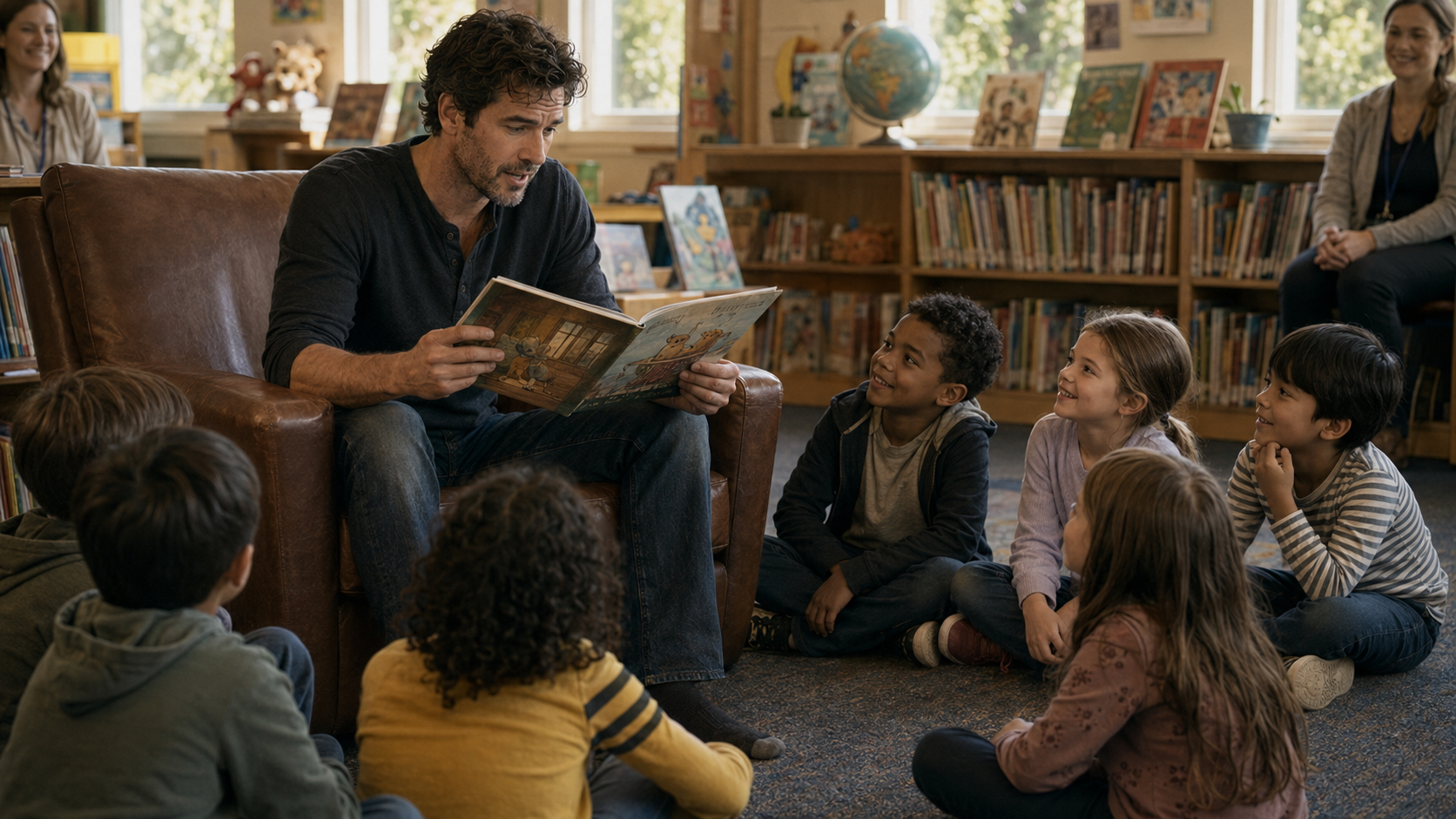
The library is already packed when I walk in.
Three first-grade classes sit in a crooked semicircle of tiny plastic chairs. Teachers line the walls, arms crossed, eyes sharp—less “educator,” more “minimum-security prison detail for six-year-olds.”
The moment the kids see me, the room detonates.
Cheers.
Waving.
A small human in the front row actually stands up like I just hit a home run.
At least someone still thinks I’m famous.
I move through the chaos, slapping high fives, absorbing the noise like it’s something I can store for later. Something I might need.
At the front of the room sits the chair.
Technically, it was donated to the school.
Technically, I got tired of the old rocking chair screaming every time I shifted my weight like it had something to confess.
So now I sit in a wide leather monstrosity that makes me look like I’m about to pass judgment on a kingdom of first graders.
The kids settle.
Eventually.
I hold up the latest book.
Princess and Mr. Sullivan Discover the Land Down Under.
Ten books in now.
Patti Smith does the illustrations.
Not that Patti Smith.
Apparently the Godmother of Punk had scheduling conflicts.
A few kids laugh. Most just stare at the cover like it might do something if they wait long enough.
The story’s simple.
Princess and her dog, Mr. Sullivan, help their new Australian neighbor find a missing koala.
Missing animals are big with this crowd.
Happy endings don’t hurt either.
What they don’t know—
Princess is Rachel.
Not officially.
But close enough that sometimes I forget I made her up.
Rachel before everything tilted. Rachel before the silence. Rachel before I started looking at empty spaces like they might answer back.
Mr. Sullivan is Sasha.
Black Lab. Professional shadow. The only thing in my house that still moves from room to room like it belongs there.
For the record, she hates that she’s a boy in the books.
I start reading.
The kids lean in like gravity shifted.
We laugh where we’re supposed to.
Gasp when the koala disappears.
Hold our breath just long enough to make the ending matter.
For fifteen minutes, the world behaves.
No missing wives. No cops with long memories. No empty rooms that echo when you walk through them.
Just a guy reading to kids.
Just—
Something moves.
At the back window.
At first, I ignore it. Reflection. Light. A car passing through the glass and bending itself into something it’s not.
I keep reading.
“…and Princess said—”
It moves again.
Not light.
Not a car.
Slower than that.
Wrong.
My eyes drift without permission. Just a flick. Just enough.
White.
A shape.
Fabric, maybe.
And—
hair.
Long.
My voice keeps going, but I’m not tracking the words anymore. They’re coming from somewhere behind me, like I left them running.
The thing outside shifts.
Back and forth.
Not drifting.
Pacing.
Like it’s trying to decide something.
Like it’s waiting for me to notice.
My chest tightens.
There’s a sound in my ears—low, building—like pressure before a storm.
No.
Not here.
I angle sideways, trying to see past the bookshelf displays without making it obvious.
The shape moves again.
Closer to the glass now.
Too clear.
Too—
My brain says impossible.
My body doesn’t wait for a vote.
I step sideways.
Catch my foot on a chair.
And go down hard.
Plastic legs snap against tile. Kids scream. Then laugh. Then scream again because now everyone’s doing both.
“Mr. Lewis!”
Ms. Chatterstone is suddenly there, hauling me upright like I weigh nothing. Former Olympic weightlifting hopeful. I am apparently her warm-up set.
“You okay?”
“Yeah—yeah, I’m good.”
Too fast.
Too automatic.
I look at the window.
Nothing.
Just sunlight. A car passing. A completely normal world pretending it’s always been that way.
My heart doesn’t believe it.
“Thought I saw my dog,” I say, forcing something that passes for a smile. “But then I forgot Sasha doesn’t know how to drive.”
A chorus of laughter ripples through the room.
We finish the story.
I don’t remember reading the last few pages.
Questions come after.
Important ones.
“Do kangaroos talk?”
“Do koalas smell?”
“Have you ever been to Outback?”
For six-year-olds, these are pretty good questions.
I answer as best I can.
Eventually the teachers gather their classes, and the room empties in waves of noise and Velcro and small shoes squeaking on tile.
Then it’s quiet.
Too quiet.
The kind that doesn’t feel like absence—it feels like something holding its breath.
“Bodhi.”
My stomach drops.
I turn.
Slow.
In the doorway stands a shape.
Familiar in a way that bypasses thought and goes straight to something older. Something that doesn’t ask permission.
Not again.
Because the first time—
the windows didn’t survive it.
My heart forgets what it’s doing. My throat goes dry.
One thought pushes through everything else.
Rachel.
Around the fire
Join the conversation.
Reader comments appear only after T. G. Bonfire approves them. That keeps this space thoughtful, human, and free of noise.