Chapter 3
When Answers Turn to Nightmares
John snatched the keys from my hand before I could end the call.
“I’ll drive,” he said.
Too numb to argue, I followed him to his truck and slid onto the cracked vinyl passenger seat. It groaned under my weight but smelled faintly like baked cookies—some ghost of a childhood kitchen I hadn’t realized I missed.
A new truck would have made me tense.
This one felt like home.
We rode in silence.
I didn’t have words for what had happened—or what hadn’t happened. My tongue felt huge in my mouth. My throat dry as a rattlesnake’s tail.
Outside the window, the world rolled past in a blur of manicured lawns and oversized mailboxes. A cornucopia of suburban privilege I suddenly couldn’t process.
I repeated her name under my breath until it escaped.
“Rachel.”
John glanced at me.
“We’ll be there in a moment, buddy.”
I gave him the weakest smile I could manage.
John existed somewhere between friend and confessor—the kind of guy you could tell your darkest secrets or just grab a beer with. I often wondered if his glovebox contained both holy water and a Budweiser.
I ran through the timeline again.
Rachel had left for ice cream.
That was the last thing I knew for certain.
Until then, all I had was a wife who hadn’t come home. Now her car had been found wrecked, and the police finally had something tangible to investigate.
Strange how possessions matter more than people these days.
Over the phone, Sergeant Charles Henderson had already told me to go home. He’d come to me. Said I wasn’t needed at the scene.
He hung up before I could tell him I’m not great at following directions.
Apparently, John wasn’t either.
He took Shingle Point Road, guided by the chatter on his scanner and a guess about where the cops would be.
It was a narrow two-mile stretch of mostly dirt. The kind of road that felt like it existed to keep outsiders away.
The only house in sight was an old farmhouse set behind a sagging fence. Two chickens scratched in the dirt beside the porch while a goat watched the police lights from the field. The owners stood in the doorway. I would later learn they were the ones who called in the wreck.
John slowed as the police lights came into view.
I didn’t wait for him to stop.
I jumped out while the truck was still rolling.
“Hey,” John called after me. “I can’t stay.”
I paused, already reaching for my wallet.
“No need,” he said. “Just wanted to wish you luck. Got other calls.”
I patted the door twice—my silent thank-you—and turned toward the wreck.
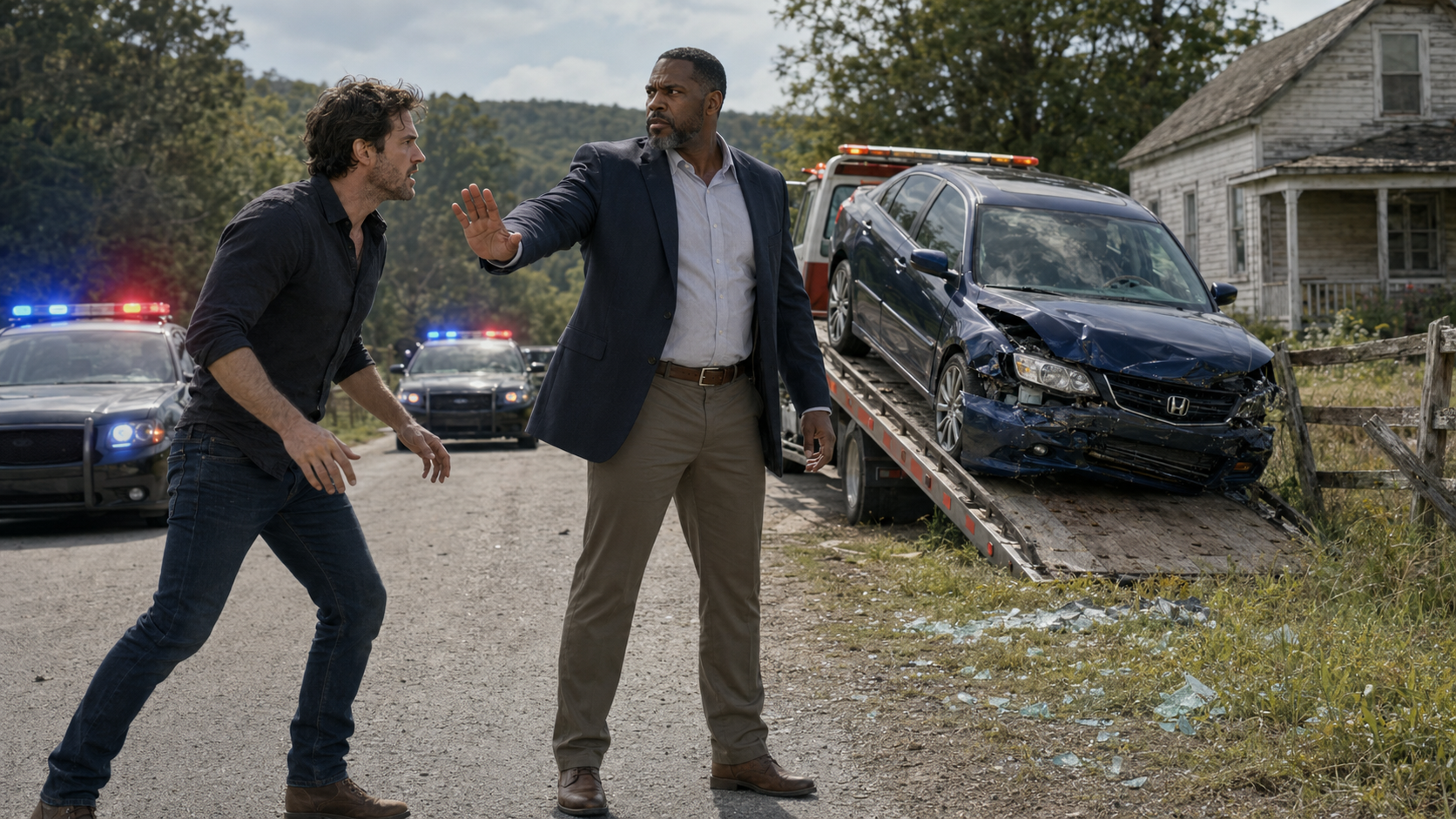
Rachel’s midnight-blue Honda sat halfway up a flatbed.
The front end was crushed like it had tried to kiss a tree and been violently rejected. Shattered glass glittered across the grass like frost.
My stomach twisted.
For a moment I pictured Rachel thrown forward, landing on the hood like some terrible physics experiment.
Then I saw the panda bear air freshener swinging from the rearview mirror.
Rachel’s.
I had dated her for a year, been married to her for eight, and apparently still didn’t understand the depth of her panda bear obsession
Not the time to analyze that.
“Rachel!” I shouted.
Every head turned.
No one answered.
No ambulance.
No blanket-wrapped figure sitting on the curb.
No officer helping a shaken woman into a patrol car.
Nothing.
I started toward the car.
Then a hand clamped onto the back of my neck.
Hard.
“Easy,” a voice said behind me.
I twisted around.
Sergeant Charles Henderson stepped into my space.
In another life, Henderson and I might have been friends.
In this one, we met beside my wife’s wrecked Honda.
And we did not get off to a good start.
He was built like a fortress—military shoulders, linebacker stance, the kind of man who made doorways feel narrow. His blazer fit well enough to suggest someone cared how he looked, but the way he held himself suggested he’d rather be wearing body armor.
He glanced toward the Honda.
Then back at me.
“You expecting to find something in there?” he asked.
“My wife.”
For half a second he didn’t move. Didn’t blink.
“Didn’t I tell you to go home?”
“I have trust issues.”
He nodded, judging me kind of the way I figure God will someday. Then he stepped slightly aside—just enough for me to see the empty driver’s seat.
“No one in the vehicle,” he said calmly.
I started to brush past him toward the car.
He reclosed the opening and placed one finger against the middle of my chest.
Just one. But it hit like a rubber bullet.
“Ow.”
“Just my finger,” he said, flexing it slightly. “Do I have your attention now? You stay away from the car.”
I nodded. But inside, something boiled.
“Sir,” he said, pulling out a notepad. “Name?”
“Bodhi Lewis. With an i.”
He wrote it down with surgical precision.
“Owner of the vehicle?”
“Both our names are on the title, but it was my wife’s car. Rachel Lewis.”
“Where is she?”
“If I knew that,” I said, “we wouldn’t be having this conversation.”
His pen paused for half a second.
Then continued writing.
“When was the last time you saw her?”
“Last night. She went out for ice cream.”
He looked up.
“Did she return?”
“That’s why I’m here.”
He asked where I had been in the last twenty-four hours.
Yard sales.
Errands.
Driving around looking for my wife.
Calling hospitals.
Leaving my car on Bourbon Street after I ran out of gas.
Every detail.
He listened without interrupting.
Then he walked slowly around the Honda, studying it like it was a puzzle missing only one piece.
Me.
“No signs of another driver,” he said eventually.
“No signs of Rachel either.”
I swallowed.
“What does that mean?”
“It means,” he said, “we have a vehicle involved in an accident and a missing person.”
He looked directly at me.
“And husbands are always interesting in those situations.”
There it was.
Not an accusation.
Not officially.
Just a seed planted carefully in the soil.
I felt it take root immediately.
The tow truck finished securing the Honda with a final metallic clank that echoed down the road.
Henderson snapped his notebook shut.
“Your car’s on Bourbon Street, correct?” he asked.
“Yeah. Less than a block from my house.”
He studied me for a beat longer than necessary, like he was measuring the word.
“Hop in.”
He nodded toward his unmarked sedan.
I thought about pushing back. Asking why. Asking anything.
Didn’t.
I got in.
The interior smelled faintly of coffee and leather polish—clean, controlled, like nothing messy was allowed to exist inside it. Henderson started the engine and eased onto Shingle Point Road, one hand loose on the wheel.
For a while, he talked.
Sports. Weather. His kids.
Where I grew up. What kind of books I wrote.
It sounded easy. Casual.
It wasn’t.
Every question came just a second too carefully placed. Every pause lingered half a beat too long, waiting to see what I’d fill it with. He wasn’t making conversation.
He was mapping me.
I answered anyway. Because not answering felt worse.
Eventually we turned onto my street.
Henderson slowed, eyes moving, taking in everything.
“Where’d you say it was?”
“Right there.”
I pointed.
And felt something in my chest drop before I even finished the gesture.
The curb sat empty.
No car. No broken glass. No sign anything had ever been there.
Just a clean, untouched stretch of asphalt.
Henderson didn’t react right away. He just kept looking at the space, then glanced at me—quick, sharp, like he’d been waiting for this version of the story.
“Interesting,” he said.
He drove past it, slow.
Turned around.
Checked the alley.
Nothing.
He keyed his radio, voice calm as he asked dispatch to run it. The response came back the same way—flat, uneventful.
No reports.
No towing requests.
No parking violations.
Nothing.
My car hadn’t been moved.
It had been erased.
One more thing gone from my life, like it had never belonged to me in the first place.
Henderson didn’t look surprised.
If anything—
He looked entertained.
Eventually, he pulled into my driveway.
The engine idled for a moment before he shut it off, like even the car wasn’t in a hurry to end the conversation.
Henderson took his time finishing the report. Pen moving steadily. No wasted motion. No small talk now.
Just silence.
I watched his hand move across the paper, neat, deliberate, like whatever he wrote down would matter later.
When he finally clicked the pen closed, I reached for the door handle.
His hand came out of nowhere and caught my wrist.
Not hard.
But firm enough to make the point.
“Are you a bad guy?” he asked.
I blinked at him, trying to decide if I’d heard that right.
“What?”
He didn’t smile.
“Bad guys ride in the back seat,” he said. “You rode up front.”
For a second, I thought about all the ways that question could go wrong.
“I’m not a bad guy.”
He held my gaze, weighing it.
“Didn’t think so.”
He let go of my wrist and leaned back slightly, his attention drifting past me to the house.
“Nice place,” he said. “Must be a lot of money in children’s books.”
“Enough.”
It wasn’t the answer he wanted, but it was the one he got.
I opened the door.
One foot out.
Almost clear.
“Which do you miss more?”
I paused.
Turned back.
Henderson was watching me again, that same measured look, like he’d been waiting to ask the real question all along.
“Your wife,” he said, “or your car?”
The corner of his mouth twitched—something close to a smile, but without any humor in it.
Then he leaned back and laughed.
Too loud.
Too long.
Like the joke wasn’t the question—it was me.
I stepped out without answering and shut the door on it.
Three years later, he still asks.
That was the first time Henderson asked about my car.
It wasn’t the last.
Because he never found Rachel.
Around the fire
Join the conversation.
Reader comments appear only after T. G. Bonfire approves them. That keeps this space thoughtful, human, and free of noise.