Chapter 11
Rebellion
I get to Portia’s early.
Still driving The Bus.
I told Patricia I’d get rid of it. I intend to. Just not before my two-o’clock appointment with a man who considers punctuality a sacrament.
Getting caught with a compromised van feels like a problem.
Getting murdered for being late feels like a bigger one.
The Bus rattles harder than usual after its civic engagement with the gray sedan. Every bump finds a different bruise and introduces itself.
I check myself in the rearview mirror at a red light.
Black eye coming in nice and dark. Split lip. A little swelling along the jaw. Nothing fatal.
I take a deep breath to test the ribs.
Sharp enough to complain.
Dull enough to ignore.
Professional diagnosis: ugly, but operational.
WRCK is on because silence makes a man think too much.
Nick Stocky the Disc Jockey is in the middle of introducing a Tom Petty song like he’s unveiling the Second Coming.
“Comiiiiing up next, a claaaassic for all you dreamers out there…”
I hate Nick Stocky with the clean hatred some people reserve for war criminals.
Kristy Lee should have his shift too. She has a voice that makes traffic feel romantic. Nick sounds like a man who practices finger guns in mirrors.
Tom Petty saves the moment.
I sing along for the last mile and imagine an alternate life where I became a famous musician instead of a regional cautionary tale.
Unfortunately, singing in the shower and charisma in small bursts are not enough to build a career.
By the time I pull into Portia’s lot, the chorus is fading.
I kill the engine before Nick can come back on the air.
Some victories matter.
Portia’s is Paradise’s best steakhouse.
Think Ruth’s Chris if it had standards.
No peanut shells on the floor. No neon beer signs. No waitresses named Crystal wearing patriotic denim. Just dark wood, white tablecloths, and staff who move like they graduated from a private academy for elegant judgment.
Ted loves the place.
Funniest part is, he doesn’t own it.
Ted owns half the town directly and the other half through fear, debt, or signatures nobody remembers making. But Portia’s remains outside his empire.
I once asked why.
He told me to mind my own business.
My theory is simple: every king needs one foreign country to vacation in.
A waiter leads me toward the private room in the back. He has the posture of a ballet dancer and the expression of a hostage.
The double doors open.
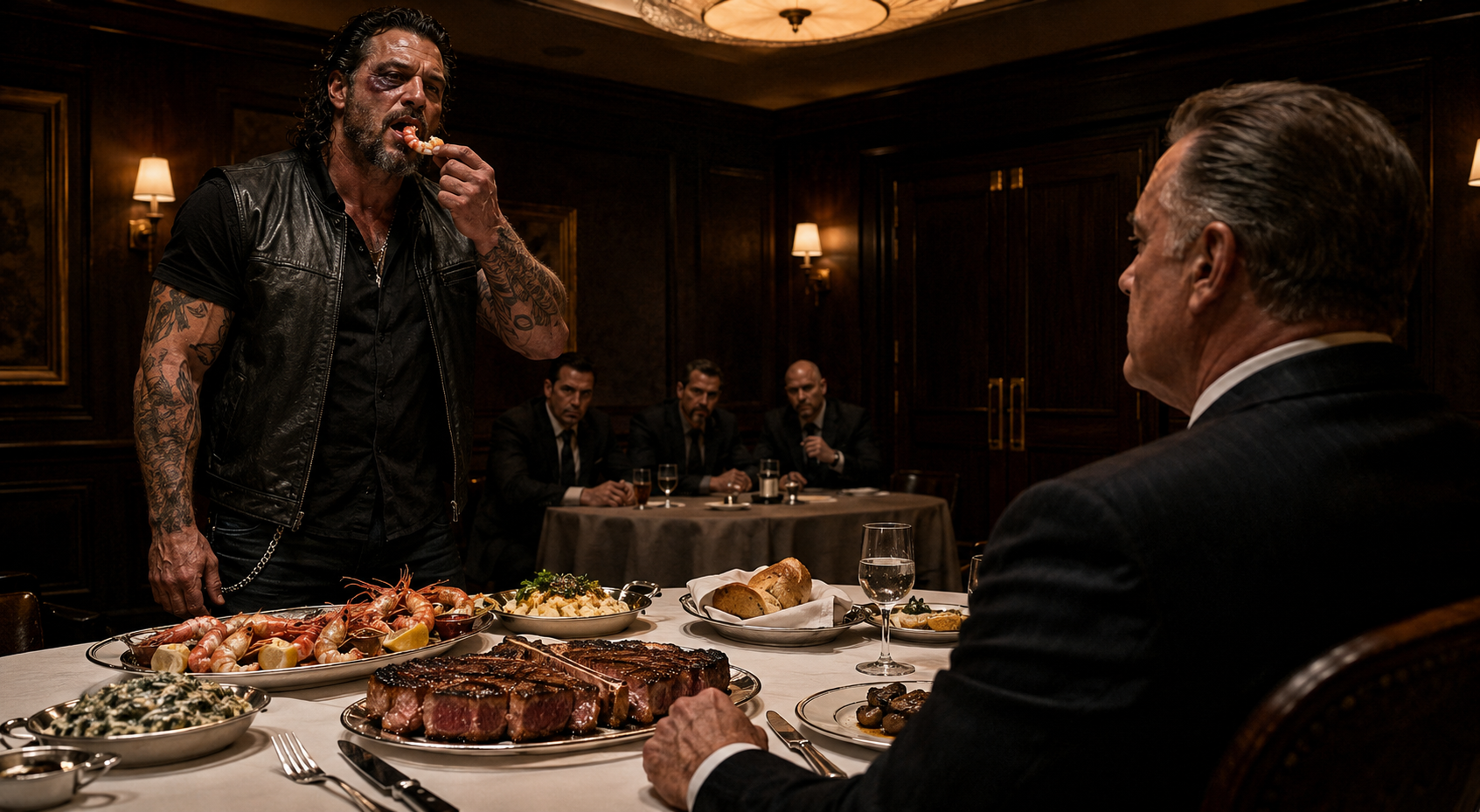
Ted Polmey sits alone at a long table with enough food for six people.
Three men occupy a smaller table along the wall.
Security.
The kind of men whose hobbies include staring too hard and hurting strangers.
Ted doesn’t look up when I enter.
The waiter vanishes the second I cross the threshold.
Smart man.
I take the chair opposite Ted.
He keeps cutting into a porterhouse with the concentration of a surgeon.
Nobody says a word.
Here’s something useful to know about me: I cannot stand hearing people chew.
It lights up a violent corner of my soul.
Ted chews like he’s trying to punish the cow twice.
So I reach over and steal one of the jumbo shrimp from his plate.
Warm.
Perfectly seasoned.
Worth the risk.
Without lifting his eyes, Ted says, “Touch another one and I’ll break something you still need.”
I finish chewing.
“Fair warning,” I say. “These are excellent.”
Ted places his knife and fork down with care.
That always scares me more than slamming them.
He dabs his mouth with a napkin.
“You think because you’re funny, consequences don’t apply to you.”
“I think because I’m charming, people make exceptions.”
His eyes rise to meet mine.
Small eyes.
Dead eyes.
Eyes that have watched men beg and found it dull.
“You’ve become expensive, Gene.”
“That sounds like a compliment.”
“It isn’t.”
He leans back. The chair groans beneath him, but then, so does everything.
“You cost me explosives. You cost me money. You cost me police attention. You cost me a body.”
“Whose body?”
Ted cuts another piece of steak.
“A principled man knows when not to ask.”
I watch him chew.
He gives me nothing else.
“I also brought personality to the organization.”
One of the men at the side table laughs before catching himself.
Ted turns his head slightly.
The man nearly swallows his tongue.
Then Ted looks back at me.
“The farm was being watched,” I say. “You rushed the job. You wanted speed over caution.”
“I wanted obedience.”
“You confused the two.”
His jaw tightens.
I see it and smile.
That’s when the side door opens.
Two men bring in a woman and sit her carefully in a chair near the wall.
At first, I don’t recognize her.
Then her left arm shifts.
Roses and doves wind from her wrist to her shoulder, partly hidden beneath bruises but still there. Her hand curls weakly against the chair.
Long fingers.
Right pinkie slightly crooked.
Artist’s hands.
Good with a brush.
Better without one.
Ginger.
The woman who painted the red-haired flaming skull on my helmet like it meant something.
She looks twenty years older than the last time I saw her.
Too thin. Eyes half-open but unfocused. Hair matted in places. Bruises in different stages of healing. Arms marked with old punctures and new ones.
I forget all about Ted for a second.
“Jesus.”
Ted waves the men away.
They leave without a sound.
Ginger makes a small noise in the back of her throat and tries to lift her head.
Ted stands, walks over to her, and gently pats her hand.
“Shh, honey.”
His voice is warm enough to melt stone.
He takes a pill from his pocket, places it on her tongue, then lifts a glass of water to her lips.
“Drink this.”
She obeys automatically.
A little water runs down her chin.
“There we are,” Ted says softly.
He dabs her mouth with his napkin.
Then he returns to his seat across from me.
“Now,” he says, picking up his fork. “Where were we?”
I stare at him.
For once in my life, I have no joke ready.
Ted cuts another piece of steak.
“You asked about Ginger once. Curiosity can be healthy in children. Less so in grown men.”
“What did you do to her?”
He chews.
“Life did what life does. I’ve been more patient than most fathers would be.”
Ginger gives a faint whimper behind me.
Every muscle in my body locks.
“You’re her father?”
“I am many things.”
“You’re an animal.”
He smiles.
“No, Gene. Animals kill to eat. I kill to maintain standards.”
I half rise from my chair.
Three guns click at the side table.
I sit back down.
Ted nods approvingly, like I answered a quiz correctly.
“See? Growth.”
He points at me with his steak knife.
“You keep pretending you’re some free spirit. Some outlaw philosopher on a motorcycle. But you are a worker who forgot who signs the checks.”
“I never forgot who signs them. I forgot to care.”
He laughs.
That laugh always sounds borrowed.
“You built yourself a little paradise out there.”
The room changes temperature.
I say nothing.
Ted sees it happen.
He loves seeing it happen.
“Men and women hiding from debts, warrants, husbands, wives, bad memories. A few children running around in the dirt pretending the world can’t find them.”
My mouth goes dry.
“You didn’t know I knew.”
“No.”
“I know everything worth knowing.”
Behind me, Ginger coughs wetly.
I start to turn.
“Eyes on me,” Ted says.
I obey before I can hate myself for it.
“I let you keep that place because you were useful. You are becoming less useful by the minute.”
“They’ve got nothing to do with this.”
“They have everything to do with this. They are how this works.”
I lean forward.
“If I owe you, then I owe you. Leave them out of it.”
Ted smiles like a teacher hearing a wrong answer.
“Next weekend, I have guests coming in. Old friends. Business associates. Men with appetites.”
My hands ball into fists.
“No.”
“You don’t say no here.”
“You’re not touching them.”
“They will entertain my guests, or I will make an example of every soul in that camp.”
Behind me comes a choking sound.
I spin before anyone can stop me.
Ginger is convulsing in the chair.
Foam gathers at the corners of her mouth.
Her eyes roll white.
The chair tips sideways and hits the floor with her still in it.
I’m up so fast my ribs scream.
Two men slam me back into my seat.
“Help her!”
Ted doesn’t even turn around.
He butters a piece of bread.
The kicking stops.
Silence.
Then Ted sighs and glances back.
“Disgusting.”
He snaps two fingers.
The security men lift Ginger by the arms and ankles and carry her out like spoiled furniture.
The side door closes.
No one speaks.
I can’t feel my face.
I can’t feel anything except the need to kill him.
Ted spreads the butter carefully to the edges of the bread.
“I am the god of your universe,” he says. “And you will show me the proper respect.”
I look at the empty doorway where they took her.
Then at Ted.
I stand slowly.
Chairs scrape behind me.
I roll my shoulders once. Flex my hands. Turn my neck until it pops.
Ted watches with interest.
I put every ugly thought I have into my face.
The kind of look that promises headlines.
Then I reach down, take another shrimp from his plate, and eat it.
Cold now.
Still good.
“You know,” I say, “I’ll buy you another order.”
Ted almost smiles.
“Wiseass to the end.”
Something hard smashes into the back of my skull.
The world goes black.
Around the fire
Join the conversation.
Reader comments appear only after T. G. Bonfire approves them. That keeps this space thoughtful, human, and free of noise.